

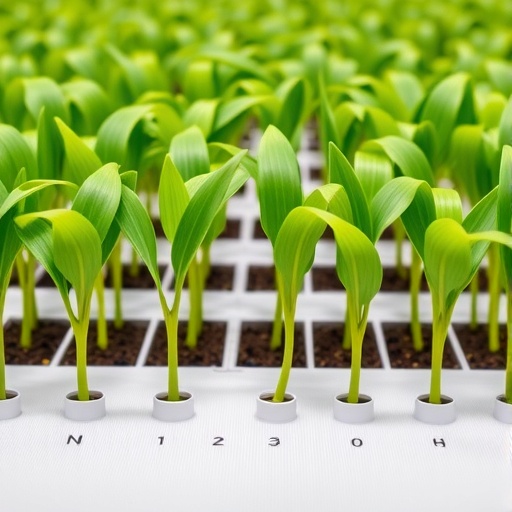
In the rapidly evolving field of agricultural biotechnology, genome editing stands as a cornerstone technology driving crop improvement and functional genomics research. Among these tools, CRISPR/Cas9 has revolutionized the ability to precisely modify plant genomes, enabling enhancements in yield, stress resilience, and nutritional value. Despite such breakthroughs, the practical challenges in identifying and selecting successfully edited plants largely impede progress. Traditionally, the detection of transgenic or edited lines involves complex, laborious, and time-consuming molecular techniques, significantly slowing down the breeding pipeline from initial transformation to mature plant development.
Addressing this critical bottleneck, a pioneering research group from China has unveiled an innovative and highly efficient visualization system tailored for soybean genome editing. This system, termed the Visual Soybean Editing System (VSES), promises to transform the selection process by allowing real-time, straightforward screening of edited plants from the earliest developmental stages. The VSES aims to eliminate the dependence on costly and specialized diagnostic equipment by introducing a visual marker that is observable under natural light conditions.
At the heart of VSES is the enhanced expression of DsRed2, a red fluorescent protein that, unlike conventional fluorescence requiring UV or blue light, manifests vividly in seeds under ambient lighting. This development means researchers and breeders can instantly discern Cas9-containing seeds without resort to complex instrumentation. The ability to differentiate such seeds by naked-eye observation streamlines large-scale screening and accelerates downstream applications, significantly reducing labor and resource input.
Extending beyond seed identification, VSES exhibits an intriguing capacity to mark transgenic plants during early seedling stages through visible pigmentation changes in the stem and leaves. Such phenotypic indicators provide a practical and rapid phenotyping method that helps in distinguishing edited plants from non-edited counterparts soon after germination. This early-stage discrimination is a game-changer for plant breeding, as it removes ambiguity long before the plants reach maturity, allowing selective cultivation of desirable lines with minimal guesswork.
Crucially, the VSES does not compromise the core genome editing efficiency of CRISPR/Cas9 systems. Maintaining high mutation rates and precise gene targeting alongside these visual markers underscores its potential as a robust tool for plant molecular biology. The molecule’s integration into the editing construct ensures that the visual selection is inherently linked to the genome editing event, fostering consistency and reliability in modified plant populations.
The development of VSES reflects meticulous optimization of genetic constructs and functional testing to balance robust reporter gene expression without adversely affecting plant physiology or gene editing outcomes. Under the guidance of Professor Xiangguo Liu and Professor Dongquan Guo at the Jilin Academy of Agricultural Sciences, China, the team has demonstrated the system’s applicability in practical agricultural research scenarios, moving closer to scalable deployment.
The implications of this visual marker system extend well beyond soybeans. Researchers envision adapting and tailoring VSES for use across a broad spectrum of crop species, allowing diverse agricultural communities worldwide to benefit from swift, cost-effective genome editing selection methods. This cross-species adaptability is supported by the conserved mechanisms underlying reporter gene expression and the modularity of genome editing platforms.
Looking ahead, the researchers emphasize their commitment to further refine the VSES, enhancing its color range, marker stability, and ease of use. Such advancements will cement its role not only in academic research but also in commercial crop breeding, where rapid, reliable identification of transgenic plants is vital for regulatory compliance and product development timelines.
The introduction of VSES aligns with a broader movement towards democratizing genome editing technologies, lowering barriers, and fostering innovation in crop biotechnology. By simplifying visual screening protocols, it bridges the gap between cutting-edge molecular tools and pragmatic field application, bolstering global efforts to meet increasing food demand sustainably.
This groundbreaking work has been documented in the Journal of Integrative Agriculture, a respected platform showcasing interdisciplinary advances in agricultural sciences. The study illustrates the seamless integration of molecular genetics and plant developmental biology towards improving agricultural methodologies pragmatically.
As genome editing technologies continue to evolve, complementary tools like VSES are integral to their translational success. By enabling visual confirmation from seed to plant, this system renders genome editing more accessible to plant breeders, molecular biologists, and agronomists alike, accelerating the development of next-generation crops.
The research team has publicly declared no conflicts of interest, underscoring their commitment to transparent and unbiased scientific progress. Supported by multiple funding bodies from the Jilin province, this work embodies collaboration between government research programs and academic excellence.
In summary, the Visual Soybean Editing System marks a significant leap in plant biotechnology, bringing together visual biology and genome editing to revolutionize the way researchers and breeders select gene-edited plants. Its simplicity and efficiency herald a new era of innovation in crop improvement strategies worldwide.
Subject of Research: Cells
Article Title: From seed to whole plant: An innovative visual marker system to enhance selection efficiency in soybean genome editing
Web References: http://dx.doi.org/10.1016/j.jia.2025.06.010
Image Credits: Xiangguo Liu et al.
Keywords: Agriculture, Cell biology, Genetics, Molecular biology, Plant sciences


