

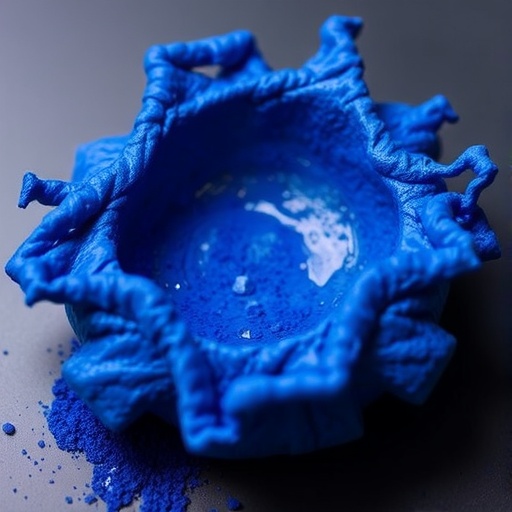
The extraordinary pigment known as Prussian blue has long been a staple in art, industry, and medicine. From immortalizing waves in Hokusai’s iconic prints to forming the blueprint hues that shaped engineering and design, this deep, enigmatic compound continues to reveal new frontiers in science. Recent pioneering work from the University of Chicago Pritzker School of Molecular Engineering (UChicago PME) has unlocked novel functionalities of Prussian blue analogs, offering transformative potential in ion separation and purification technologies.
Prussian blue’s appeal lies not only in its striking pigmentary qualities but also in its unique and versatile chemical structure. At its core, Prussian blue is a family of iron-cyanide compounds characterized by an open three-dimensional framework. This architectural openness provides an ideal lattice for accommodating a diverse array of ions, setting it apart from materials that exhibit strict selectivity for individual ion species. Researchers have now capitalized on these intrinsic properties to advance lithium purification with unprecedented precision.
The research team, led by UChicago PME PhD candidate Leeann Sun, harnessed state-of-the-art synchrotron anomalous X-ray diffraction techniques at the ChemMatCARS beamline of the Advanced Photon Source, a premier facility within Argonne National Laboratory. This advanced methodology enabled detailed, element-specific investigations of how ions intercalate within the Prussian blue analog copper hexacyanoferrate’s crystal lattice, pushing lithium purity to an extraordinary 99.9%. This breakthrough paves the way for the production of battery-grade lithium, a critical component for next-generation energy storage systems.
Beyond lithium purification, the implications of this research extend into broad environmental and industrial contexts. Prussian blue analogs’ capacity to selectively bind monovalent ions such as potassium, and distinguish them from divalent ions like calcium or magnesium commonly found in wastewater effluents, opens exciting possibilities for water treatment and recycling applications. This selectivity could revolutionize how heavy metals and other contaminants are extracted from industrial waste streams, leading to more sustainable and efficient purification technologies.
At the heart of these advances lies a deeper understanding of the interplay between redox chemistry and vacancy engineering within the PBA lattice. Associate Professor Chong Liu, corresponding author of the study, emphasized how tailoring the choice of redox-active elements and modulating vacancy levels in the material can critically influence ion separation performance. Their work provides a valuable framework for designing custom filters that precisely regulate ion transport based on chemical affinity and structural factors.
Prussian blue analogs have long been recognized for their inexpensive and accessible synthesis. Iron, a ubiquitous and earth-abundant element, forms the backbone of these compounds, facilitating rapid production using simple precipitation techniques. This accessibility democratizes the technology, making it feasible for widespread laboratory use and scalable industrial applications alike. As Professor Liu pointed out, the ease with which students can produce these materials reflects the compound’s potential for broad adoption in future scientific and commercial endeavors.
The researchers leveraged the innovative capability of anomalous small- and wide-angle X-ray scattering (ASWAXS), a cutting-edge enhancement at the ChemMatCARS facility enabled by a recent $17.35 million grant from the National Science Foundation. Unlike traditional small-angle X-ray scattering (SAXS), which provides averaged structural information, ASWAXS can isolate signals from specific elements within a complex matrix. This precision allows scientists to pinpoint the positions of individual ions within Prussian blue’s intricate framework with unmatched resolution.
ChemMatCARS Beamline Scientist and Deputy Operations Manager Mrinal Bera, a co-author of the paper, explained the novelty of this approach: “Conventional SAXS may reveal the shape of a composite particle, but our ASWAXS technique can identify exactly where critical ions like lanthanides reside in that structure.” This capability was integral in tracking how potassium ions occupy the lattice’s corners while divalent ions inhabit the center, a finding that underpins the material’s selective binding behavior.
Further insights emerged from the spatial analysis of ion occupancy within the unit cell. Monovalent ions’ preference for the edges creates vacancies in the center, allowing the framework to remain receptive to additional ions. Conversely, divalent ions occupying central sites fill these vacancies, constricting the material’s capacity and reducing selectivity. Understanding these distinctions at the atomic level is key to designing more efficient ion sieves tuned for specific separation tasks.
The expansive work concludes that Prussian blue and its analogs are not simply pigments but highly functional materials with scalable applications in energy, environmental remediation, and chemical separations. The team’s findings serve as an important step toward engineering tunable filtration membranes that can selectively admit or reject target ions based on nuanced chemical and structural properties. Such materials could dramatically improve resource recovery, pollution mitigation, and battery manufacturing industries.
Looking ahead, the researchers are optimistic about the broader industrial and scientific impacts of their discoveries. Enhanced comprehension of Prussian blue’s inner workings opens a new chapter where such materials enable cost-effective, sustainable solutions to pressing challenges in water treatment, lithium-ion battery production, and environmental waste management. The convergence of cutting-edge synchrotron techniques and molecular engineering thus heralds an exciting era for a pigment that once simply colored art now reimagined as a pillar of advanced technology.
Citation: “Selectivity mechanisms of ion intercalation in Prussian blue analogs,” Sun et al., Matter, February 3, 2026. DOI: 10.1016/j.matt.2025.102575
Subject of Research: Ion intercalation and selectivity mechanisms in Prussian blue analogs for purification and filtration applications.
Article Title: Selectivity mechanisms of ion intercalation in Prussian blue analogs
News Publication Date: February 3, 2026
Web References:
– University of Chicago Pritzker School of Molecular Engineering (UChicago PME): https://pme.uchicago.edu/
– NSF ChemMatCARS Beamline at Advanced Photon Source: https://chemmatcars.uchicago.edu/
– Published Article DOI Link: https://doi.org/10.1016/j.matt.2025.102575
Image Credits: UChicago Pritzker School of Molecular Engineering / Paul Dailing
Keywords
Energy storage, Water treatment


