

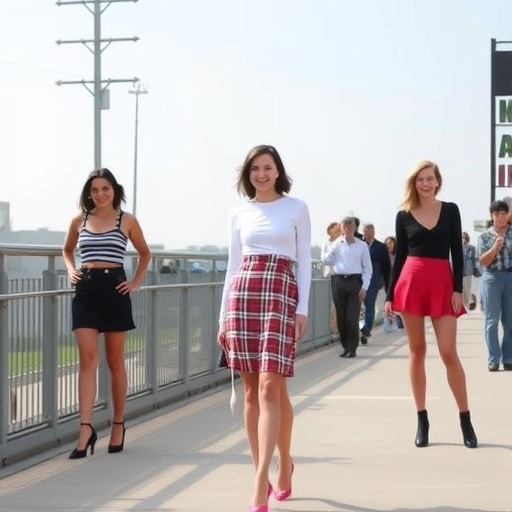
Fashion, ever the barometer of cultural and social shifts, has long tantalized both insiders and casual observers with the notion that trends recur on a predictable timetable. This idea, often called the “20-year rule,” suggests that styles ebb and flow, returning to vogue approximately every two decades. While anecdotal evidence has sustained this belief for years, scientists at Northwestern University have now provided a rigorous mathematical foundation affirming this cyclical rhythm that governs the world of fashion.
In a groundbreaking study, researchers led by Emma Zajdela harnessed the power of data science and applied mathematics to demystify the life cycle of clothing trends. By amassing and analyzing an extensive dataset comprising some 37,000 images of women’s garments spanning from the late 19th century to the present day, the team unveiled how the oscillations of style are not merely cultural happenstance but the result of dynamic social mechanisms that can be quantitatively modeled.
Central to the study was the painstaking compilation of a unique database curated from archival sewing patterns, historic runway collections, and the Commercial Pattern Archive at the University of Rhode Island. This rich trove of fashion artifacts allowed the team to extract precise, measurable features such as skirt hemlines, waistlines, and necklines—key indicators of sartorial preferences across epochs. Utilizing bespoke computational tools, these qualitative facets of design were transformed into numerical datasets amenable to rigorous analysis.
The core of the researchers’ approach lies in a mathematical model inspired by the inherent social tension between individuality and conformity. According to their framework, fashion trends emerge from a balance: people desire to distinguish themselves yet are simultaneously influenced by the prevailing tastes of their peers. When a style becomes ubiquitous, its appeal diminishes, prompting designers and consumers to pivot towards alternative looks—though within limits ensuring continued wearability and social acceptance.
As Daniel Abrams, co-director of the Northwestern Institute on Complex Systems, explains, this dynamic interaction generates intrinsic oscillations in fashion cycles. The constant push and pull between differentiation and assimilation causes styles to swing like a pendulum, underpinning the observed resurgence of trends roughly every twenty years. This rhythmic pattern was strikingly evident in the data, showcasing waves of popularity followed by declines and eventual revivals.
One of the most compelling historical patterns the study illuminated revolves around hemline length, a visible and culturally charged feature of women’s apparel. From the hemlines of the 1920s flapper dresses, signaling liberation and modernity, to the more demure styles of the 1950s, and onward to the radical introduction of miniskirts in the late 1960s, the rise and fall of skirt lengths depicted a vivid cyclic narrative reflecting broader societal moods and values.
Interestingly, however, the study also reveals a recent disruption in this rhythmic purity. Post-1980s fashion exhibits a fragmentation of trends, with multiple skirt lengths coexisting simultaneously, diverging from the previously clearer dichotomy of short versus long dresses. This fragmentation likely mirrors a societal shift towards embracing multifaceted identities and diversity, spawning a multiplicity of niches rather than a single dominant style.
Emma Zajdela, who conducted this research during her doctoral studies at Northwestern and now holds postdoctoral and research fellow positions at Princeton University and the Santa Fe Institute respectively, underscores the novelty of their approach. “To our knowledge, this is the first time that anyone has curated such a comprehensive and quantitative dataset encompassing over a century of fashion measures,” she stated. Such a robust empirical foundation enabled the team’s breakthroughs where previous attempts faltered due to lack of extensive data.
The implications of this work extend well beyond the realm of aesthetics or sartorial preference. By elucidating how new ideas propagate and evolve within social systems, the study offers insights into the broader dynamics of cultural innovation and diffusion. Patterns identified in fashion, a particularly visible manifestation of social behavior, may hold clues applicable across various domains where collective adoption and abandonment behaviors occur.
Moreover, by linking detailed measurements to a formalized social model, the research bridges the disciplines of applied mathematics, engineering, psychology, and social science. It illustrates how quantitative techniques can decode human creativity and social interaction, transforming nebulous cultural phenomena into systems governed by understandable, if complex, principles.
The research was presented by Zajdela at the 2026 American Physical Society Global Physics Summit within a session dedicated to the statistical physics of networks and complex societal structures. There, the interplay of mathematical modeling and real-world data set a new precedent in comprehending societal trends with predictive aspirations.
This landmark study, coauthored by experts across engineering, mathematics, and art history, sets a foundation on which future investigations could build more refined models and examine emerging fashion dynamics in today’s fast-paced and digitally connected world. As the clothing industry increasingly embraces data-driven insights, understanding the rhythm and structure of trend cycles could transform design, marketing, and consumer engagement strategies.
In a contemporary era marked by accelerated dissemination of styles through social media and globalization, grasping the underlying cyclical nature and evolving fragmentation of fashion offers both cultural and commercial value. The Northwestern research group’s innovative melding of archival diligence, computational precision, and theoretical modeling heralds an exciting leap forward in fashion studies and complex systems research alike.
Subject of Research: The cyclical dynamics of fashion trends, measured quantitatively through archival clothing designs and modeled mathematically to reveal underlying social mechanisms.
Article Title: Back in Fashion: Mathematical Modeling Reveals 20-Year Cycles in Clothing Trends
News Publication Date: March 17, 2026
Web References:
- Emma Zajdela’s research page: https://sites.northwestern.edu/emmazajdela/
- Northwestern Institute on Complex Systems: https://www.nico.northwestern.edu/
- Commercial Pattern Archive at University of Rhode Island: https://web.uri.edu/specialcollections/copa/
- American Physical Society Global Physics Summit: https://summit.aps.org/events/MAR-J62/6
Image Credits: Emma Zajdela/Daniel Abrams
Keywords: Applied mathematics, Mathematical modeling, Human behavior, Human social behavior, Conformism, Fashion cycles, Trend dynamics, Complex systems


