

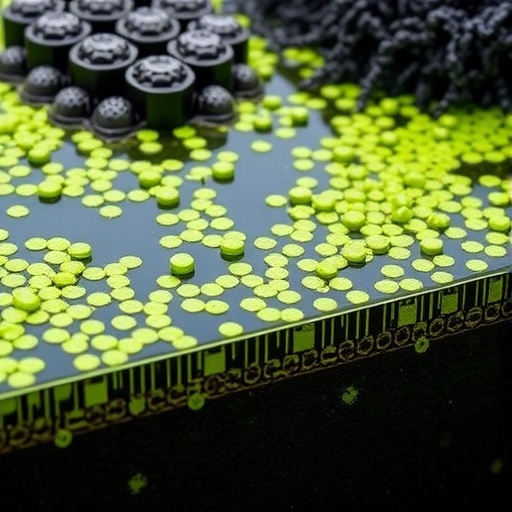
A groundbreaking advancement in sustainable water purification has emerged, spotlighting innovative environmental remediation technology that harnesses the potential of biochar derived from microalgal waste. This technology introduces amine-functionalized biochar/cellulose acetate hybrid membranes, specifically engineered to tackle the persistent challenge of municipal wastewater contamination. Researchers have transformed microalgae biomass, an abundant biological residue, into a high-value biochar material that, when chemically modified and embedded into biodegradable polymer matrices, yields filtration membranes with superior performance metrics.
The interdisciplinary team behind this development sought to convert residual biomass into functional materials capable of substantially improving water treatment efficiency. By chemically introducing amine groups onto the biochar surface, they enhanced its reactive properties, facilitating stronger interactions with contaminants. This modified biochar was then integrated into cellulose acetate, a biodegradable and widely used polymer for membrane fabrication. The resulting hybrid membranes exhibited significant advances in both structural attributes and surface chemistry compared to conventional counterparts.
A primary dilemma in water treatment is the prevalence of natural organic matter (NOM), a heterogeneous mix of decomposed biogenic substances that notoriously impairs membrane filtration by inducing fouling and deteriorating membrane integrity over time. Conventional cellulose acetate membranes, while biodegradable, fall short in combating these fouling effects, displaying limited pollutant rejection and diminished operational longevity. The amine-functionalization technique addresses these shortcomings by modifying hydrophilicity, surface charge, and porosity, fundamentally altering membrane interaction dynamics with aqueous contaminants.
Laboratory-scale evaluations underscore the superior performance of these engineered membranes. The optimized hybrid membranes achieved a water flux rate exceeding 169 liters per square meter per hour, a substantial leap over traditional membranes, which often falter under similar testing conditions. More impressively, they demonstrated an organic contaminant rejection rate of over 64 percent when treating authentic municipal wastewater—a realistic and complex medium—effectively doubling the removal efficiency of standard cellulose acetate membranes. This data substantiates the membranes’ practical applicability beyond idealized laboratory scenarios.
Moreover, the functionalized membranes showcased robust antimicrobial filtration capabilities, completely eliminating bacterial presence from treated wastewater samples. This bactericidal proficiency, coupled with significant partial removal of inorganic pollutants such as nitrate, phosphate, and sulfate ions, underscores the multifunctional nature of the biochar-enhanced membranes. Such broad-spectrum contaminant removal elevates the technology’s relevance to stringent water quality standards needed for municipal water reuse or discharge.
A critical factor underpinning this membrane innovation is its remarkable resistance to fouling, a persistent issue that inflates operational expenses and curtails membrane lifespan in large-scale water treatment systems. Post-filtration cleaning cycles revealed that the membranes retained over 80 percent of their original flux capacity, demonstrating exceptional durability. This fouling resistance can be attributed to the hydrophilic amine groups enhancing water attraction to the membrane surface while electrostatically repelling fouling-causing organic molecules.
The dual mechanism—where biochar’s functional groups improve surface wettability and simultaneously increase negative surface charge—was a strategic design element. This synergy minimizes organic material adhesion and accumulation, thereby preserving membrane efficacy during repeated usage. Such enhancements mark a paradigm shift, marrying membrane chemistry and surface engineering to overcome longstanding limitations of biopolymer-based filtration technologies.
Beyond performance metrics, the environmental implications of this approach are profound. Microalgae cultivation generates considerable residual biomass that traditionally constitutes waste, posing disposal challenges and potential environmental hazards. The conversion of this biowaste into functional biochar not only valorizes an underused resource but also aligns with circular economy principles, closing the loop between waste generation and resource recovery.
The study’s rigorous use of real municipal wastewater for membrane assessment adds to its credibility, distinguishing it from numerous studies that rely solely on synthetic test solutions which often fail to capture wastewater’s complex variability. This realistic testing enhances confidence in the technology’s scalability and prospective deployment in operational water treatment plants, making it a promising candidate for immediate practical uptake.
Looking ahead, the researchers emphasize the necessity of scaling up fabrication processes and conducting long-duration field studies to rigorously assess the membranes’ long-term operational stability and economic viability in full-scale wastewater treatment facilities. Addressing these aspects will be pivotal in transitioning from laboratory success to commercial applications, ultimately contributing to sustainable urban water management amid increasing global water scarcity concerns.
With global freshwater demand surging and pollution challenges intensifying, the integration of such biochar-enhanced hybrid membranes into existing treatment infrastructures could revolutionize municipal wastewater management. This innovation presents a cost-effective, environmentally benign alternative to conventional membranes, paving the way for greener, more resilient water purification systems that synergize advanced material science with sustainable waste valorization.
The study represents a landmark in biochar research, highlighting the transformative potential of biochemical engineering approaches that interlace material science, environmental chemistry, and bioresource sustainability. This multifaceted advancement points toward a future where waste biomass is seamlessly integrated into high-performance materials, directly addressing critical environmental challenges while championing ecology-centric technological progress.
Subject of Research: Waste biomass valorization and membrane technology for municipal wastewater treatment.
Article Title: Amine-functionalized biochar/cellulose acetate hybrid membranes for sustainable municipal wastewater treatment.
News Publication Date: March 3, 2026.
Web References: http://dx.doi.org/10.1007/s42773-026-00582-3
References:
Abuhasheesh, Y., Kumar, M., Abuhatab, F. et al. Amine-functionalized biochar/cellulose acetate hybrid membranes for sustainable municipal wastewater treatment. Biochar 8, 68 (2026).
Image Credits: Yazan Abuhasheesh, Mahendra Kumar, Farah Abuhatab, Pau Loke Show, Fawzi Banat & Shadi W. Hasan
Keywords: biochar, microalgae biomass, amine functionalization, cellulose acetate membranes, municipal wastewater treatment, membrane fouling resistance, organic matter removal, water purification, sustainable filtration technology, biodegradable membranes, environmental remediation, water safety.


