Spasticity, the velocity-dependent increase in muscle tone that follows damage to the motor pathways of the brain and spinal cord, remains one of the most stubborn problems in rehabilitation medicine. An estimated twelve million people worldwide live with extremity spasticity, and roughly nineteen percent of stroke patients develop it within three months, a figure that may climb to forty to seventy percent in chronic stroke. A newly published case series from Egypt reports that freezing targeted peripheral nerves, a technique known as cryoneurolysis, produced immediate and in some cases long-lasting reductions in spasticity in eight patients whose symptoms had resisted conventional therapy.
The study, published in the Egyptian Rheumatology and Rehabilitation, describes eight patients treated in an outpatient clinic with ultrasound-guided cryoneurolysis of selected nerves supplying spastic muscles. The patients presented with neuropathic gait, lower extremity pain, weakness and spasticity arising from a range of underlying conditions, including stroke, multiple sclerosis, cerebral palsy and spinal cord injury. According to the authors, all eight patients experienced immediate benefits that persisted for periods ranging from a few months to one year.
Cryoneurolysis works by applying freezing temperatures, between minus twenty and minus one hundred degrees Celsius, to peripheral nerves. The extreme cold induces Wallerian degeneration, a second-degree nerve injury, without permanently destroying the neurons or the surrounding tissues. Temperatures colder than this range risk irreversible neurotmesis, while warmer temperatures may have no effect or produce only a transient neuropraxia. After the injury, Schwann cells build a scaffold for nerve regeneration at a pace of roughly one to two millimeters per day, which is why the effects of the procedure can persist for months as the nerve slowly regrows.
In the reported protocol, the clinicians first performed diagnostic nerve blocks with two percent lidocaine on the intramuscular motor branches of each spastic muscle, injecting one milliliter per branch. A nerve stimulator set at one milliampere and ultrasound guidance, using a twelve megahertz linear probe and an eighteen megahertz high-frequency hockey-stick probe, were used to localize the target nerves. Five hours after the block, the team assessed the degree of spasticity reduction, requiring at least a two-point drop on the modified Ashworth scale, along with functional improvement and pain relief. Only patients who responded to the block proceeded to cryoneurolysis the following day.
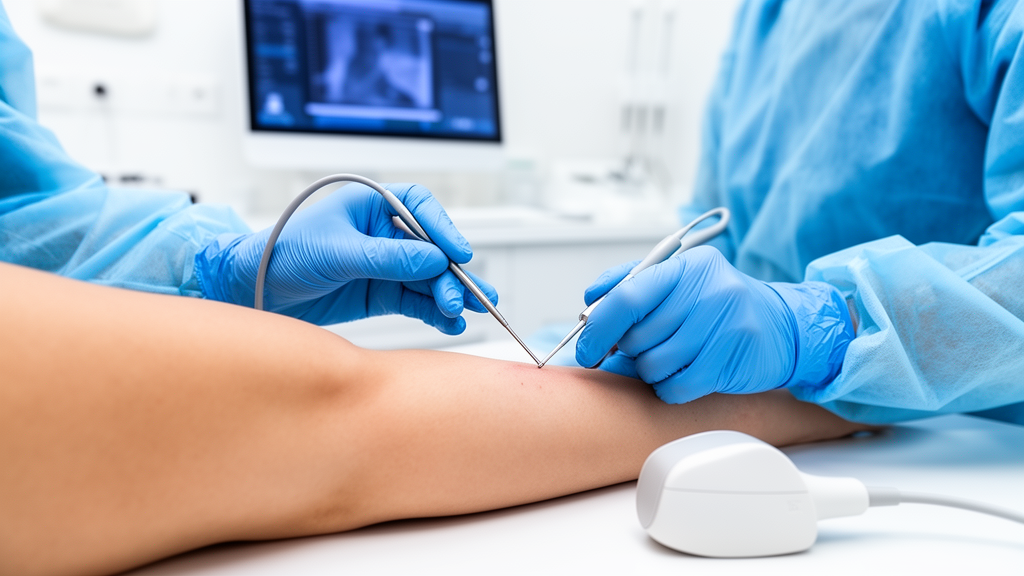
The cryoneurolysis procedure itself used a Metrum CryoFlex device. After additional lidocaine anesthetized the skin, a fourteen-gauge cannula introduced the cryoprobe to the target nerve. Two freeze-thaw cycles were applied to each intramuscular motor nerve branch, each consisting of one hundred twenty seconds of freezing at temperatures between minus twenty and minus eighty degrees Celsius followed by thirty seconds of thawing. Freezing was terminated either when adequate ice ball coverage of the target nerve was visualized on ultrasound or when the predetermined timed cycle completed. Written informed consent was obtained from all patients or their caretakers, ethical approval was secured, and the researchers followed the CARE checklist in preparing the report.
The individual cases illustrate the range of applications. A fifty-five-year-old man with right hemiparesis one year after stroke had a modified Ashworth scale score of three in tibial-innervated muscles, severe equinovarus foot deformity and foot pain, and had failed botulinum toxin and could not tolerate splinting. After cryoneurolysis of the tibialis posterior muscle and the tibial nerve, his score immediately fell to one plus, and at one year he walked two hundred feet with a walker, showed no clinical spasticity in the treated muscles and tolerated progressively longer splinting. A forty-three-year-old man with painful spastic hemiparesis of the right arm after stroke, whose response to three hundred units of botulinum toxin A had waned within about three months, underwent cryoneurolysis of the medial pectoral, musculocutaneous, median and ulnar nerves. By the sixth week his score had improved from three to one plus and his pain had completely subsided, with continued gains in range of motion over six months of physical therapy.
Other cases involved the lower limbs and activities of daily living. A twenty-seven-year-old woman with three years of multiple sclerosis, whose oral drugs and botulinum toxin injections had failed, received cryoneurolysis of the nerves supplying the bilateral hamstrings and gastrocnemius muscles; her gait improved immediately and over time, and four months after resuming physical therapy her spasticity and her capacity to perform numerous deadlifts continued to improve. A thirty-three-year-old man with cerebral palsy and spastic dystonic quadriparesis, whose severe adductor spasticity complicated personal hygiene care, underwent treatment of the obturator nerve branches to the adductor magnus, longus and brevis, the medial and lateral hamstrings and the gastrocnemius. His family reported that abducting his legs for diaper changes became easier, and the immediate drop to one plus on the modified Ashworth scale persisted at six months.
Functional outcomes extended beyond muscle tone. A thirty-nine-year-old man with left hemiparesis after stroke, with a score of three in the thumb, wrist and finger flexors, dropped one point immediately after cryoneurolysis of the median and ulnar nerves above the elbow and the intramuscular branches to the flexor pollicis longus and the flexor digitorum profundus and superficialis; at six months he reported improved wrist and finger dexterity, lasting pain relief and regular use of splints. A fifty-eight-year-old teacher whose uncontrollable pain had blocked participation in physical therapy six months after stroke resumed working as a teacher at four-month follow-up after cryoneurolysis of the pectoralis major and minor, biceps, brachialis, brachioradialis, pronator teres and flexor carpi radialis reduced his tightness to a score of one. A thirty-eight-year-old man with an eight-year history of stroke improved instantly and durably in gait speed and safety after treatment of the medial gastrocnemius branch of the tibial nerve, cutting his timed up and go test from fifteen seconds, a level associated with a significantly increased risk of falling, and reporting improved gait and quality of life three months later. An eighth patient, a thirty-five-year-old man with spastic diparesis one month after a vehicle accident causing spinal cord injury, saw his gastrocnemius and hamstring scores fall from two to one immediately after treatment.
The authors argue that cryoneurolysis offers several advantages over established options. Physical modalities such as stretching, orthoses, icing and electrical stimulation are labor-intensive and provide temporary relief with limited long-term effects. Botulinum toxin type A injections act locally by inhibiting acetylcholine release, with motor effects appearing within days and lasting three to four months. Phenol neurolysis produces sustained effects for several months up to two years and is inexpensive and rapid, but carries a higher rate of complications including pain during injection, local inflammation, hypotension, weakness from muscle necrosis and cutaneous dysesthesia. Intrathecal baclofen pumps deliver the drug at roughly one percent of the oral dose, because intrathecal administration yields more than a four-fold higher concentration in cerebrospinal fluid, but implanted pumps risk withdrawal symptoms if delivery is interrupted, overdose from pump malfunction or programming errors, and systemic infection related to the device. By contrast, cryoneurolysis is percutaneous, requires no implanted hardware, allows rapid access to the affected nerves and, crucially, offers predictable results through the preprocedural lidocaine block, which lets clinicians anticipate success before committing to the freeze.
The technique is not without risks. Possible side effects include bleeding, bruising, redness and infection at the injection site, development of an insensate area near the treated nerve, hyper- or hypopigmentation and hair loss. Contraindications include Raynaud’s phenomenon, cryoglobulinemia and cold urticaria. And the evidence base remains thin: this report is a case series of eight patients, not a controlled trial, and the authors themselves state that beyond the cases presented, more study is required to establish cryoneurolysis as a treatment for spasticity. Their conclusion is correspondingly measured: within this series, cryoneurolysis was a rapidly effective and safe therapy option that spasticity specialists may consider in the management algorithm, a claim that larger and controlled studies will need to test before the technique can move from promising case reports into routine clinical practice.
Subject of Research: Cryoneurolysis as a treatment for limb spasticity in a case series of eight patients
Article Title: Cryoneurolysis as an effective spasticity treatment option : a case series
Article References: Rageh, E. S., Nada, D. W., El Khouly, R., & Elgohary, G. (2026). Cryoneurolysis as an effective spasticity treatment option : a case series. Egyptian Rheumatology and Rehabilitation, 53(1), Article 81. https://doi.org/10.1186/s43166-026-00447-4
Image Credits: AI Generated
DOI: 10.1186/s43166-026-00447-4
Keywords: cryoneurolysis, spasticity, stroke rehabilitation, ultrasound guidance, modified Ashworth scale, case series, peripheral nerves, botulinum toxin, cerebral palsy, multiple sclerosis, spinal cord injury, physical therapy
Cite Scienmag News
Cassandra Pierce. (October 29, 2026). Freezing Nerves: Small Case Series Reports Lasting Spasticity Relief. Scienmag. https://scienmag.com/freezing-nerves-small-case-series-reports-lasting-spasticity-relief/
Cassandra Pierce. "Freezing Nerves: Small Case Series Reports Lasting Spasticity Relief." Scienmag, 29 October 2026, https://scienmag.com/freezing-nerves-small-case-series-reports-lasting-spasticity-relief/. Accessed 30 October 2026.
Cassandra Pierce. "Freezing Nerves: Small Case Series Reports Lasting Spasticity Relief." Scienmag. October 29, 2026. https://scienmag.com/freezing-nerves-small-case-series-reports-lasting-spasticity-relief/