


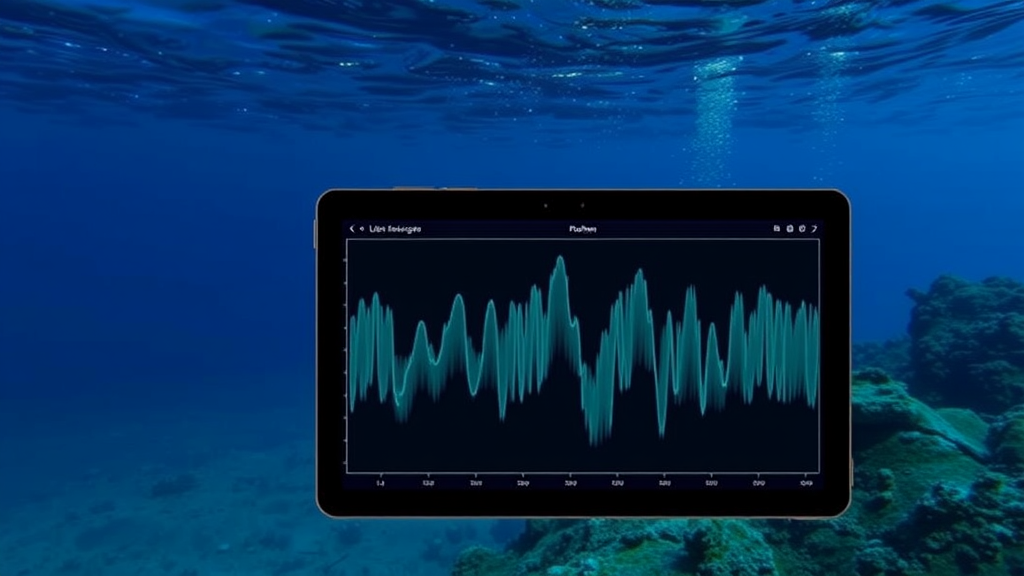
Beneath the waves, an invisible form of pollution is steadily reshaping the lives of marine animals, and for years scientists and regulators have struggled to measure it in a consistent, comparable way. Now a team of Italian researchers has released a free, open-access software application designed to solve exactly that problem. The tool, called TUNE, short for Tool for Underwater Noise Evaluation, was described in a recent paper published in the journal SoftwareX and developed by Valentina Caradonna, Silvano Buogo, Arianna Azzellino, Diego Vicinanza and Junio Fabrizio Borsani. Built as a standalone MATLAB application that runs on Windows without requiring a paid MATLAB license, TUNE converts ordinary hydrophone recordings into standardized acoustic indicators that European marine regulators explicitly require. Its release matters because underwater noise, though it leaves no visible trace, has been shown to cause stress, alter behavior and even physically damage the hearing of whales, dolphins and fish.
The scientific and legal momentum behind tools like TUNE stems largely from the European Union’s Marine Strategy Framework Directive, the landmark 2008 legislation that obliges member states to achieve Good Environmental Status in their marine waters. Under the Directive’s Descriptor 11, which covers the introduction of energy, including underwater sound, two distinct criteria apply. The first addresses low- and mid-frequency impulsive sounds, such as the hammering of pile drivers during offshore construction, while the second targets continuous low-frequency noise, dominated overwhelmingly by commercial shipping. Shipping noise is the most pervasive form of underwater noise pollution and dominates ambient sound levels below one kilohertz across much of the world’s oceans. Criterion D11C2 specifically requires monitoring programs to report sound pressure levels within decidecade frequency bands centered at 63 and 125 hertz, two narrow slices of the acoustic spectrum that serve as proxies for overall shipping-related noise exposure.
Meeting that regulatory requirement sounds straightforward, but in practice it has been anything but. Reliable estimation of these acoustic quantities depends on robust and reproducible signal processing workflows, and the software landscape has long been fragmented. Raven Pro, a mainstay of bioacoustics research, offers limited flexibility in calibration and requires a commercial license. MATLAB-based tools such as CHORUS provide advanced processing capabilities but are not distributed as freely available standalone applications. The open-source MANTA package has improved accessibility and standardization for long-term ocean soundscape analysis, but it produces outputs in hybrid millidecade bands rather than the decidecade bands adopted for Marine Strategy Framework Directive reporting. Many other packages remain proprietary or closed-source, preventing users from inspecting and verifying the algorithms that ultimately feed into official environmental assessments. TUNE was engineered to close this gap by combining calibration accuracy, usability and regulatory compliance in a single freely available package distributed under the GNU General Public License.
At its core, TUNE processes calibrated acoustic recordings in wav format and computes a suite of standard underwater noise metrics. These include broadband sound pressure level, decidecade sound pressure level, zero-to-peak sound pressure level and power spectral density estimates. The software embraces recent international standardization: it uses the term decidecade in place of one-third octave band, following the 2025 update of the relevant ISO standard, which considers the two metrics approximately equivalent, and it adopts the sound pressure symbol conventions of ISO 18405:2017 for the definitions and equations of all four metrics. Processing is carried out over user-defined time intervals called snapshots, a concept aligned with the temporal observation windows introduced in recent ISO documents. Each recording can be segmented into consecutive, skipped or overlapping snapshots, allowing fully time-resolved estimates of how noise levels rise and fall, for example as a vessel approaches and then recedes from a monitoring station.
A distinguishing technical feature of TUNE is its support for frequency-dependent calibration. Hydrophones, the underwater microphones that record ocean sound, do not respond uniformly across frequencies, and their sensitivity can vary substantially across the acoustic spectrum. Many existing tools accept only a single calibration factor, which introduces errors when the hydrophone response is uneven. TUNE instead accepts a two-column text file containing frequency values and corresponding hydrophone sensitivity, expressed either as voltage sensitivity in decibels relative to one volt per micropascal or as an equivalent calibration factor in pascals per volt, with a minimum of three frequency points required. Spectral estimates are corrected bin by bin using this sensitivity curve, improving the accuracy of the resulting sound pressure levels. The software also allows optional high-pass, low-pass or band-pass digital filtering before analysis, with filters designed to fixed passband ripple and stopband attenuation specifications, and it supports flexible FFT parameters including window type, overlap and transform length.
Internally, the software follows a modular architecture organized into five stages: user input, data import, calibration, signal processing and output generation. A single-window graphical user interface lets users configure directories, calibration files, time ranges, spectrogram settings and filtering options, and the entire parameter set can be saved and reloaded as a setup file to guarantee reproducibility across monitoring campaigns. Processing proceeds through three nested loops at the file, channel and snapshot levels, with multi-channel recordings handled channel by channel. For each snapshot, the software computes a series of Fast Fourier Transforms over signal subsegments and averages them into a single representative spectrum, then corrects that spectrum against the calibration curve. Decidecade integration is performed using the nearest available FFT bins rather than exact theoretical band edges, a pragmatic approximation that benchmarking described in the paper’s supplementary materials shows produces negligible discrepancies for standard monitoring applications, while dramatically accelerating computation. One creative addition is the option to overlay Knudsen curves for sea states zero through six, letting analysts compare measured ambient noise against classic empirical predictions of wind-driven sea-state noise.
To demonstrate the tool, the researchers analyzed a real recording of a ship passing through a harbor, captured with a Teledyne Reson TC4040 hydrophone and VP1000 preamplifier feeding a Tascam DR-100 recorder at 96 kilohertz sampling with 24-bit resolution. The ten-minute recording was processed in ten-second snapshots using 131072-point FFTs with a Hann window and fifty percent overlap, and the entire computation completed in just two minutes and thirty-five seconds. The results were vivid: mean sound pressure levels in the 63 and 125 hertz decidecade bands reached 111 and 117 decibels respectively, the mean broadband level was 123 decibels, and the maximum zero-to-peak level hit 156 decibels at 256 seconds into the recording, precisely the closest point of approach of the vessel. All four metrics rose clearly during the first half of the recording, matching the ship passage documented in the campaign logs, and every output was delivered both as figures and as numerical text files ready for statistical aggregation across recordings, sites and seasons.
The impact of the software is already visible in practice. By providing a consistent, transparent and reproducible framework for acoustic data processing, TUNE directly addresses a long-standing problem: differences in signal processing workflows can produce substantial discrepancies in reported sound pressure levels, undermining the comparability of environmental assessments across institutions and countries. Perhaps most significantly, the tool has been adopted by multiple Regional Environmental Protection Agencies in Italy, establishing a shared national framework for underwater noise monitoring and overcoming methodological fragmentation among regional programs. This software-driven harmonization improves the consistency of reported indicators, increases transparency in reporting and supports the coordinated implementation of national monitoring obligations under the Marine Strategy Framework Directive. Because TUNE can process long-term acoustic datasets and generate decidecade-band time series, it also supports the estimation of baseline conditions, trend analysis and threshold exceedance assessments in line with recent European Commission guidance on threshold values.
The developers see TUNE as a foundation rather than a finished product. Future versions will extend the range of computed metrics to include the Sound Exposure Level, which would allow the software to cover the Directive’s impulsive-sound criterion in addition to continuous noise, along with greater flexibility in temporal analysis. Beyond European regulatory monitoring, the authors note that the tool’s applicability extends to a broad range of marine and freshwater acoustic studies, from low-noise calibration sites to research linking low-frequency noise shifts to changes in fin whale song. In a field where proprietary licenses and closed algorithms have often stood between environmental agencies and their legal obligations, TUNE represents a quietly radical proposition: that the measurement of a pollutant threatening ocean life should be accurate, transparent and free for anyone who needs it.
Subject of Research: A free standalone software tool for standardized evaluation of underwater noise pollution under the Marine Strategy Framework Directive
Article Title: TUNE: a Tool for Underwater Noise Evaluation
Article References: Caradonna, V., Buogo, S., Azzellino, A., Vicinanza, D., & Borsani, J. F. (2026). TUNE: a Tool for Underwater Noise Evaluation. SoftwareX, 35, Article 103008. https://doi.org/10.1016/j.softx.2026.103008
Image Credits: AI Generated
DOI: 10.1016/j.softx.2026.103008
Keywords: underwater noise, TUNE software, Marine Strategy Framework Directive, shipping noise, hydrophone calibration, sound pressure level, decidecade bands, power spectral density, ocean acoustics, marine monitoring, MATLAB, environmental protection
Cite Scienmag News
Margaret Porter. (September 12, 2026). Free Software Tool Brings Standardized Underwater Noise Monitoring to Europe. Scienmag. https://scienmag.com/free-software-tool-brings-standardized-underwater-noise-monitoring-to-europe/
Margaret Porter. "Free Software Tool Brings Standardized Underwater Noise Monitoring to Europe." Scienmag, 12 September 2026, https://scienmag.com/free-software-tool-brings-standardized-underwater-noise-monitoring-to-europe/. Accessed 4 October 2026.
Margaret Porter. "Free Software Tool Brings Standardized Underwater Noise Monitoring to Europe." Scienmag. September 12, 2026. https://scienmag.com/free-software-tool-brings-standardized-underwater-noise-monitoring-to-europe/


