


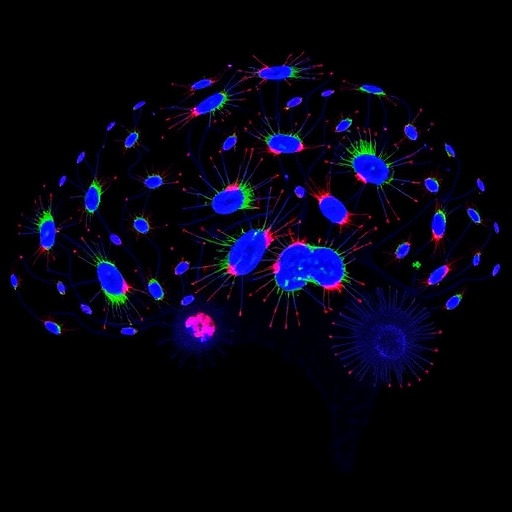
In a groundbreaking study that pushes the boundaries of neurodevelopmental biology, researchers have unveiled the critical role of FOXP genes in orchestrating the diversity of Purkinje cells and the intricate morphogenesis of the cerebellum. This revelation sheds new light on how genetic regulation during brain development sculpts one of the most complex and vital neural structures in the vertebrate brain. The cerebellum, long celebrated for its contributions to motor coordination and cognitive processes, relies on a precise cellular architecture, and the current research elucidates the molecular underpinnings that guide this sophisticated organization.
The cerebellum’s highly organized circuitry is anchored on Purkinje cells, the largest neurons within the cerebellar cortex, which serve as the principal output of cerebellar processing. Although Purkinje cells share common features, their diversity in terms of molecular identity, physiological properties, and spatial distribution has remained a puzzle. The new study deciphers how FOXP transcription factors drive this cellular heterogeneity, advancing our understanding of how genetic programs map onto neuronal subtypes and ultimately influence cerebellar formation.
FOXP genes, belonging to the forkhead box (FOX) family of transcription factors, have been implicated in a spectrum of developmental and cognitive functions. While well-studied for their roles in speech and language development, immune system regulation, and cancer, their influence on cerebellar architecture introduces a novel dimension to their functional portfolio. The present findings demonstrate that FOXP1, FOXP2, and FOXP4 are expressed in distinct subsets of Purkinje cells and act in a combinatorial manner to modulate gene networks that define cell identity and morphology.
To unravel these mechanisms, the investigators employed a suite of state-of-the-art methodologies, including single-cell RNA sequencing to capture transcriptional profiles with unprecedented resolution. By mapping FOXP expression patterns during critical windows of cerebellar development, they revealed temporal and spatial gradients governing Purkinje cell diversification. Functional perturbation experiments using conditional knockout models further illuminated how disruption of FOXP gene dosage led to aberrant Purkinje cell phenotypes, highlighting the genes’ essential roles in establishing neuronal subtype specification.
Morphological analyses in mutant cerebella uncovered defects in dendritic arborization and axonal targeting of Purkinje cells, which are fundamental for synaptic connectivity. These structural abnormalities corresponded to alterations in cerebellar foliation patterns, underscoring how genetic control at the single-cell level translates into large-scale architectural disruption. The study’s findings suggest that FOXP genes coordinate cascades of downstream effectors, including cytoskeletal regulators and synapse-associated molecules, to ensure precise assembly of cerebellar circuits.
Importantly, the research also bridges developmental biology with clinical neuropathology. Mutations and dysregulation of FOXP genes have been associated with neurodevelopmental disorders characterized by motor deficits and cognitive impairment. By delineating the molecular pathways through which FOXP transcription factors govern Purkinje cell heterogeneity, the study offers mechanistic insights relevant to conditions such as autism spectrum disorders, ataxias, and speech-language pathologies linked to cerebellar dysfunction.
The research team further explored how FOXP genes interact with other established cerebellar morphogens and transcriptional regulators. For instance, cross-talk between FOXP factors and molecules like Engrailed and Zic family proteins appears to refine the spatial patterning and maturation of Purkinje cell subpopulations. These interactions underscore a complex regulatory network where FOXP genes act as central nodes integrating extrinsic and intrinsic developmental cues to fine-tune cerebellar architecture.
By leveraging in vivo imaging and computational modeling, the study visualized the dynamic processes of Purkinje cell specification and positioning. These approaches illuminated how FOXP-driven transcriptional programs influence cell migration trajectories and layer formation within the developing cerebellar cortex. The integration of high-dimensional transcriptomic data with anatomical reconstructions provided a systems-level perspective on how gene expression patterns unfold into coherent tissue structures.
One particularly fascinating aspect of the study involved the identification of FOXP target genes involved in synaptic plasticity and neurotransmitter signaling. This points to a dual role for FOXP transcription factors—not only in early developmental patterning but also in fine-tuning Purkinje cell function throughout maturation. Such plasticity-related gene regulation has profound implications for understanding how experience-dependent changes in the cerebellum may be genetically scaffolded.
Furthermore, the research elucidates temporal windows when FOXP gene activity is most critical, highlighting sensitive periods in cerebellar development susceptible to genetic or environmental insults. This temporal specificity suggests that therapeutic interventions targeting FOXP pathways could be timed strategically to mitigate or reverse developmental disruptions. The potential to manipulate FOXP-mediated gene networks offers exciting avenues for regenerative medicine and neurodevelopmental disorder treatment.
The study’s comprehensive integrative approach merges molecular genetics, neuroanatomy, and functional assays, setting a new standard for dissecting brain development complexity. Its implications extend beyond the cerebellum, as FOXP gene functions may be conserved in other brain regions where neuronal diversity and circuit assembly are pivotal, hinting at broader principles of neural organization.
Overall, this seminal work enriches our understanding of how transcriptional regulation sculpts neural diversity and brain morphology, anchoring abstract genetic codes to the concrete architectural reality of the central nervous system. The FOXP transcription factors emerge as master regulators choreographing neuronal identity and connectivity, integral to developing the intricate cerebellar networks underpinning motor coordination and cognitive processing.
As neuroscience continues its rapid evolution, such studies exemplify the transformative power of combining genetic tools with cutting-edge analytical technologies to decode the brain’s developmental blueprint. Charting the genetic circuitry behind Purkinje cell diversity and cerebellar morphogenesis not only deepens fundamental knowledge but also empowers future strategies to tackle a spectrum of neurological disorders with roots in early brain development.
Continued exploration of FOXP-mediated pathways promises to illuminate how gene-environment interactions shape the cerebellum’s adaptive potential throughout life. This pioneering research thus represents a significant leap forward, evoking renewed excitement about the genetic mysteries embedded in the brain’s architecture and inspiring new quests to unlock the secrets of human cognition and behavior.
Khouri-Farah, N., Guo, Q., Perry, T.A. et al. FOXP genes regulate Purkinje cell diversity and cerebellar morphogenesis.
Nat Neurosci (2025). https://doi.org/10.1038/s41593-025-02042-w
Cite Scienmag News
Juliet Wilcox. (August 18, 2025). FOXP Genes Shape Purkinje Cell Diversity, Cerebellum. Scienmag. https://scienmag.com/foxp-genes-shape-purkinje-cell-diversity-cerebellum/
Juliet Wilcox. "FOXP Genes Shape Purkinje Cell Diversity, Cerebellum." Scienmag, 18 August 2025, https://scienmag.com/foxp-genes-shape-purkinje-cell-diversity-cerebellum/. Accessed 4 September 2026.
Juliet Wilcox. "FOXP Genes Shape Purkinje Cell Diversity, Cerebellum." Scienmag. August 18, 2025. https://scienmag.com/foxp-genes-shape-purkinje-cell-diversity-cerebellum/


