


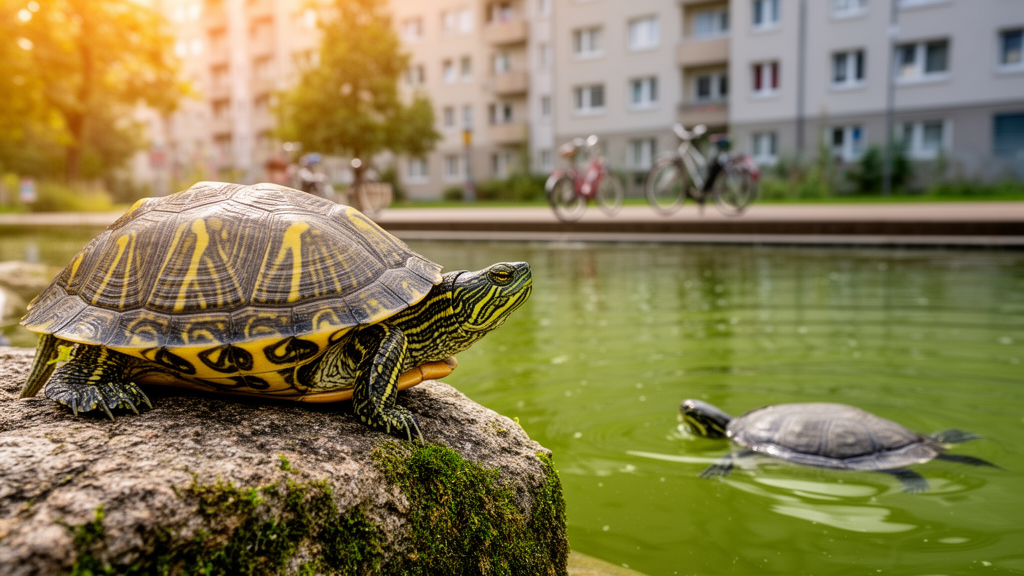
Germany’s ponds, lakes and urban waterways are home to a far greater cast of non-native turtles than scientists had previously documented. A new study published in the journal NeoBiota has compiled 1770 records of free-ranging terrapins across the country and confirmed the presence of fourteen non-native freshwater chelonian species, a striking level of diversity for a temperate European nation. The findings reveal that these animals are not scattered randomly across the landscape but cluster tightly around human population centres, pointing to pet owners releasing unwanted animals as the dominant pathway of introduction.
The research team assembled its dataset from five sources, with roughly seventy-two percent of the records drawn from citizen-science observations on the iNaturalist platform. Only observations reaching Research Grade status, meaning they included a photograph, a date, geographical coordinates and community consensus on the species identification, were accepted. These were supplemented with data from the Federal Environment Agency of Baden-Württemberg and three previously published studies. To gauge the reliability of crowd-sourced identifications, the researchers cross-checked a random sample of every twentieth observation, sixty-nine records in total, and detected an error rate of zero percent, lending considerable confidence to the citizen-science foundation of the analysis.
The North American pond slider, Trachemys scripta, dominates the dataset by a wide margin, accounting for 1237 of the observations, roughly seventy percent of all records. This species has been spreading globally since the 1930s, with a peak in the 1980s and early 1990s, and ranks among the top three most widely distributed invasive reptiles worldwide alongside the Brahminy blind snake and the common house gecko. It is also listed among the hundred worst invasive alien species compiled by the IUCN Invasive Species Specialist Group. The remaining thirteen non-native species were recorded far less frequently: Pseudemys concinna contributed 166 records, Graptemys pseudogeographica 106, and Chrysemys picta and Pseudemys nelsoni 31 records each, while species such as Mauremys leprosa, Sternotherus odoratus and Chrysemys dorsalis were documented only once or twice.
Mapping the sightings onto a twenty-kilometre grid revealed a pattern that is hard to miss: the highest species diversity occurs in and around densely populated areas, particularly in western Germany. Notable hotspots include Hamburg, the Ruhr metropolitan region, Frankfurt am Main, Offenburg, Freiburg im Breisgau, Stuttgart and Munich, while eastern Germany shows only a single cluster around Berlin with isolated records near Leipzig. To quantify this relationship, the team used the CORINE Land Cover dataset, a satellite-derived pan-European classification, and measured the proportion of urban land within a one-kilometre buffer around each sighting. The mean urbanisation level around turtle observations was approximately sixty percent, even though urban areas cover only 14.5 percent of Germany’s land surface, a disparity that strongly supports the link between human presence and terrapin occurrences.
The statistical comparisons between species added further nuance. Graptemys pseudogeographica was found at significantly higher mean urbanisation levels, 73.3 percent, than both Trachemys scripta at 59.2 percent and Chrysemys picta at 40.5 percent, with the differences highly significant after Bonferroni correction. Pseudemys concinna, at around 70 percent urban land, also occupied significantly more urbanised surroundings than the pond slider. These patterns mirror findings for other released animals: ornamental freshwater fish are more likely to be dumped in waterbodies close to roads and footpaths, and non-native grass snakes in Germany are mostly found in publicly accessible urban parks and artificial green spaces. Accessible urban water bodies, it seems, are the default destination for unwanted pets.
Why are some species widespread while others remain rare? The authors point to seventy years of pet trade history. Trachemys scripta, Pseudemys concinna and Graptemys pseudogeographica share the traits that made them popular pets: simple husbandry requirements, attractive appearance and low cost. The red-eared slider subspecies has been traded internationally since at least the 1950s and is likely the most widely traded reptile in the world, with more than 52 million individuals exported from the United States between 1989 and 1997 alone. The European Union banned the import of that subspecies in 1997 because of its invasion risk, which triggered a surge in trade of the other subspecies and hybrids, and a full ban on selling all subspecies followed in 2016. Yet many animals remain in circulation, and their release into the wild continues.
The situation of Germany’s only native freshwater turtle, the European pond turtle Emys orbicularis, adds a conservation paradox to the picture. The species appears in the dataset with 150 records spread across nearly the whole country, but almost all of these populations are allochthonous, meaning they descend from introduced or escaped pets rather than ancestral stock. Historical native populations are assumed to be extinct except for a few in Brandenburg, which remain in critical conservation status. Only a single genetic lineage, endemic to north-eastern Germany and neighbouring Poland, represents truly native pond turtles; all other populations carry strong genetic influence from lineages introduced from southern and south-eastern Europe. This makes Emys orbicularis simultaneously a native species needing protection and, in most of its current German occurrences, effectively non-native, a duality the study describes as understudied and problematic for conservation planning.
Classifying each species within the unified framework for biological invasions developed by Blackburn and colleagues clarifies the actual risk. Eleven of the fourteen non-native species survive in the wild, but successful reproduction has been documented for only three: Trachemys scripta, Pseudemys concinna and Graptemys pseudogeographica, the latter two confirmed genetically for the first time in a temperate continental region outside their native range. The remaining species sit at the boundary between the survival and reproduction stages, and none currently qualifies as invasive in Germany under the framework’s definition, which requires self-reproducing and dispersing populations. However, the authors warn that advancing climate change is expected to allow more species to overcome reproduction barriers, turning today’s casual survivors into tomorrow’s established populations.
The potential ecological consequences remain poorly quantified but are cause for concern. Many terrapins are broad omnivores capable of preying on native flora and fauna, although no data yet exist on the diets of these species in Central Europe. Indirect effects may prove equally significant: non-native terrapins can act as reservoirs for novel parasites and pathogens, and Trachemys scripta is known to carry various Salmonella strains, is vulnerable to ranaviruses, and parasite transmission from invasive to native chelonians has already been documented elsewhere in Europe. Because sightings concentrate in urban habitats, impacts on threatened species in natural areas may currently be limited, but the higher habitat connectivity of natural landscapes means even small numbers of released turtles could have disproportionate effects where vulnerable native species persist.
The study closes with a suite of management proposals grounded in the evidence. The authors call for extensive public outreach on the consequences of releasing pets, a mandatory certificate of competence for exotic pet ownership building on Germany’s existing voluntary scheme, mandatory PIT tags for chelonians to enable tracking and prosecution of illegal releases, and a conservation fee on chelonian sales to fund research and rescue capacity. They note that the country’s only specialised reptile rescue facility, in Munich, faces chronic funding and space shortages, and that most animal shelters cannot accommodate terrapins, leaving few legal alternatives for owners who can no longer keep their animals. For populations already in the wild, the authors argue that prompt and thorough removal is generally more effective than gradual trapping, although extensive intervention may be unnecessary in fully artificial urban habitats while remaining critical near native Emys orbicularis populations. Finally, they urge herpetologists and conservationists to include non-native terrapins in monitoring schemes and invite the public to contribute to the growing iNaturalist project Turtles of Germany, whose value grows with every expert-verified observation.
Subject of Research: Diversity and distribution of non-native freshwater turtles in Germany and their relationship to urbanisation
Article Title: Striking diversity and distribution of non-native chelonians in Germany
Article References: Schloddarick, H., Griesbaum, F., Vamberger, M., & Penner, J. (2026). Striking diversity and distribution of non-native chelonians in Germany. NeoBiota, 107, 207-224. https://doi.org/10.3897/neobiota.107.178668
Image Credits: AI Generated
DOI: 10.3897/neobiota.107.178668
Keywords: invasive species, terrapins, pond slider, Trachemys scripta, Germany, citizen science, iNaturalist, urbanisation, Emys orbicularis, biological invasions, pet trade, conservation
Cite Scienmag News
Patricia Pace. (October 17, 2026). Fourteen alien turtle species are quietly spreading through Germany’s cities. Scienmag. https://scienmag.com/fourteen-alien-turtle-species-are-quietly-spreading-through-germanys-cities/
Patricia Pace. "Fourteen alien turtle species are quietly spreading through Germany’s cities." Scienmag, 17 October 2026, https://scienmag.com/fourteen-alien-turtle-species-are-quietly-spreading-through-germanys-cities/. Accessed 17 October 2026.
Patricia Pace. "Fourteen alien turtle species are quietly spreading through Germany’s cities." Scienmag. October 17, 2026. https://scienmag.com/fourteen-alien-turtle-species-are-quietly-spreading-through-germanys-cities/


