


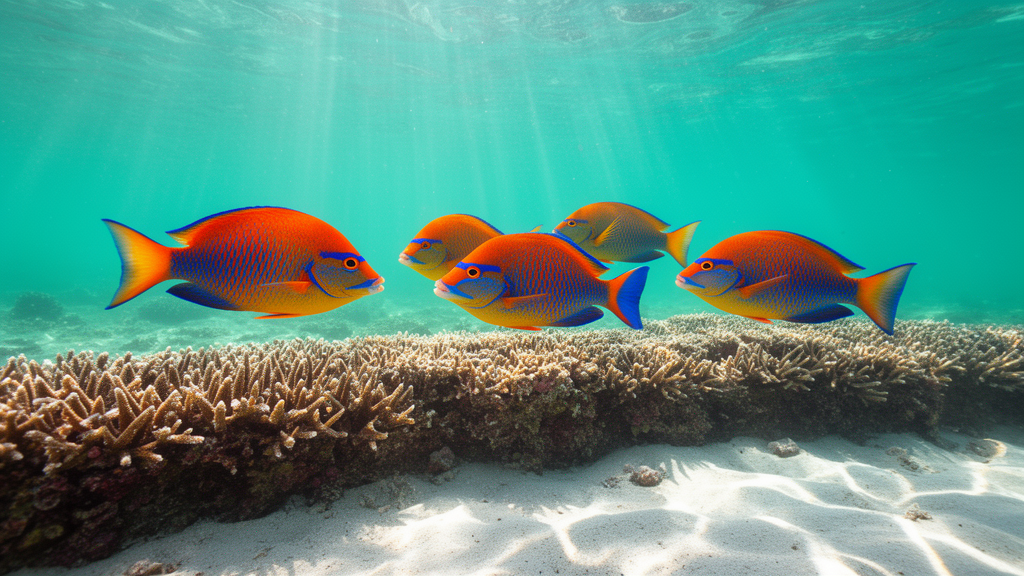
Four demersal marine fish species that scientists had long classified as anti-equatorial—found only at higher latitudes north and south of the tropical belt—have now been recorded from equatorial waters off Lembeh Island, northern Sulawesi, Indonesia. All five specimens, representing the four species, were caught by local fishermen using vertical hooked lines at depths of roughly 100 to 150 meters near the northern tip of Sulawesi, at a latitude of 1.4°N. The discovery, published in the journal Acta Ichthyologica et Piscatoria, marks the first record of each of these species from both equatorial waters and Indonesian seas, and it prompts the authors to call for a re-evaluation of the anti-equatorial biogeographical labels that have been attached to some of them for decades.
The specimens were not collected by a dedicated expedition but were purchased between 2008 and 2012 from local fishermen at the Girian Fish Market in Bitung, northern Sulawesi. Deep-sea line fishing is a traditional practice in the area, with fishermen from Lembeh Island and the mainland targeting large deeper-water species such as tuna, groupers, and snappers that are abundant around the island. After purchase, the fresh specimens were photographed, fixed in 4% formalin, and preserved in 70% ethanol. They are now housed in the fish collection of the Research Center for Oceanography (LBRC-F), National Research and Innovation Agency, in Bitung. Counts and measurements followed established species-specific protocols, taken with digital calipers to the nearest 0.01 millimeter, with cyanine blue stain used to examine scale counts. Standard length and head length are abbreviated SL and HL in the species accounts.
The first species account concerns Plectranthias yamakawai, an anthiadine fish whose type locality is the Ryukyu Islands of southern Japan. The single Lembeh specimen, LBRC-F 3002, measures 182.5 mm SL and was purchased on 22 December 2012. Its diagnostic characters match those previously published for the species: the dorsal fin carries 10 spines and 16 soft rays, the anal fin 3 spines and 7 soft rays, and the pectoral fin 13 rays with the uppermost unbranched; there are 32 pored lateral-line scales, and the pre-opercle bears two antrorse spines on its ventral margin. The fourth dorsal-fin spine is the longest. In life, the body is orange dorsally and rosy ventrally, with numerous small yellow-fringed dark greenish spots across the head, body, and fin bases, and a large red spot just below the lateral line at the center of the body. The specimen also matched published photographs and the figure of the species’ holotype.
Until now, P. yamakawai had been reported only from southern Japan, Taiwan, the Philippines, and Samoa, at latitudes between 15 and 30°N and at 13°S. The Lembeh specimen, collected at 1.4°N, therefore represents the first record of the species in equatorial and Indonesian waters and a substantial southward extension of its known range. The authors note that the species is known to inhabit depths of 100 to 300 meters, a range consistent with the cold, deeper-water conditions at the collection site.
The second species, Aulacocephalus temminckii, the yellowband soapfish, is represented by two specimens: LBRC-F 367, 190.7 mm SL, and LBRC-F 402, 152.1 mm SL, both caught off Lembeh Island and purchased in August and December 2008. The species is readily recognized by its bluish-grey body and a bright yellow band running from near the snout tip through the eye, along the upper part of the back and the dorsal fin base, toward the caudal fin. The dorsal fin has 9 spines and 12 soft rays, the anal fin 3 spines and 9 soft rays, and the pectoral fin 15 rays; the pored lateral-line scales number 74 to 79, and the head and body are covered with ctenoid scales. The specimens match the diagnostic features described by Heemstra and Randall, including the serrated posterior margins of the pre-opercle, subopercle, and interopercle, and a rounded caudal fin.
Aulacocephalus temminckii is the species whose anti-equatorial classification receives the most direct challenge in the paper. The species was recognized as anti-equatorial by Randall in 1982, by Springer in 1982, and by Fricke and colleagues in 2009, because its presence had been observed exclusively at higher latitudes both north and south of the equatorial zone. It is common in subtropical waters between 20 and 36°N or S, and before the new account the lowest latitudes reported were 11°N at Port Blair in the Andaman Islands and 11°S in the Comoros off eastern Africa. However, Bos and Gumanao reported a first record from the Philippines in 2013, based on a specimen caught at roughly 7°N near Samal Island in Davao Gulf. The new Lembeh specimens, at 1.4°N, indicate in the authors’ view that the anti-equatorial classification is no longer valid. The species is also relatively rare in collections despite its wide distribution across the Red Sea and the Indo-west Pacific, with the exception of the Hawaiian Islands; in Southeast Asia it had previously been reported only from the Philippines, making the new specimens the first from Indonesia.
The third species, Iniistius geisha, is a wrasse described originally as Xyrichtys geisha from the Okinawa Islands, Japan. It is considered relatively rare and had been reported, on the basis of several specimens, only from the Northern Hemisphere: southern Japan, Taiwan, and the Mariana Islands, at latitudes from 16 to 30°N. The single Lembeh specimen, LBRC-F 1681, measures 236.5 mm SL and was purchased on 2 April 2012. The species is easily distinguished from its congeners by its distinctive coloration: the snout and ventral surface of the head are whitish-grey, the dorsal and ventral surfaces of the body are black, the remainder of the head and body is yellowish red, and the dorsal, anal, and pelvic fins are entirely black. Morphologically, the dorsal fin has 9 spines and 12 soft rays, the anal fin 3 spines and 14 soft rays, the lateral line is interrupted on the posterior half of the body with 19 plus 6 pores, and a pair of large, slightly recurved canine teeth projects from the tip of each jaw. The discovery off Lembeh significantly extends the species’ known geographical range, constituting the first record in equatorial waters and the southernmost occurrence reported to date. The species is known from depths of about 95 to 100 meters.
The fourth species, Randallichthys filamentosus, or Randall’s snapper, is a lutjanid whose type locality is New Caledonia. The single Lembeh specimen, LBRC-F 2425, measures 175.0 mm SL and was purchased on 20 December 2011, caught at a depth of more than 100 meters. The species is distinguished from all other lutjanids by a combination of characters: the dorsal fin has 10 spines and 11 soft rays, the maxilla and the dorsal- and anal-fin bases lack scales, the premaxillae are not protrusible, the lateral surface of the maxilla bears longitudinal ridges, the vomer carries teeth, and the pectoral fin is shorter than the head length. In life, the head and body are rosy red ventrally with a yellowish tinge dorsally, and four indistinct blackish bands run along the body. R. filamentosus has previously been recorded across a broad range of oceanic islands in the western and central Pacific, including southern Japan, Hawaii, and the Mariana, Society, Tuamotu, Tonga, and Marshall Islands, as well as Scott Reef in northwestern Australia, at latitudes of 8 to 27°N and 16 to 21°S. That pattern had supported Randall’s 1982 categorization of the species as anti-equatorial, but the new specimen at 1.4°N prompts the authors to call for that classification to be reconsidered. The species is known from depths of 150 to 380 meters.
In the discussion, the authors place the four records in a broader context. A similar occurrence was reported by Motomura and Peristiwady in 2012 for two scorpionfish species, Neosebastes entaxis and Neosebastes longirostris, recorded in the same region of northern Sulawesi despite their previously known distribution being restricted to the northwestern coast of Western Australia at latitudes of 14 to 20°S. Motomura and Peristiwady suggested that the presence of N. longirostris in northern Sulawesi reflected a relict species emerging during the Pleistocene. The authors of the new study, however, favor a different explanation for the four species reported here: the isothermal submergence pattern, reflecting ecological adaptation to temperature gradients in tropical ocean depths. The five specimens, representing the four species, were found at depths corresponding to the tropical thermocline, approximately 100 to 150 meters, where temperatures remain stable and resemble the conditions of these species' native habitats. Aulacocephalus temminckii, known to inhabit depths of 20 to 350 meters, demonstrates flexibility in occupying both thermocline zones and shallower waters.
The finding also underscores the significance of the waters around Lembeh Island, which lie within the Coral Triangle, one of the world’s most biologically diverse marine regions. The island is separated from the Sulawesi mainland by the narrow Lembeh Strait, and the waters around Lembeh Island and Tomini Bay form part of a hotspot of reef fish endemism in the East Indian region, with 16 endemic species recorded. The new records show that the area is important not only for biodiversity and endemism but also as a distribution zone for non-endemic species reliant on thermal adaptation. The authors highlight the need for further research on deep-sea fish diversity in equatorial regions at very low latitudes, an environment that remains poorly sampled despite the evidence that it harbors species long thought to be absent from the equatorial zone.
Subject of Research: First equatorial records of four demersal marine fish species collected off Lembeh Island, northern Sulawesi, Indonesia
Article Title: First equatorial records of four marine fishes ( Actinopterygii ) caught off Lembeh Island, northern Sulawesi, Indonesia
Article References: Wibowo, K., Peristiwady, T., Makatipu, P., Oktaviyani, S., Oktaviani, D., & Wahyudewantoro, G. (2025). First equatorial records of four marine fishes (Actinopterygii) caught off Lembeh Island, northern Sulawesi, Indonesia. Acta Ichthyologica et Piscatoria, 55, 1-9. https://doi.org/10.3897/aiep.55.142574
Image Credits: AI Generated
Keywords: anti-equatorial distribution, Lembeh Island, Indonesia, marine fishes, biogeography, deep-sea fish, Plectranthias yamakawai, Aulacocephalus temminckii, Iniistius geisha, Randallichthys filamentosus, thermocline, Coral Triangle
Cite Scienmag News
Margaret Porter. (October 27, 2026). Four Reef Fishes Turn Up at the Equator, Rewriting Their Biogeography. Scienmag. https://scienmag.com/four-reef-fishes-turn-up-at-the-equator-rewriting-their-biogeography/
Margaret Porter. "Four Reef Fishes Turn Up at the Equator, Rewriting Their Biogeography." Scienmag, 27 October 2026, https://scienmag.com/four-reef-fishes-turn-up-at-the-equator-rewriting-their-biogeography/. Accessed 27 October 2026.
Margaret Porter. "Four Reef Fishes Turn Up at the Equator, Rewriting Their Biogeography." Scienmag. October 27, 2026. https://scienmag.com/four-reef-fishes-turn-up-at-the-equator-rewriting-their-biogeography/


