


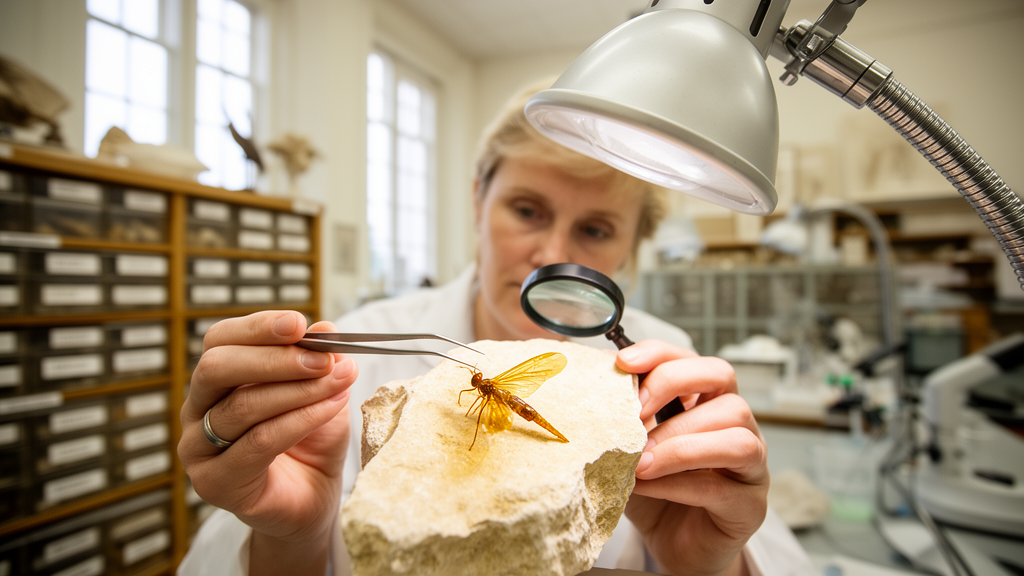
A wasp that spent decades languishing in a museum drawer under the unhelpful label “wasp” has turned out to be something far more remarkable: an entirely new species of extinct Darwin wasp, described this week in the journal Fossil Record. The fossil, preserved in finely laminated limestone from the Luberon region of south-eastern France, dates back roughly 31 to 30 million years to the early Oligocene epoch. Its discoverers named it Lithoserix oublierus, drawing on the French word “oublier,” meaning to forget, in a deliberate tribute to the countless overlooked specimens that may still be hiding in natural history collections around the world. The specimen, catalogued as PNRL-SIG-216 in the Signoret collection of the Parc naturel régional du Luberon, was finally recognized for what it was when researchers André Nel and Corentin Jouault spotted its distinctive wing venation and identified it as an ichneumonid wasp rather than just another generic hymenopteran.
Darwin wasps, the family Ichneumonidae, are one of the most species-rich families of animals on Earth, with tens of thousands of described species and many more awaiting discovery. These slender parasitoid insects lay their eggs inside or on other insects, and their evolutionary history stretches back deep into the Mesozoic. The subfamily Pimplinae, to which the new fossil belongs, began diversifying during the Cretaceous period, meaning that Lithoserix oublierus lived tens of millions of years after its lineage first split from relatives. Today Pimplinae is divided into four tribes: Pimplini, which branches off first at the base of the group, and the three more closely related tribes Ephialtini, Delomeristini and the recently resurrected Theroniini. Understanding where an extinct genus like Lithoserix fits into this framework is essential for reconstructing how the modern diversity of Darwin wasps came to be.
The new species is only the third known member of Lithoserix, an extinct genus with a surprisingly wide geographic and temporal range. The first species, Lithoserix williamsi, was described from the late Eocene Florissant Formation in Colorado, roughly 34 million years old, and was originally misidentified as a horntail wasp in the family Siricidae before later work moved it into Ichneumonidae. The second species, Lithoserix antiquus, was found in the late Oligocene deposits of Aix-en-Provence in France and was only transferred to the genus in recent years. With the addition of the Luberon specimen, the genus now spans both sides of the Atlantic and a window of several million years, offering a rare glimpse into the persistence of an ancient wasp lineage through a period of dramatic global cooling.
The limestone that preserved the new holotype belongs to the Calcaires de Campagne-Calavon Formation, a unit famous among palaeontologists for its exceptional fossils. Around 31 to 30 million years ago, this area of what is now Provence was covered by a quiet, calm and shallow lake whose fine-grained sediments entombed fish, birds, plants and vast numbers of insects. Most fossil insects from these deposits are beetles and flies, and Darwin wasps are remarkably scarce. Only two Darwin wasp species had previously been described from these formations, both by Nicolas Théobald in 1937 from the locality of Céreste, and even those assignments are questionable: one probably does not belong to Pimplinae at all, based on the pentagonal shape of its areolet, a small cell in the fore wing, while the other shows features that make its placement uncertain. The new specimen therefore substantially enriches a very thin fossil record.
Diagnosing a new species from a compression fossil is a painstaking business, and the description of Lithoserix oublierus rests on a suite of subtle anatomical details. The specimen, a female preserved in dorso-lateral view, measures just 12 to 13 millimetres long and sports dark colouration with lighter antennae and fore and mid coxae. Several features mark it out immediately as a pimpline: a stout and short first tergite bearing a lateromedian carina, a closed, nearly triangular areolet in the fore wing, a long 2R1 cell, and, crucially, a nervellus in the hind wing that is intercepted clearly above its midpoint, a hallmark of the tribe Pimplini. But the fossil also carries a combination of traits rarely seen in modern Pimplinae, including extensive carination on the propodeum, a long 1Rs + M vein and a sinusoidal 4Rs vein, a pattern characteristic of Lithoserix.
What separates Lithoserix oublierus from its two congeners is a matter of fine measurements. Its vein 1cu-a is strongly postfurcal, meeting the median vein well behind the point where other veins converge, whereas both older species show an interstitial condition. Its 3Cu vein is about twice the length of 2cu-a, compared with 1.3 times in L. williamsi and equal lengths in L. antiquus. In the hind wing, the 1Rs vein is 2.6 times the length of rs-m, far more elongated than in either relative, and the hind femora are proportionally narrower, 4.2 times as long as wide. The new species is also smaller than L. williamsi, which reaches 22 millimetres, and differs from L. antiquus in lacking smooth transverse bands on the hind margins of the second through seventh tergites and in having dark rather than bright orange legs. Because the specimen has no counterpart and no paratypes, the authors caution that the colour interpretation should be treated with care.
To place the new species in context, the study went beyond traditional descriptive taxonomy and applied geometric morphometrics, a quantitative technique that converts biological shapes into sets of coordinate landmarks that can be compared statistically. The researchers marked 20 fixed landmarks on the fore wings and 10 on the hind wings of 62 pimpline taxa, covering 49 of the 79 known extant genera across all four tribes, plus 10 fossil species including all three Lithoserix species and several species of the extinct genus Crusopimpla. After a generalised Procrustes analysis to align, scale and rotate the wing configurations, the team used Procrustes regression, between-group principal component analysis with a leaving-one-out cross-validation of 10,000 permutations, and canonical variate analysis to ask a deceptively simple question: which living tribe, if any, do the wings of Lithoserix most resemble?
The results were revealing. In the fore wing, size explained 30 percent of shape variation and group affiliation a further 16.7 percent, both highly significant, with no interaction between the two. In the hind wing, size accounted for 25.9 percent, group for 16.3 percent, and, unlike the fore wing, there was a significant interaction, meaning different groups show distinct allometric trends as wings grow. In the between-group analyses, the two extinct genera separated cleanly from the modern tribes and from each other. Crusopimpla, with its broad pterostigma, elongated areolet and short, wide wing cells, differed significantly from most groups and may represent an ancestral or basal pimpline lineage of its own. Lithoserix, by contrast, showed narrow wings with slender cells and a hind-wing shape strikingly similar to Pimplini, with no significant shape differences detected between the two in either wing pair.
That similarity to Pimplini, however, comes with a complication. The ovipositor of Lithoserix, the egg-laying organ at the tip of the female’s abdomen, is very long in both previously described species, a trait that is rare in Pimplini but common in Ephialtini, even though the wing venation of Lithoserix argues against an ephialtine affinity. The new fossil’s ovipositor is only partially preserved, so it cannot settle the question. The author’s conclusion is that Lithoserix most likely represents either a basal member of Pimplini or an extinct tribe closely related to it, a placement consistent with the great antiquity of the group, since Pimplinae probably originated in the Cretaceous. Given that key diagnostic features such as the shape of the clypeus and the tarsal claws are simply not preserved in these compression fossils, a definitive assignment will require better material.
Beyond the fate of one small wasp, the study carries a broader message about the hidden wealth of museum collections. The researchers note that there is a shortage not only of specialists studying the astonishing living diversity of Darwin wasps, but even more so of scientists working on their fossil representatives, and it is probably common for undescribed ichneumonid fossils to sit in drawers labelled only “wasp” or “Hymenoptera.” Every such overlooked specimen is a missing data point in the evolutionary history of one of the planet’s most successful insect families. The resurrection of Lithoserix oublierus from obscurity suggests that the fossil record of Darwin wasps may be far richer than current tallies indicate, waiting patiently in storage for the next pair of trained eyes.
Subject of Research: Description of a new extinct Darwin wasp species and geometric morphometric analysis of its placement within Pimplinae
Article Title: Another one bites the dust: A new Lithoserix species ( Hymenoptera , Ichneumonidae , Pimplinae ) from the early Oligocene in France, with an evaluation of wing morphometrics
Article References: Viertler, A. (2024). Another one bites the dust: A new Lithoserix species (Hymenoptera, Ichneumonidae, Pimplinae) from the early Oligocene in France, with an evaluation of wing morphometrics. Fossil Record, 27(1), 135-145. https://doi.org/10.3897/fr.27.116373
Image Credits: AI Generated
DOI: 10.3897/fr.27.116373
Keywords: Darwin wasps, Ichneumonidae, Pimplinae, Lithoserix oublierus, fossil insect, Oligocene, France, Luberon, geometric morphometrics, wing venation, paleontology, taxonomy
Cite Scienmag News
Gavin Prescott. (October 19, 2026). Forgotten Fossil Reveals New Species of 30-Million-Year-Old Darwin Wasp from France. Scienmag. https://scienmag.com/forgotten-fossil-reveals-new-species-of-30-million-year-old-darwin-wasp-from-france/
Gavin Prescott. "Forgotten Fossil Reveals New Species of 30-Million-Year-Old Darwin Wasp from France." Scienmag, 19 October 2026, https://scienmag.com/forgotten-fossil-reveals-new-species-of-30-million-year-old-darwin-wasp-from-france/. Accessed 19 October 2026.
Gavin Prescott. "Forgotten Fossil Reveals New Species of 30-Million-Year-Old Darwin Wasp from France." Scienmag. October 19, 2026. https://scienmag.com/forgotten-fossil-reveals-new-species-of-30-million-year-old-darwin-wasp-from-france/


