


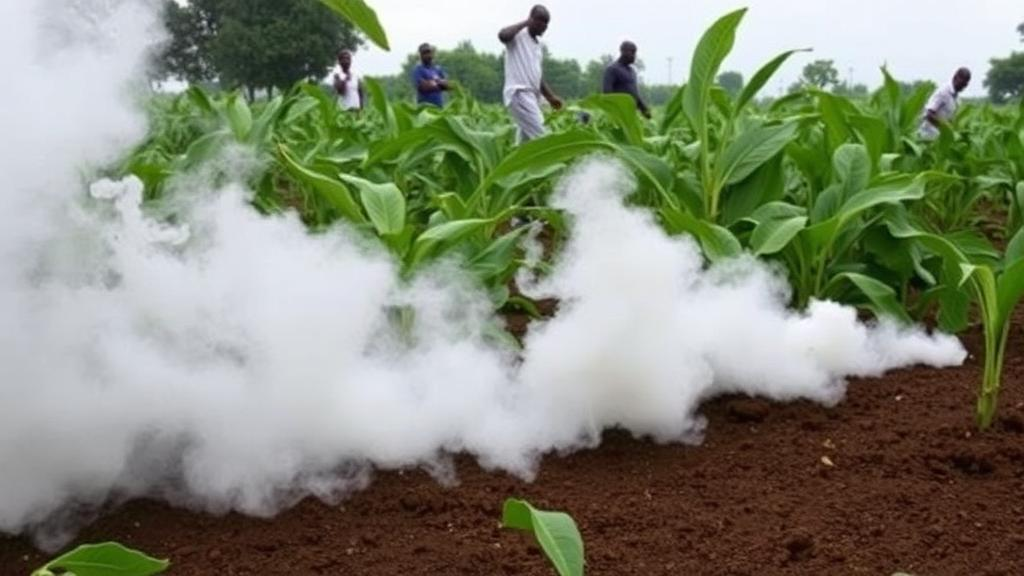
Persistent organic pollutants, the synthetic compounds often called forever chemicals, have become one of the most troubling environmental health stories of our time, and a new review published in Discover Toxicology argues that Nigeria sits at the center of the crisis. The study, led by Daniel Omeodisemi Omokpariola of Nnamdi Azikiwe University together with colleagues at the National Agency for Food and Drug Administration and Control, examines how these chemicals accumulate in ecosystems and human tissue, and how that accumulation may be feeding into the country’s rising cancer burden. Because POPs resist chemical, biological, and photolytic degradation, they persist in soils, water bodies, and the atmosphere for decades, bioaccumulate through the food web, and can travel long distances through the atmosphere, making them a uniquely stubborn public health problem.
The chemical family is broad and familiar. It includes per- and polyfluoroalkyl substances, or PFAS, used in non-stick cookware, firefighting foams, and water-resistant fabrics; polychlorinated biphenyls, once prized as industrial insulators; polybrominated biphenyls and brominated flame retardants; polycyclic aromatic hydrocarbons; dioxins; organochlorine and organophosphate pesticides; and phthalates. The International Agency for Research on Cancer classifies PCBs and dioxin-like PCBs as Group 1 carcinogens, meaning they are known to cause cancer in humans, while PBBs are rated Group 2A, probably carcinogenic. Epidemiological work worldwide has tied PFAS exposure to kidney, testicular, and breast cancers, and the review notes that these compounds can disrupt endocrine function, alter immune responses, and damage DNA. Their lipophilic character is central to the danger: they dissolve readily into fatty tissue, producing prolonged internal exposure that raises cancer risk over years or decades through genotoxicity, endocrine disruption, and immunotoxicity.
What makes Nigeria’s situation acute is the convergence of rapid industrialization, intensive agriculture, and weak chemical management. The Niger Delta, one of the most polluted regions on Earth, is saturated with hydrocarbons from oil exploration, including PAHs and BTEX compounds, both carcinogenic groups. Oil spills and gas flaring release these chemicals directly into the air, water, and soil of communities that depend on fishing and subsistence farming. Agriculture adds another layer: despite international and local bans on substances such as DDT, aldrin, benzene hexachloride, calcium cyanide, and dieldrin, residues of these organochlorine pesticides persist in Nigerian soils and water, and in 2023 the national regulator NAFDAC listed numerous banned pesticides that continue to proliferate. Urbanization compounds the problem. In cities such as Lagos, Kano, Abuja, and Port Harcourt, informal e-waste recycling, which often involves burning electronic components to recover metals, releases brominated flame retardants and dioxins into the environment.
The review quantifies the scale of oil-related contamination using data from the National Oil Spill Detection and Response Agency’s spill monitor, cross-checked against government, industry, and news sources. In 2023 alone, Nigeria recorded 1,162 oil spills, losing 18,747 barrels of oil, including 3 major and 12 medium spills. The preceding years were scarcely better: 794 spills and 47,732 barrels lost in 2022, 613 spills and 40,707 barrels in 2021, and more than 550 spills in each year from 2017 through 2020. Studies cited in the review found PCB concentrations in Niger Delta sediments exceeding international safety limits and elevated PAH levels in water and sediments, contaminants that are known carcinogens and have been linked to respiratory problems and cancer among local populations.
Regional case studies paint a consistent national picture. In Lagos, industrial discharge, urban runoff, and poor waste disposal have loaded the lagoon with organochlorine pesticides and PCBs, while traffic congestion, biomass burning, and industrial emissions foul the air; one analysis of West African cities attributed roughly a third of fine particulate pollution to road transport and a quarter to biomass fuels. Port Harcourt’s notorious soot, driven by illegal refineries and poorly operated flares, pushes particulate levels far beyond World Health Organization guidelines. In Kano, the Challawa River, used for irrigation and domestic purposes, carries high pollutant loads from tanneries and industry. Onitsha, Warri, and Abeokuta each show elevated PAHs and PCBs in air, water, or soil. Satellite-based trend analysis by the research team found that fine particulate matter, PM2.5, dominated Nigeria’s atmospheric pollution profile, accounting for just over half of the measured particulate burden, with industrial emissions driving the formation of volatile organic compounds that act as precursors to POPs.
The epidemiological evidence, though incomplete, points in a worrying direction. Breast cancer is now the most common cancer among Nigerian women, and studies cited in the review found higher incidence among women living in areas of heavy industrial pollution. Liver cancer rates correlate with PAH and PCB levels in the Niger Delta, where oil exploration is concentrated. Prostate cancer, the most common cancer among Nigerian men, has been associated in one review with high environmental POP levels, and colorectal cancer risk appears elevated among people exposed to organochlorine pesticides and PAHs. A World Bank assessment of air pollution costs in Lagos estimated that children under five account for 60 percent of pollution-related deaths there, with an estimated 11,200 premature deaths in 2018, and ranked lung cancer among the leading health effects. Data from the Institute for Health Metrics and Evaluation show neoplasms climbing from ninth among causes of death in Nigeria in 2000 to sixth by 2010, where they have remained.
At the molecular level, the review explains how these chemicals plausibly drive carcinogenesis. POPs generate oxidative stress, an imbalance between reactive oxygen species and the body’s antioxidant defenses, producing radicals that damage DNA and activate signaling pathways such as NF-kB, Nrf2, Akt/PI3K/mTOR, MAPK, and p53, which regulate cell growth, repair, and apoptosis. Carcinogens such as PAHs and PCBs also form DNA adducts, chemical bonds between pollutants and DNA that cause mutations and genomic instability; when the burden is high, nucleotide and base excision repair pathways are overwhelmed. Endocrine-disrupting chemicals like dioxins and phthalates mimic or block hormones, altering receptor expression and metabolism in ways that promote hormone-dependent cancers of the breast, prostate, and thyroid. A systematic review of 95 studies found that POPs measured in breast adipose tissue were more clearly associated with higher breast cancer incidence and worse prognosis than measurements in blood, suggesting that tissue-specific accumulation matters.
Establishing firm causality in Nigeria, however, is hampered by a data crisis. Cancer registries are underfunded and sparse; the well-regarded Ibadan Cancer Registry is hospital-based and may not represent the wider population. Many cases go unreported, particularly in rural areas where diagnostic facilities are scarce and patients often present at advanced stages. Stigma, the cost of treatment, and reliance on traditional healing further suppress reporting, and inconsistent data collection methods make regional comparisons difficult. The informal economy, including oil theft and unregulated refining, releases pollutants that are never monitored. The authors acknowledge that these limitations constrain their own conclusions and call for population-based registries and standardized surveillance as prerequisites for precise causal research.
The burden falls unevenly. Rural communities face pesticide residues in food and drinking water and, in oil-producing regions, direct exposure to volatile organic compounds and gas flaring emissions. Urban slums sit beside industrial zones, landfills, and e-waste dumps, with contaminated water, unregulated cooking fuels, and overcrowding amplifying exposure. Poverty limits access to diagnosis and treatment, and lower educational attainment reduces awareness of chemical hazards, widening health disparities between socioeconomic groups. On the policy front, Nigeria has ratified the Stockholm, Rotterdam, Basel, and Bamako conventions and maintains a regulatory architecture spanning NESREA, NAFDAC, and other agencies, but enforcement is undermined by capacity constraints, limited political will, and low public awareness. The review recommends stronger legal frameworks aligned with international treaties, monitoring enhanced by remote sensing and geographic information systems, institutional investment, public education campaigns, and transparent environmental impact reporting. Without such reforms, the authors warn, the country’s most vulnerable communities will continue to pay the highest price for a pollution problem the world already knows how to prevent.
Subject of Research: The role of persistent organic pollutants in cancer development in Nigeria
Article Title: Assessing the role of Persistent Organic Pollutants (POPs) in cancer development in Nigeria: environmental exposure, risk factors, and policy gaps
Article References: Omokpariola, D. O., Omokpariola, P. L., Okechukwu, V. U., Okeke, A. P., & Daramola, A. A. (2025). Assessing the role of Persistent Organic Pollutants (POPs) in cancer development in Nigeria: environmental exposure, risk factors, and policy gaps. Discover Toxicology, 2(1), Article 9. https://doi.org/10.1007/s44339-025-00030-0
Image Credits: AI Generated
DOI: 10.1007/s44339-025-00030-0
Keywords: persistent organic pollutants, PFAS, cancer, Nigeria, Niger Delta, oil spills, pesticides, e-waste, environmental health, endocrine disruption, Stockholm Convention, public health policy
Cite Scienmag News
Nathaniel Bowman. (October 3, 2026). Forever Chemicals and Cancer: Nigeria Faces a Growing Toxic Burden. Scienmag. https://scienmag.com/forever-chemicals-and-cancer-nigeria-faces-a-growing-toxic-burden/
Nathaniel Bowman. "Forever Chemicals and Cancer: Nigeria Faces a Growing Toxic Burden." Scienmag, 3 October 2026, https://scienmag.com/forever-chemicals-and-cancer-nigeria-faces-a-growing-toxic-burden/. Accessed 4 October 2026.
Nathaniel Bowman. "Forever Chemicals and Cancer: Nigeria Faces a Growing Toxic Burden." Scienmag. October 3, 2026. https://scienmag.com/forever-chemicals-and-cancer-nigeria-faces-a-growing-toxic-burden/


