


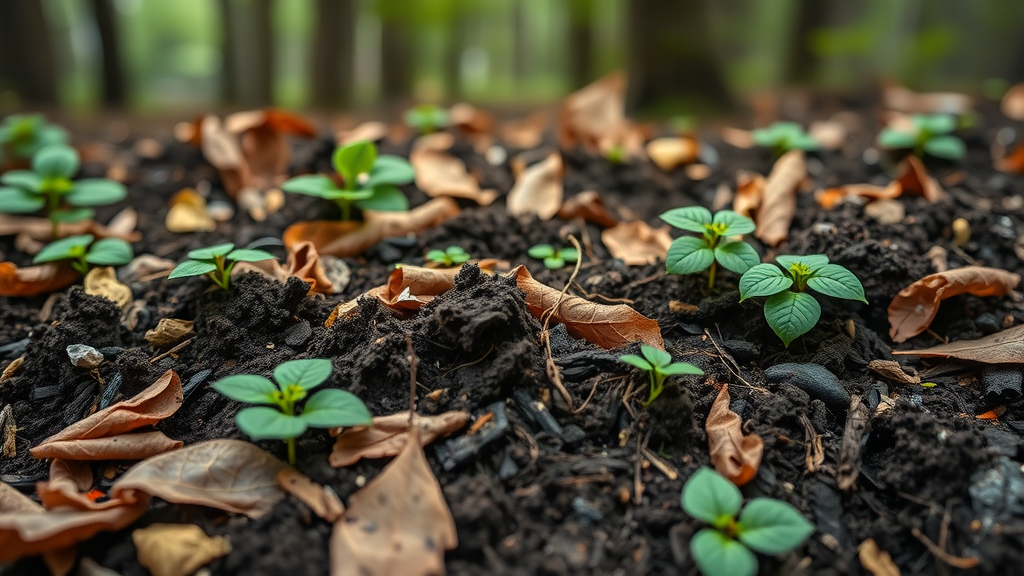
Deep in the soil of temperate forests, an enormous and largely invisible library of antibiotic resistance genes sits embedded in the genomes of bacteria, fungi, and other microorganisms. These genes, which encode the molecular machinery that lets microbes survive exposure to antibiotics, have long been studied in hospitals, farms, and wastewater plants, but forests remain one of the least understood reservoirs on Earth. A new study published in the journal Microbial Ecology has now tested whether one of the most fundamental ecological inputs in a forest, the layer of fallen leaves and twigs that blankets the ground, shapes this so-called resistome. The answer, at least over the short term, is surprising: removing or retaining litter changed soil chemistry substantially, yet the resistance genes themselves barely moved.
The research team, led by Dongmei He, Qi Wang, and Wei Xing of the Jiangsu Academy of Forestry together with Cong Xu and Yingdan Yuan of Yangzhou University, set up a litter manipulation experiment across three distinct forest stand types in eastern China: a pure coniferous stand, a pure broad-leaved stand, and a mixed coniferous stand. In each stand, they compared plots where natural litter was left in place with plots from which litter had been removed, creating a with-litter and a no-litter treatment. After an experimental period of roughly three months, they collected soil samples and subjected them to metagenomic sequencing, the technique that reads out all the genetic material present in an environmental sample without needing to culture the organisms first.
The scale of the sequencing effort revealed just how rich the forest resistome truly is. Across the samples, the researchers identified antibiotic resistance determinants spanning 43 different antibiotic drug classes and 1,595 distinct ARG subtypes. That diversity alone underscores why ecologists care about forests as resistance reservoirs: genes conferring tolerance to tetracyclines, macrolides, beta-lactams, and many other drug families all coexist in forest floor soils, long before any clinical antibiotic has ever been applied to these landscapes.
Before turning to the genes, the team verified that the litter treatment actually did something to the soil environment. It did. Removing litter significantly altered a suite of soil physicochemical properties, particularly those related to nutrient availability, since leaf litter is the principal organic input that feeds decomposer food webs and releases nitrogen, phosphorus, and carbon into the mineral soil. The strongest treatment effects on soil chemistry appeared in the mixed coniferous stand, suggesting that the interaction between litter quality and stand composition influences how dramatically soil conditions respond when the organic layer is stripped away.
Given that the soil environment had clearly changed, one might expect the microbial communities and their resistance genes to shift in parallel. The microbial data told a more nuanced story. Within each forest stand, comparisons between with-litter and no-litter plots revealed no significant differences in microbial diversity indices at the study’s endpoint, even though a two-way analysis of variance detected a significant main effect of litter treatment on the Shannon index, a standard metric combining species richness and evenness, with a p-value below 0.05. In other words, litter removal left a statistical fingerprint when stand types were pooled, but within any single stand the community-level signal was too subtle to resolve with confidence.
The resistance genes themselves were even more stubborn. Total ARG abundance and the Shannon diversity of ARGs showed no detectable difference between with-litter and no-litter treatments within any of the three forest stands. To probe why the resistome appeared so stable, the researchers adapted a beta-distribution abundance-occupancy model from the Sloan framework, a class of neutral models originally developed to describe how microbial taxa colonize and persist across spatially structured habitats. The model yielded similar descriptive relationships under both treatments, indicating that the fundamental processes governing which resistance genes occupy which soil patches had not been meaningfully reorganized by the litter manipulation within the study’s timeframe.
To dig deeper into the forces that do govern ARG distributions, the team integrated three complementary analytical approaches: co-occurrence networks, which map statistical associations between genes and taxa across samples; generalized additive models, which capture nonlinear relationships between ARG abundance and environmental or biological predictors; and partial least squares path modeling, a statistical framework that tests hypothesized causal pathways linking sets of variables. The convergent conclusion was clear. ARG abundance was more strongly associated with attributes of the microbial community and with the abundance of mobile genetic elements, such as plasmids, integrons, and transposons that shuttle genes between organisms, than with measured soil variables such as nutrients and pH.
This finding carries real weight for how scientists think about resistance in natural environments. A common working assumption is that antibiotic resistance genes in soil track their chemical environment: change the nutrients, moisture, or organic matter, and the resistome should follow. The new results suggest instead that the biotic context is dominant, at least over timescales of months. Resistance genes live inside microbial cells, and their fates are tied to the population dynamics of their microbial hosts and to the activity of mobile genetic elements that mediate horizontal gene transfer. If the host communities themselves are resilient to disturbance, the resistome riding within them will be resilient too, regardless of shifts in soil chemistry.
The authors are careful about what the word apparent means in their title. The study captured a single sampling endpoint after approximately three months, which is a short window in the life of a forest where litter accumulates over years and decades. The observed stability of resistome metrics under litter manipulation may reflect genuine ecological buffering, or it may reflect lag effects, with microbial communities and their gene complements needing longer to respond to altered nutrient regimes. Either interpretation has practical value. For land managers, the results suggest that routine practices affecting litter layers, such as litter raking or the removal of harvest residues, are unlikely to produce rapid changes in soil resistance gene loads. For researchers, the results point to microbial community attributes and mobile genetic elements as the key variables to monitor when forecasting how environmental reservoirs of resistance will respond to global change. The study was supported by the Jiangsu Forestry Science and Technology Innovation and Promotion Program and related forestry research grants, and it was published as open access, allowing the broader scientific community to build on a dataset that catalogues nearly 1,600 resistance gene subtypes across three forest ecosystems.
Subject of Research: Short-term effects of plant litter manipulation on antibiotic resistance genes in forest soil microbial communities
Article Title: Apparent Short-term Stability of Forest Soil Resistomes under Litter Manipulation is Associated with Microbial Communities and Mobile Genetic Elements
Article References: He, D., Xu, C., Wang, Q., Niu, H., Lian, J., Xing, W., & Yuan, Y. (2026). Apparent Short-term Stability of Forest Soil Resistomes under Litter Manipulation is Associated with Microbial Communities and Mobile Genetic Elements. Microbial Ecology. https://doi.org/10.1007/s00248-026-02878-0
Image Credits: AI Generated
DOI: 10.1007/s00248-026-02878-0
Keywords: antibiotic resistance genes, resistome, forest soil, litter manipulation, metagenomics, microbial communities, mobile genetic elements, soil nutrients, forest stand types, horizontal gene transfer, microbial ecology, environmental microbiology
Cite Scienmag News
Juliet Wilcox. (September 20, 2026). Forest Soil Antibiotic Resistance Genes Prove Stubbornly Stable When Leaf Litter Is Removed. Scienmag. https://scienmag.com/forest-soil-antibiotic-resistance-genes-prove-stubbornly-stable-when-leaf-litter-is-removed/
Juliet Wilcox. "Forest Soil Antibiotic Resistance Genes Prove Stubbornly Stable When Leaf Litter Is Removed." Scienmag, 20 September 2026, https://scienmag.com/forest-soil-antibiotic-resistance-genes-prove-stubbornly-stable-when-leaf-litter-is-removed/. Accessed 4 October 2026.
Juliet Wilcox. "Forest Soil Antibiotic Resistance Genes Prove Stubbornly Stable When Leaf Litter Is Removed." Scienmag. September 20, 2026. https://scienmag.com/forest-soil-antibiotic-resistance-genes-prove-stubbornly-stable-when-leaf-litter-is-removed/


