

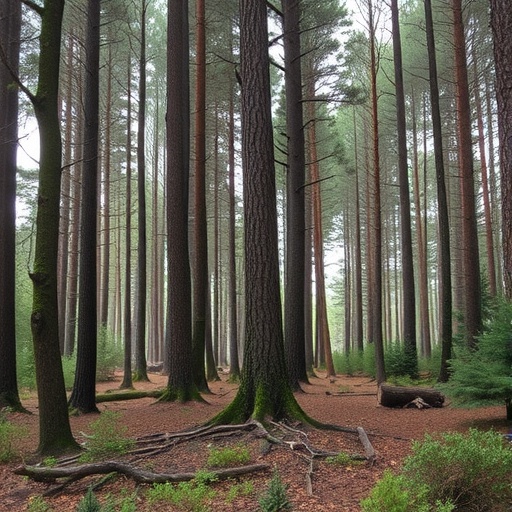
In a groundbreaking study led by researchers at the Technical University of Munich (TUM), scientists have for the first time precisely modeled the future trajectory of forest disturbances across Europe under varying climate change scenarios. This comprehensive analysis reveals a worrying trend: no matter the scenario, Europe’s forests are poised to endure substantially more damage from wildfires, storms, and bark beetle outbreaks by the year 2100. These disturbances, which are already reshaping forest landscapes in Central Europe, threaten to dramatically alter ecosystem services and carbon storage capabilities that are indispensable for environmental stability and human well-being.
Historically, tree mortality from natural disturbances such as insect infestations, fires, and windstorms has been an integral part of forest ecosystem dynamics, facilitating renewal and growth. However, the scale and severity of these events have escalated markedly due to the accelerating impacts of climate change. This study quantifies these changes by integrating two powerful data streams: remotely sensed satellite observations spanning over three decades and sophisticated forest simulation models enhanced with artificial intelligence. By leveraging data from 13,000 sites across the continent, the team constructed a robust, AI-driven framework to simulate forest disturbance patterns on an unprecedented spatial and temporal scale.
The heart of this methodological advancement lies in the AI-based modeling employed. The researchers trained their model on an immense dataset consisting of 135 million data points derived from detailed forest dynamics simulations coupled with multi-decadal satellite disturbance records. This enormous computational undertaking allowed for forest disturbance projections with a fine spatial resolution that reaches down to individual hectares. This granularity facilitates the capture of nuanced regional differences and disturbance trajectories otherwise masked in broad-scale assessments.
One of the most alarming outcomes of this modeling effort is the projected doubling of disturbed forest area under a high-emission climate scenario that assumes a global warming exceeding 4 degrees Celsius by the century’s end. Even under more optimistic conditions—where global temperature rises are limited to approximately 2 degrees Celsius—forest disturbances are still expected to surpass the already elevated baseline levels observed from 1986 to 2020. This baseline period itself was characterized by unprecedented disturbance frequency and intensity, underscoring just how dire future trajectories may be.
Regionally, the study forecasts a heterogeneous pattern of change across Europe. Southern and Western European forests are predicted to face the most significant increases in disturbance frequency and severity, profoundly altering forest structure and composition. In contrast, Northern Europe may experience somewhat less overall damage. However, localized disturbance hotspots could emerge even in these cooler, more temperate regions, signaling a continent-wide challenge rather than one confined to traditionally vulnerable zones.
This increase in disturbance has multifaceted implications. Forests serve as vital carbon sinks, sequestering vast amounts of atmospheric carbon dioxide and mitigating climate change. Enhanced disturbance levels compromise this role by killing trees and reducing forest biomass. Furthermore, disturbances disrupt timber supply chains—which many European economies rely on—by causing widespread tree mortality and altering species distributions. The cascading effects extend to biodiversity loss and degraded habitat quality, which in turn impairs crucial ecosystem services such as water regulation, soil stability, and recreational opportunities.
The research team emphasizes the urgent need for adaptive forest management policies tailored to the increasingly dynamic disturbance regimes anticipated in the coming decades. Such policies should encompass not only protective measures aimed at minimizing harm but also strategic interventions to foster the establishment of climate-resilient and disturbance-adapted forest stands. Disturbances, while destructive, also act as catalysts for ecological succession and renewal. Harnessing this dynamic could pave the way for forest ecosystems better equipped to withstand future stressors and to continue providing critical services.
Rupert Seidl, lead author and Professor of Ecosystem Dynamics and Forest Management at TUM, highlights that “the future of Europe’s forests hinges on our capacity to integrate novel scientific insights and advanced algorithmic tools into practical forestry. By anticipating disturbance patterns at fine spatial scales, we can build resilience into both ecological and economic systems dependent on forests.” The integration of big data, remote sensing, and machine learning stands as a pioneering approach in ecological forecasting that may serve as a model for other regions worldwide facing similar challenges.
This research was conducted within the framework of the Resonate project, coordinated by the European Forest Institute (EFI), aiming to enhance the resilience of forest ecosystems against emerging climatic threats. As global negotiations and policy discussions intensify over climate mitigation and adaptation strategies, these findings underscore forests’ pivotal role and vulnerability. This nuanced understanding of how disturbances interplay with changing climatic variables is critical for aligning conservation efforts with sustainable forest utilization.
The study also brings to light the broader cross-regional and economic implications of shifting disturbance patterns. By disrupting timber markets and altering forest composition at large scales, rising disturbance levels may induce volatility and supply constraints beyond ecological boundaries. Policymakers and forest managers face an intricate balancing act: mitigating volatility risks while embracing the opportunities disturbance-driven forest succession presents for regenerating more adaptive landscapes.
Altogether, these findings paint a sobering portrait of Europe’s forested future but also open a window for proactive intervention and innovation. Continued advancements in computational simulation models, coupled with integrative monitoring via satellite technologies, equip scientists and decision-makers with a powerful toolkit to anticipate challenges and blueprint resilient forest landscapes for generations ahead.
Subject of Research: Forest disturbances (wildfires, storms, bark beetle outbreaks) under climate change scenarios in Europe using AI-based computational simulation and satellite data.
Article Title: Not provided.
News Publication Date: 5-Mar-2026
Web References: https://resonateforest.org/, http://dx.doi.org/10.1126/science.adx6329
References: Seidl, R., et al. (2026). [Title not provided]. Science. DOI: 10.1126/science.adx6329.
Image Credits: Rupert Seidl / Technical University of Munich (TUM)
Keywords: Forest disturbance, climate change, Europe forests, AI modeling, bark beetle, wildfires, storms, ecosystem dynamics, carbon storage, forest management, remote sensing, ecological resilience


