

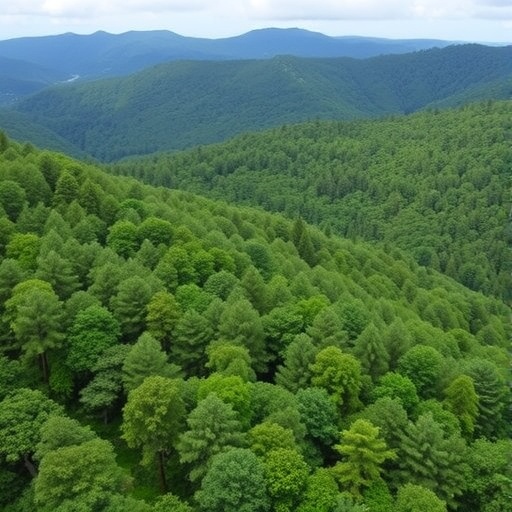
In the dynamic realm of ecological restoration, the Atlantic Forest—one of South America’s most biodiverse yet imperiled biomes—emerges anew as a focal point for groundbreaking research. Recent scientific advances underscore the pivotal role of forest connectivity in accelerating carbon recovery among regenerating forest landscapes, a revelation with profound implications for climate mitigation strategies globally. The findings, published in Communications Earth & Environment by Rosan, Vedovato, Heinrich, and colleagues, elucidate how linking fragmented forest patches significantly enhances the carbon sequestration potential of these ecosystems, thereby reshaping conservation paradigms and policy priorities.
The Atlantic Forest, or Mata Atlântica, historically stretched across vast swathes of eastern Brazil, Paraguay, and Argentina. However, centuries of deforestation have reduced this once-continuous canopy to a mere fraction of its original extent, fragmented into thousands of isolated remnants. This fragmentation compromises not only biodiversity but also the forest’s ability to function as a robust carbon sink. The new study confronts this challenge by quantifying how the spatial arrangement and connectivity of regenerating forest patches influence the pace and magnitude of carbon recovery.
At the heart of the research lies the concept of “forest connectivity,” a term that encompasses both physical proximity between patches and the ecological corridors that facilitate species and nutrient flows. The investigators employed a suite of remote sensing technologies combined with on-the-ground biomass measurements to analyze patterns of forest regrowth over several decades. They meticulously mapped the configuration of dozens of regenerating plots within the Atlantic Forest biome, comparing isolated fragments with those in connected networks.
Their analyses reveal a striking trend: regenerating forests embedded within well-connected landscapes recover biomass—and consequently carbon—at a significantly accelerated rate compared to isolated patches. This is attributed to multiple interdependent factors, including enhanced seed dispersal, greater animal-mediated pollination, and improved microclimatic conditions within connected mosaics. These biotic and abiotic interactions foster faster forest succession stages, propelling young patches into mature, carbon-rich states more rapidly.
Moreover, the study quantifies how connectivity mitigates the detrimental edge effects that dominate small, isolated forest remnants. Edge zones typically experience harsher sunlight exposure, higher temperatures, and increased vulnerability to invasive species, all of which suppress biomass accumulation. Connected landscapes, by contrast, exhibit increased core habitat areas buffered against such stresses, enabling superior ecological functioning and carbon uptake.
From a carbon sequestration perspective, the implications are substantial. The authors estimate that restoring connectivity within currently fragmented Atlantic Forest landscapes could amplify carbon stocks by up to 30% in regenerating stands over a few decades, compared to the status quo. This acceleration of carbon recovery not only contributes to local ecosystem resilience but also offers a tangible climate mitigation pathway aligned with international goals under the Paris Agreement.
The methodology underpinning this research integrates high-resolution satellite imagery—capable of detecting subtle changes in canopy density—with rigorous field campaigns measuring tree growth and soil carbon dynamics. By correlating spatial network metrics with biomass accumulation data, the researchers construct predictive models capable of informing restoration prioritization. These models enable identification of critical patches where reforestation efforts and corridor establishment yield maximum carbon dividends.
Beyond carbon metrics, the study also touches on the broader biodiversity benefits mediated by enhanced connectivity. As dispersal networks strengthen, animal populations—including birds, bats, and primates—are better able to recolonize regenerating areas, facilitating key ecological processes that sustain forest health. This synergistic interplay underlines how carbon-focused restoration can concurrently nurture biodiversity recovery, exemplifying nature-based solutions that are multifunctional.
Importantly, this research challenges conventional restoration strategies that often emphasize reforestation in isolated pockets without sufficient consideration of landscape context. It advocates for integrated approaches that weave connectivity into project design, such as strategic placement of corridors, stepping stones, and buffer zones. Such landscape-scale planning unlocks the latent potential of regenerating forests to serve as powerful carbon sinks, thereby maximizing ecological return on investment.
From a policy perspective, the findings beckon a shift towards cross-sectoral collaboration encompassing forestry management, agriculture, urban planning, and indigenous land stewardship. Facilitating connectivity demands coordinated actions across governance levels, incentivizing landowners and communities to participate in landscape restoration initiatives. Mechanisms like payment for ecosystem services could be instrumental in aligning economic interests with ecological connectivity objectives.
The temporal dimension is equally noteworthy. By demonstrating accelerated carbon recovery trajectories in connected landscapes, the study bolsters the argument for early and sustained interventions. Delays in restoring connectivity not only exacerbate carbon emissions from continuing degradation but also diminish restoration efficacy and increase costs. Thus, time-sensitive investments are essential to harness regenerative dynamics fully.
This work also contributes methodologically by advancing geospatial analysis techniques that can be adapted to other fragmented ecosystems worldwide. The integration of remote sensing data with ecological modeling provides a replicable framework for assessing connectivity effects on carbon dynamics in diverse forest types, from temperate woodlands to tropical rainforests. Such transferability amplifies the global impact of the findings.
In summation, the research by Rosan and collaborators spotlights forest connectivity as a linchpin for carbon recovery in regenerating Atlantic Forests, underscoring a critical yet underappreciated dimension of tropical forest restoration. By illuminating the pathways through which landscape structure modulates carbon sequestration, this study enriches the scientific foundation for tackling climate change through nature-based solutions. Its call for holistic, connectivity-centered restoration strategies resonates powerfully amid escalating environmental crises.
As the world grapples with the dual imperatives of biodiversity conservation and climate mitigation, the Atlantic Forest’s resurgence offers a beacon of hope—showcasing how harmonizing landscape connectivity with ecological processes can revitalize carbon stocks. This synergy redefines how we envision and implement forest recovery, charting a promising course towards more resilient and carbon-rich ecosystems that benefit both people and the planet.
Subject of Research: Forest connectivity’s influence on carbon sequestration dynamics in regenerating Atlantic Forest ecosystems.
Article Title: Forest connectivity boosts carbon recovery in regenerating Atlantic Forests.
Article References:
Rosan, T.M., Vedovato, L.B., Heinrich, V.H.A., et al. Forest connectivity boosts carbon recovery in regenerating Atlantic Forests. Communications Earth & Environment (2026). https://doi.org/10.1038/s43247-026-03480-5
Image Credits: AI Generated


