


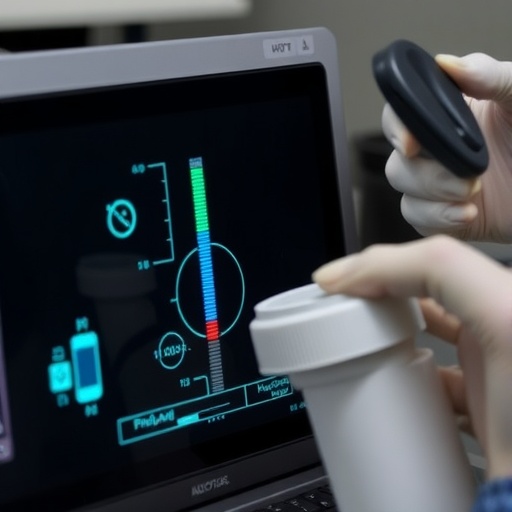
In the ever-evolving field of forensic science, the estimation of the postmortem interval (PMI)—the time elapsed since death—remains a paramount challenge. Traditional methodologies, such as rigor mortis, livor mortis, and body cooling, are subjected to numerous environmental and biological variables, often leading to significant deviations and uncertainties in forensic investigations. A groundbreaking systematic review recently published in the International Journal of Legal Medicine by Cianci, Fracasso, Germanà, and colleagues brings fresh insights into a novel, biomolecular approach that promises to revolutionize PMI estimation: the forensic application of postmortem protein analysis.
This comprehensive review meticulously delves into the current state-of-the-art techniques and quantifies the reliability of protein degradation patterns as postmortem clocks. Proteins, the fundamental building blocks of life, undergo predictable degradation pathways after death, influenced by various intrinsic and extrinsic factors. These biochemical changes can provide a molecular timeline that forensic experts can harness to refine the accuracy of PMI determination, overcoming the limitations imposed by environmental conditions that confound conventional methods.
The core premise rests on understanding how specific proteins deteriorate in a temporally regulated manner postmortem. Proteins such as cytoskeletal elements, enzymes, and structural components demonstrate differential stability and decay kinetics. The systematic review synthesizes data from numerous experimental setups ranging from controlled laboratory conditions to real-case forensic scenarios, revealing consistent patterns that correlate protein fragmentation or total abundance with elapsed time since death.
Key to this approach is the utilization of cutting-edge proteomic techniques, including mass spectrometry, western blotting, and enzyme-linked immunosorbent assays (ELISA). These advanced analytical tools enable the precise quantification and characterization of protein modifications and degradation products. The review highlights several candidate proteins whose dynamics serve as robust biomarkers for PMI, emphasizing their varying stability profiles and degradation timeframes. This molecular-level insight allows forensic scientists to pinpoint postmortem changes with unprecedented specificity.
Moreover, the authors systematically assess the influence of postmortem temperature, humidity, and the presence of microbial activity, factors known to accelerate or decelerate protein degradation. By integrating multidimensional data sets, they propose refined models that incorporate environmental parameters alongside protein degradation metrics, thus enhancing the predictive power of PMI estimations. This holistic approach marks a significant advancement over previous linear or empirical models.
An intriguing aspect explored is the compartmentalization of proteins within different human tissues such as skeletal muscle, brain, and liver. Each anatomical site exhibits unique protein degradation kinetics, linked to variations in tissue composition, enzymatic profiles, and microbial colonization patterns. The review underscores that sampling strategies must carefully consider tissue-specific degradation characteristics. This information guides forensic protocols to select optimal biological matrices for PMI analysis, improving overall accuracy.
The review also tackles the challenges and limitations currently confronting the field. Variability in protein degradation rates caused by individual physiological differences, pathological conditions, or external contaminants can introduce errors. The authors call for standardization of sampling methods, analytical protocols, and comprehensive databasing of protein degradation profiles across diverse populations and environmental contexts. Such collective efforts are critical to transitioning protein-based PMI estimation from research labs to routine forensic practice.
Technological innovations in proteomics have dramatically increased sensitivity and throughput. The review projects that integrating multi-omics platforms—combining proteomics with genomics and metabolomics—will provide a multidimensional understanding of postmortem biochemical changes. Harnessing machine learning and artificial intelligence to analyze these complex datasets could unlock highly accurate, real-time PMI estimations, personalized to specific forensic cases.
Furthermore, the potential forensic applications extend beyond merely determining the time of death. Postmortem protein analysis can assist in uncovering underlying pathological conditions or toxicological impacts that might have contributed to death. This multifaceted approach enriches forensic investigations, supporting more comprehensive death scene reconstructions and judicial outcomes.
Ethical and legal considerations surrounding the implementation of molecular PMI techniques are also discussed. The authors emphasize the need for rigorous validation to ensure evidentiary reliability and admissibility in court. Transparent communication between forensic scientists, legal professionals, and policy makers will be essential for the smooth adoption of these novel methodologies.
In sum, this systematic review by Cianci et al. illuminates a vibrant frontier in forensic science, where molecular biology intersects with legal medicine to solve forensic enigmas that have puzzled experts for decades. By exploiting the temporal degradation patterns of proteins postmortem, forensic investigators gain a powerful tool to deliver more precise PMI estimates, thereby strengthening the integrity of death investigations.
As research in this domain advances and technology evolves, the forensic community stands on the cusp of a paradigm shift. Postmortem protein analysis represents a transformative step toward personalized, accurate, and scientifically robust death time estimations. This synergy of biomolecular insights and forensic expertise heralds a future where uncertainties surrounding the time since death may become a relic of the past.
With ongoing interdisciplinary collaboration and sustained research investment, postmortem proteomics could soon become a staple in the global forensic toolkit. The results promise not only to enhance justice but also to deepen our understanding of the biological processes that unfold in death, unlocking secrets held within the silent molecular whispers that follow life’s final moment.
—
Subject of Research: Forensic applications of postmortem protein analysis for estimating time since death.
Cite Scienmag News
Ophelia Keating. (February 2, 2026). Forensic Protein Analysis Reveals Time Since Death. Scienmag. https://scienmag.com/forensic-protein-analysis-reveals-time-since-death/
Ophelia Keating. "Forensic Protein Analysis Reveals Time Since Death." Scienmag, 2 February 2026, https://scienmag.com/forensic-protein-analysis-reveals-time-since-death/. Accessed 5 September 2026.
Ophelia Keating. "Forensic Protein Analysis Reveals Time Since Death." Scienmag. February 2, 2026. https://scienmag.com/forensic-protein-analysis-reveals-time-since-death/


