


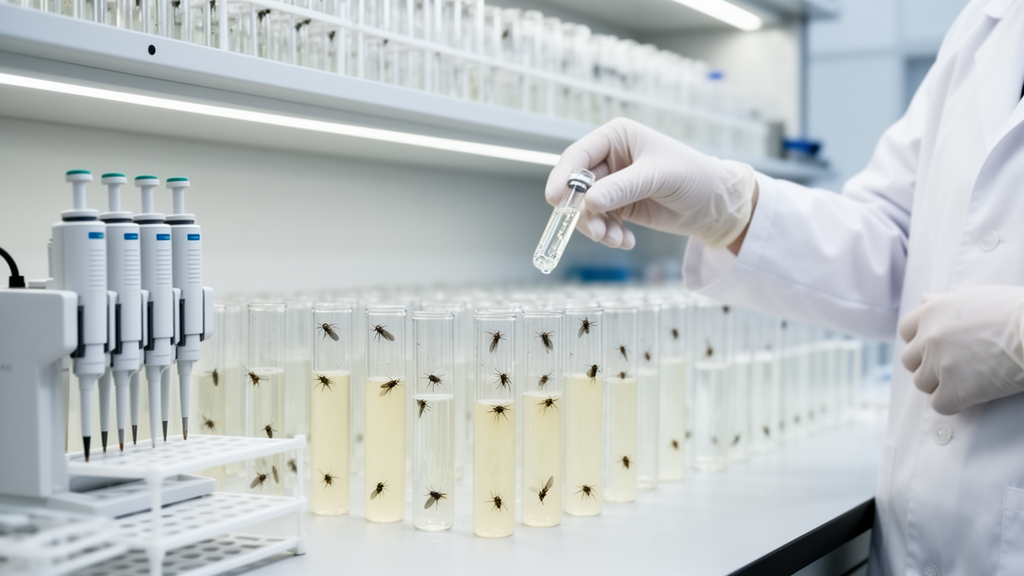
Studying how diet shapes genes and disease has long been slowed by a deceptively simple problem: making the food. Precisely defined synthetic diets for the fruit fly Drosophila melanogaster contain more than forty individual purified ingredients, and under conventional workflows each nutrient-varied diet must be assembled as a separate formulation, with components weighed, solubilised and batched by hand. For researchers wanting to test dozens of dietary variations across a disease model, that labour becomes a hard bottleneck. A team reporting in Genes & Nutrition has now built a way around it, describing a flexible stock-solution-based platform that lets a single researcher generate arrays of tens to hundreds of reproducible diets, and demonstrating its power with a fifty-one-diet screen in a fly model of a severe inherited metabolic disorder.
The core idea is to split diet preparation into two reusable parts. The researchers first prepared a synthetic base medium in bulk that contained every nutrient of the holidic diet except the amino acids. Each amino acid was then dissolved as an individual stock solution in water, adjusted to pH 4.5 with hydrochloric acid and filter sterilised. These stocks are standardised, stored at 4 degrees Celsius for up to two months, and reused across many diets. To build any given experimental diet, defined volumes of each amino acid stock are combined, manually or with a liquid-handling robot, and mixed into tubes containing 35 millilitres of molten base medium, with water replacing the volume of any nutrient that is omitted or reduced. Diets are dispensed at 6 millilitres per vial.
The authors note that robotics is not essential; manual pipetting works too. But they recommend testing wild-type flies on every diet batch to confirm reproducibility, and they built quality control into the workflow itself: stock solutions are inspected visually for precipitation and vortexed before use, while base media are routinely checked for microbial growth and kept under consistent preparation and storage conditions. Because amino acids were supplied in a mix of free and salt forms, including hydrochloride and sodium salts, the team also checked whether salt load could confound results. Even the largest manipulation tested, raising lysine to 150 percent of the standard formula, changed predicted total chloride concentration by less than 10 percent, reaching about 25 millimolar, well below the roughly 100 millimolar level predicted to alter fly behaviour and survival.
Validation came first in wild-type flies. The team reared Drosophila on media made by the flexible protocol and compared them directly with flies raised on diets prepared by the established standard method. Across five replicate vials per diet, with 100 larvae per diet in the developmental assays, they found no differences in survival or developmental timing to the pupal stage, no differences in adult body weight, and no difference in how long adult males survived starvation, an assay performed on 16 males per diet with hourly imaging over five days. Starvation resistance is a sensitive readout of nutritional provisioning, so its equivalence argues that the stock-solution route delivers nutritionally complete food, not merely food that looks right.
With the platform validated, the researchers designed a rational dietary array in which single amino acids were varied systematically. Diets completely lacking essential amino acids were excluded, since these nutrients are indispensable for protein synthesis and required to sustain life. Instead, essential amino acids were reduced to 50 or 75 percent of the complete formula, non-essential amino acids were reduced to 0 or 50 percent, and every amino acid was also tested in excess at 150 percent. The result was 51 distinct diets, described as a first-pass screen for Drosophila models of inherited metabolic disorders at a scale one researcher can manage.
The disease model chosen was isolated sulfite oxidase deficiency, a severe human metabolic disorder caused by defective sulfur amino acid catabolism. The fly model, carrying the shopC15 mutation, impairs the metabolism of methionine and cysteine and mirrors the human condition, in which neurotoxic intermediates such as sulfite, thiosulfate and S-sulfocysteine accumulate, driving rapid neurodegeneration and lethality. In the pathway, methionine is the precursor for cysteine biosynthesis, with serine supplying the carbon backbone through the trans-sulfuration route. Earlier targeted studies had shown that restricting methionine, serine or cysteine, individually or together, rescues shopC15 lethality to varying degrees, with cysteine depletion having the strongest effect.
The fifty-one-diet screen reproduced those known interactions, validating the approach. Affected hemizygous males, identified by the absence of a fluorescent balancer chromosome, were reared on all 51 diets with five replicates each and monitored daily for 25 days, with survival calculated as the proportion of total pupae that were shopC15 hemizygotes. Survival improved significantly on the cysteine-free diet and upon restriction of methionine and serine, and the sibling control flies, which carry the fluorescent balancer, were unaffected by these diets. At the other extreme, complete lethality occurred on the diet containing 150 percent cysteine, indicating that the mutants are hypersensitive to elevated cysteine levels.
The untargeted screen also surfaced new candidates. Moderate restriction of the essential amino acids threonine, valine, tryptophan and histidine each significantly increased pupal survival of shopC15 mutants toward the expected Mendelian proportion of 0.25. A shared feature of these amino acids is their capacity to engage amino acid stress-response pathways such as GCN2 and mTOR when limited in the diet, raising the possibility, which the authors frame as a hypothesis rather than a demonstrated mechanism, that such responses contribute to the protection. Survival also rose when glycine was removed, which could reduce serine availability through the glycine cleavage system and thereby mirror serine restriction, and when phenylalanine, lysine or glutamate were supplemented. For these, the authors suggest effects on amino acid transport and nutrient handling rather than direct pathway activity: glutamate might influence nitrogen balance or cystine uptake via the cystine-glutamate exchanger, while phenylalanine and lysine could act through competition in large neutral amino acid and cationic or dibasic transport systems respectively.
Developmental timing told a sharper story. shopC15 larvae pupariate markedly late, at around day 20 compared with day 12 in controls. Among all diets tested, only the cysteine-free diet shifted this delay significantly toward control values; reduced methionine showed only a non-significant trend, with a p value of 0.060. Control siblings’ developmental timing was largely unaffected, confirming that the observed effects are genotype-specific, the sole exception being the 0 and 50 percent tyrosine diets, which delayed pupariation in controls as previously described. When survival and developmental timing were summarised together, cysteine depletion stood out as the only manipulation that significantly improved both, supporting a strong and nutrient-specific normalising effect on the shopC15 phenotype.
The authors point toward translation with appropriate caution. Clinical dietary management of sulfite oxidase deficiency has typically restricted cysteine and methionine concurrently; their data suggest that cysteine restriction alone may provide benefit and warrants further investigation as a targeted dietary strategy, though they emphasise that mechanisms behind the other surviving diets remain unknown and that findings must be tested in other pre-clinical models. They are equally candid about the platform’s limits: the study validated the approach with amino acid manipulations in a single fly model and a small set of developmental and survival phenotypes, so broader disease generality, mechanistic interpretation and translational relevance will require additional genotypes, readouts and models. Still, by shifting the major constraint from diet formulation to phenotypic analysis, the platform opens dose-response studies, multidimensional nutrient analyses and untargeted screens for novel diet-genotype-phenotype interactions, and it could extend beyond amino acids to vitamins and trace minerals, offering a scalable first-pass framework for precision nutrition research in disorders with strong metabolic bases.
Subject of Research: A stock-solution-based synthetic diet platform for systematic nutrient-gene interaction screening in Drosophila
Article Title: A flexible synthetic diet platform for Drosophila nutrigenomics
Article References: Novosiadla, Z., Mele, S., Kerton, E., Christodoulou, J., Dworkin, S., Piper, M. D. W., & Johnson, T. K. (2026). A flexible synthetic diet platform for Drosophila nutrigenomics. Genes & Nutrition, 21(1), Article 18. https://doi.org/10.1186/s12263-026-00808-w
Image Credits: AI Generated
DOI: 10.1186/s12263-026-00808-w
Keywords: Drosophila, nutrigenomics, synthetic diet, holidic diet, amino acids, sulfite oxidase deficiency, inherited metabolic disorders, cysteine restriction, diet-gene interactions, precision nutrition, developmental timing, pupal survival
Cite Scienmag News
Daisy Hatcher. (October 30, 2026). Fly Food on Demand: Stock-Solution Diet Platform Speeds Nutrigenomics Screening. Scienmag. https://scienmag.com/fly-food-on-demand-stock-solution-diet-platform-speeds-nutrigenomics-screening/
Daisy Hatcher. "Fly Food on Demand: Stock-Solution Diet Platform Speeds Nutrigenomics Screening." Scienmag, 30 October 2026, https://scienmag.com/fly-food-on-demand-stock-solution-diet-platform-speeds-nutrigenomics-screening/. Accessed 4 November 2026.
Daisy Hatcher. "Fly Food on Demand: Stock-Solution Diet Platform Speeds Nutrigenomics Screening." Scienmag. October 30, 2026. https://scienmag.com/fly-food-on-demand-stock-solution-diet-platform-speeds-nutrigenomics-screening/




