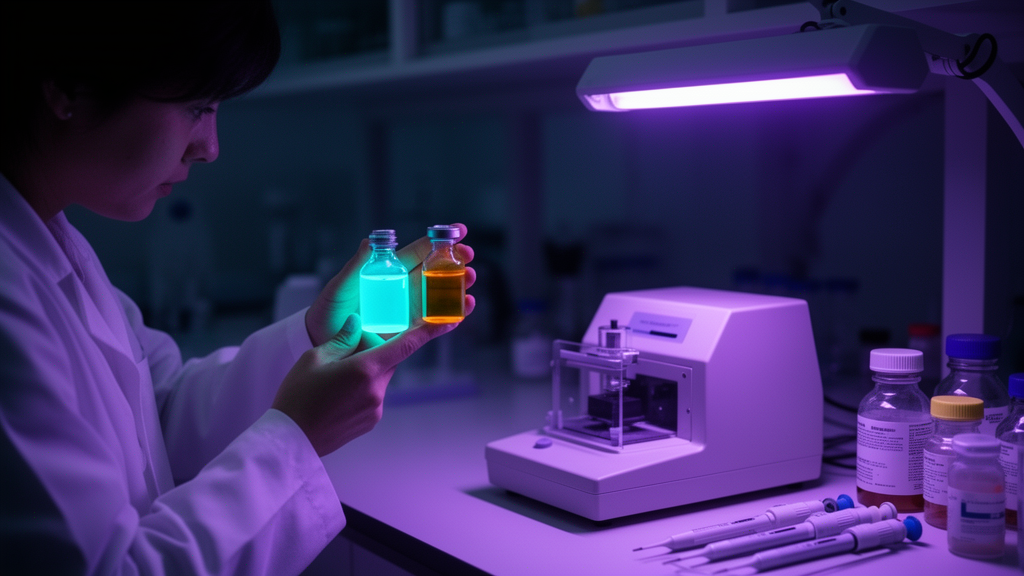
Chemists have developed a fluorescence-based technique that can measure the antidepressant duloxetine and its genotoxic impurity 1-naphthol at the same time, without chromatography or chemical derivatization, according to a study published in the Beni-Suef University Journal of Basic and Applied Sciences. The method relies on synchronous fluorescence scanning, which narrows the overlapping light signals of two molecules that are otherwise nearly impossible to tell apart.
The problem the researchers set out to solve is a genuine analytical headache. Duloxetine hydrochloride, a widely prescribed serotonin–norepinephrine reuptake inhibitor, and 1-naphthol, a process-related impurity that can arise during its manufacture, are both built around the same naphthalene ring system. That shared, rigid, highly conjugated framework gives both compounds strong native fluorescence, with excitation at 236 nm and emission maxima of 358 nm for duloxetine and 354 nm for 1-naphthol. In a conventional fluorescence spectrum the two signals overlap so severely that the compounds are effectively indistinguishable, which is a serious concern because 1-naphthol is classified as a Class 2 genotoxic impurity with demonstrated mutagenic potential in in vitro assays.
Regulatory pressure makes that overlap more than an academic nuisance. Under the ICH M7 guidelines, the threshold of toxicological concern for genotoxic impurities is 1.5 micrograms per day. For duloxetine’s maximum daily dose of 60 to 120 mg, the acceptable limit for 1-naphthol works out to between 12.5 and 25 ppm, so any quality-control method must detect the impurity at trace levels. The authors also note that 1-naphthol is environmentally persistent, adding to the need for sensitive monitoring across the drug lifecycle.
The team’s solution was to scan both the excitation and emission monochromators simultaneously with a fixed wavelength difference of 125 nm, a value chosen after testing a range from 50 to 200 nm. Synchronous scanning compresses the spectral bandwidth, sharpens the peaks, and suppresses Rayleigh and Raman scatter, amplifying the small differences in Stokes shift between the two molecules. Dual-wavelength measurements at 356 to 362 nm captured duloxetine, while 359 to 366 nm captured 1-naphthol, allowing selective detection of each analyte in a single run. Attempts to separate the signals with first- and second-order derivative spectra failed, producing insufficient peak separation and extra noise.
Chemical conditions proved just as important as the optical setup. Working in an 80% methanol and Britton–Robinson buffer system, the researchers screened five diluting solvents and found methanol gave the highest and most reproducible signal for both compounds at 400 ng/mL. Buffer volume was optimized at 2.0 mL per 10 mL final volume, where the fluorescence intensity plateaued. The pH sweep was the most striking: maximum emission for both analytes occurred sharply at pH 3.0, with a pronounced decline above pH 6.0. That drop reflects deprotonation of 1-naphthol’s phenolic hydroxyl group, which forms a non-fluorescent phenolate anion, while duloxetine’s signal also fades at high pH. The narrow optimum means strict pH control is essential for reliable quantification.
Validation followed the ICH Q2(R1) guideline and produced strong numbers. Calibration curves were linear from 20 to 500 ng/mL for both analytes, with coefficients of determination of 0.9997 for duloxetine and 0.9996 for 1-naphthol. Limits of detection came out at 6.19 ng/mL for duloxetine and 6.54 ng/mL for 1-naphthol. Mean recoveries were 100.26% for duloxetine and 99.89% for 1-naphthol, and precision was tight, with intra-day relative standard deviations of 1.244% and 1.175% and inter-day values of 1.329% and 0.991%. Robustness testing, which deliberately varied the wavelength difference, pH, and buffer volume, kept the %RSD below 2% in every case.
The method then faced real samples. In binary mixtures of the two compounds at varying ratios, no cross-interference was observed, and standard addition experiments in pharmaceutical formulations gave recoveries between 98.5% and 101.3%. Analysis of commercial Cymbalta capsules, labeled to contain 60 mg of duloxetine, yielded concentrations within 98.7% to 101.1% of the labeled amount. For the biological application, known amounts of both compounds were added to human plasma, which was treated by protein precipitation with acetonitrile, centrifugation, evaporation, and reconstitution. Recovery in the spiked plasma ranged from 97.8% to 102.1% with %RSD below 2.0%. The sub-7 ng/mL detection limits sit well below duloxetine’s typical therapeutic plasma concentration, which peaks between 47 and 110 ng/mL.
Sustainability was assessed with four independent metrics. The AGREE tool, which scores compliance with the 12 principles of green chemistry, gave 0.79, with strong marks for waste prevention and energy efficiency of less than 0.1 kWh per sample. The ComplexMoGAPI framework returned 72.5 out of 100, penalizing the use of methanol and acetonitrile, which are classified as non-green solvents under the GSK Solvent Sustainability Guide, along with manual, unsealed sample handling. The penalty-based Analytical Eco-Scale tallied 19 penalty points, including 8 for methanol and 3 for open handling of volatile solvents, for a final score of 81, above the threshold of 75 for excellent analysis. The Blue Applicability Grade Index, which judges real-world practicality, scored 72.5 out of 100, crediting the absence of chromatography and derivatization, instrumental analysis times under 3 minutes, and ultra-low cost.
Compared with conventional HPLC methods, which can generate hundreds of milliliters of mixed aqueous-organic waste per run and rely on energy-intensive high-pressure pumps, the authors estimate the new approach cuts organic solvent consumption by more than 80% and energy use by more than 95%, using only 8 mL of 80% methanol per sample.
The researchers are candid about the limits of the work. Forced degradation studies were not conducted, and the biological application used spiked human plasma rather than samples from actual patients, so further validation in routine pharmacokinetic studies is still required. The method’s selectivity also depends on the absence of other naphthalene-based fluorescent interferents, which the authors say holds for targeted applications such as Cymbalta quality control and pharmacokinetic plasma samples with known composition. Future work, they suggest, could explore greener, bio-based solvents to improve the environmental profile further. Even with those caveats, the study offers pharmaceutical laboratories a chromatography-free, derivatization-free platform that meets ICH requirements while trimming solvent waste, energy use, and cost.
Subject of Research: Development and validation of a synchronous fluorescence spectroscopy method for simultaneous quantification of duloxetine and its genotoxic impurity 1-naphthol in pharmaceutical and biological matrices
Article Title: Simultaneous quantification of duloxetine and 1-naphthol in pharmaceutical and biological matrices using a sensitive and eco-friendly synchronous fluorescence technique
Article References: Abdallah, F. F., Waseem, A. M., Yehia, A. M., & Farid, N. F. (2026). Simultaneous quantification of duloxetine and 1-naphthol in pharmaceutical and biological matrices using a sensitive and eco-friendly synchronous fluorescence technique. Beni-Suef University Journal of Basic and Applied Sciences, 15(1), Article 115. https://doi.org/10.1186/s43088-026-00826-y
Image Credits: AI Generated
DOI: 10.1186/s43088-026-00826-y
Keywords: duloxetine, 1-naphthol, genotoxic impurity, synchronous fluorescence spectroscopy, pharmaceutical analysis, green analytical chemistry, ICH Q2(R1) validation, quality control, spiked human plasma, greenness metrics, spectrofluorometry, Simultaneous
Cite Scienmag News
Connor Fletcher. (October 28, 2026). Fluorescence trick untangles antidepressant from its toxic impurity. Scienmag. https://scienmag.com/fluorescence-trick-untangles-antidepressant-from-its-toxic-impurity/
Connor Fletcher. "Fluorescence trick untangles antidepressant from its toxic impurity." Scienmag, 28 October 2026, https://scienmag.com/fluorescence-trick-untangles-antidepressant-from-its-toxic-impurity/. Accessed 28 October 2026.
Connor Fletcher. "Fluorescence trick untangles antidepressant from its toxic impurity." Scienmag. October 28, 2026. https://scienmag.com/fluorescence-trick-untangles-antidepressant-from-its-toxic-impurity/