


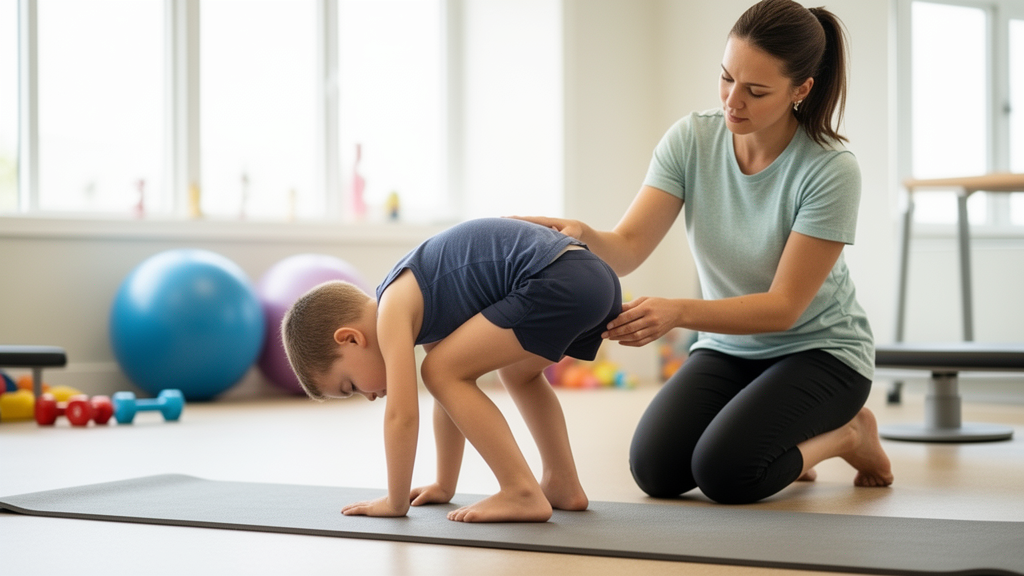
For decades, physical education teachers, coaches, and parents have operated on a simple assumption: a supple spine is a strong spine, and children who bend, twist, and flex with ease are better equipped to generate force through their trunks. A new school-based study from Valencia, Spain, puts that intuition to a rigorous test—and finds it largely wanting. In 226 healthy schoolchildren aged 9 to 16, researchers measured spinal mobility, movement speed, trunk strength, and perceived pain with laboratory-grade instruments, then searched for the connections between them. What they found was striking in its absence: global spinal mobility showed no consistent association with trunk strength, a result that challenges a cornerstone belief of warm-up routines and back-health programs alike.
The research, published in Frontiers in Sports and Active Living, was motivated by a growing public health concern. Low back pain is not merely an adult affliction. Previous studies cited by the research team estimate that between 38 and nearly 44 percent of children and adolescents experience back pain before the age of 15, with girls showing greater severity due to thoracic abnormalities. Over a lifetime, roughly 80 percent of people will contend with chronic lower back pain. Because puberty represents the most favorable window for establishing physical activity habits that persist into adulthood—and simultaneously marks a steep decline in activity levels—researchers have long sought reliable, school-friendly ways to identify children whose spines might be vulnerable before problems become chronic.
The prevailing hypothesis rested on two theoretical mechanisms. The first is mechanical: an adequate range of motion should allow the trunk extensor muscles to operate closer to their optimal length-tension region, permitting the postural adjustments needed to transmit force efficiently along the kinetic chain. The second is neuromuscular: available joint range might interact with proprioceptive feedback, co-contraction strategies, and motor control, which are the main determinants of maximal voluntary force during growth. If either mechanism operated strongly, children with greater spinal mobility should, on average, produce more trunk force. The Valencia team, led by Julio Martín-Ruiz and colleagues at the Catholic University San Vicente Mártir, designed their study to quantify exactly how much of the variation in trunk strength could be explained by mobility—and whether the answer differed between primary and secondary school students, or between boys and girls.
The measurement protocol was unusually comprehensive for a school setting. In a single Physical Education session, each child completed anthropometric assessments—arm span, biacromial distance, weight, height, and leg length—followed by a standardized warm-up of cat-camel, bird-dog, and plank exercises. Spinal mobility was then captured with a wearable inertial sensor, the Baiobit device, fixed to the thoracic spine above the scapula apex. The unit integrates a triaxial accelerometer, gyroscope, and magnetometer, sampling at 200 hertz and transmitting data via Bluetooth to software that computes angular displacement and peak angular velocity for each movement plane. Each participant performed trunk flexion and extension, right and left rotation, and right and left lateral inclination, with the best of two trials retained and any trial marred by sensor detachment or compensatory pelvic movement discarded and repeated.
Strength was assessed with two complementary tests chosen for their reproducibility in inexperienced samples. The Biering-Sørensen test, a paravertebral isometric endurance test along a horizontal force vector, required children to hold their spine parallel to the floor in a prone position for as long as possible, with termination criteria standardized by a single investigator to minimize variability. The isometric deadlift, performed with a dynamometer and steel plate, measured maximal force production along a vertical vector, with participants pulling at knees bent to 110 degrees after two verbal cues to pull progressively and then maximally. The deadlift showed excellent relative reliability in this sample, with an intraclass correlation coefficient of 0.948. After each test, children rated perceived pain on the Wong-Baker Pediatric Faces scale from 0 to 10.
The results painted a picture of two largely independent physical qualities. Secondary school students were substantially stronger than their primary school counterparts, with a strength index difference that was highly significant, but mobility itself did not differ between educational stages. Mobility was greater in girls than boys across the sample, and movement speed showed a notable interaction: primary school girls moved their trunks faster than primary school boys, but this sex difference vanished in secondary school. When the researchers computed correlations between the global mobility index and the composite strength index, three of the four stage-by-sex subgroups showed weak, non-significant relationships. The single exception was secondary school boys, who displayed a small negative association—more mobility, slightly less strength—driven mainly by Biering-Sørensen endurance time rather than maximal deadlift force.
That lone significant association deserves careful scrutiny, and the authors themselves treat it as tentative. The correlation with the composite strength index was r = −0.25, with a 95 percent confidence interval stretching from −0.45 to −0.03, meaning the upper bound is compatible with a negligible effect. After adjusting for anthropometric characteristics—age, weight, height, body mass index, arm span, and leg length—the composite association was no longer statistically significant. Only the link with Biering-Sørensen time persisted after adjustment. The researchers note that secondary school boys are the subgroup with the greatest anthropometric heterogeneity, spanning the pubertal growth spurt, so greater body size increases the external torque that must be sustained in the endurance position while simultaneously inflating absolute ranges of motion. Part of the apparent association, in other words, may reflect body size rather than mobility itself. Alternatively, a greater available range without proportional stabilization capacity could reduce the efficiency of isometric holding—but with the finding appearing in only one of four subgroups, the team explicitly frames it as a hypothesis for future study, not an established result.
Why, mechanistically, might mobility and strength fail to travel together in growing bodies? The authors offer several interpretations grounded in the exercise science literature, while cautioning that none were directly tested. Flexibility and strength are relatively independent physical qualities during growth: range of motion depends largely on the mechanical properties of connective tissue and stretch tolerance, whereas maximal voluntary force depends on muscle cross-sectional area and, above all, on neural factors such as motor unit recruitment, firing frequency, and intermuscular coordination—the primary drivers of strength gains in children and adolescents. Moreover, the association between mobility and force production is likely regional and task-specific rather than global: the paravertebral muscles work within a narrow range around the neutral position during both strength tests, so total available range adds little information about the capacity to stabilize the trunk. Only a deficit severe enough to prevent adopting the test position would be expected to limit force. In a healthy school-aged sample, the restricted range of both variables—no extreme hypomobility, no severe weakness—further attenuates any linear association that might emerge more clearly in clinical populations.
The study’s treatment of pain adds a preventive dimension that resonates with physical education practice. The relationship between mobility and pain was weak and, in most subgroups, non-significant, with one borderline exception: primary school girls showed a small negative correlation, suggesting that higher mobility tended to accompany lower average pain during spinal movements. Overall perceived discomfort was low throughout the sample. The researchers emphasize that monitoring pain remains essential given its persistent presence in adulthood, and that the multicomponent protocol—anthropometry, sensor-based mobility, two strength tests, and pain ratings in one session—offers physical education teachers a feasible, reproducible resource for building early detection programs and postural education units, from preventive analytical exercises in warm-ups to replacing questionable spinal stability items in standard test batteries.
The authors are careful about what their findings do and do not mean. The cross-sectional design captures covariation at a single point in time and cannot establish temporal or causal relationships; the absence of a significant association should not be read as proof that mobility never influences strength development. The composite indices, by design, summarize heterogeneous dimensions rather than a single latent construct—the Biering-Sørensen test and the deadlift were practically uncorrelated in this sample—so component-level analysis was essential, and the stratified analyses, with roughly 47 to 79 children per subgroup, had limited statistical power to detect small effects. Biological maturation status and habitual physical activity were not assessed, both of which could modulate the relationship. What the study does establish is that, in healthy schoolchildren assessed cross-sectionally, global spinal mobility and trunk strength behave as relatively independent dimensions that should be measured separately in school-based fitness protocols. The neural, coordinative, and technical factors that likely determine trunk strength in this population remain unmeasured—and identifying them is the next frontier for keeping young spines healthy before pain takes root.
Subject of Research: Spinal mobility shows no consistent association with trunk strength in children aged 9-16, a cross-sectional study of 226 Spanish schoolchildren finds
Article Title: Global spinal mobility shows no consistent association with trunk strength in children: a school-based cross-sectional study
Article References: Martín-Ruiz, J., Ros-Ros, C., Gallego-Cerveró, C., & Ruiz-Sanchis, L. (2026). Global spinal mobility shows no consistent association with trunk strength in children: a school-based cross-sectional study. Frontiers in Sports and Active Living, 8, Article 1936520. https://doi.org/10.3389/fspor.2026.1936520
Image Credits: AI Generated
DOI: 10.3389/fspor.2026.1936520
Keywords: spinal mobility, trunk strength, children, adolescents, low back pain, physical education, Biering-Sorensen test, inertial sensor, biomechanics, pediatric health, cross-sectional study, puberty
Cite Scienmag News
Courtney Benton. (October 26, 2026). Flexible Spines, Weak Links? Study Finds Mobility and Strength Move Separately in Children. Scienmag. https://scienmag.com/flexible-spines-weak-links-study-finds-mobility-and-strength-move-separately-in-children/
Courtney Benton. "Flexible Spines, Weak Links? Study Finds Mobility and Strength Move Separately in Children." Scienmag, 26 October 2026, https://scienmag.com/flexible-spines-weak-links-study-finds-mobility-and-strength-move-separately-in-children/. Accessed 26 October 2026.
Courtney Benton. "Flexible Spines, Weak Links? Study Finds Mobility and Strength Move Separately in Children." Scienmag. October 26, 2026. https://scienmag.com/flexible-spines-weak-links-study-finds-mobility-and-strength-move-separately-in-children/


