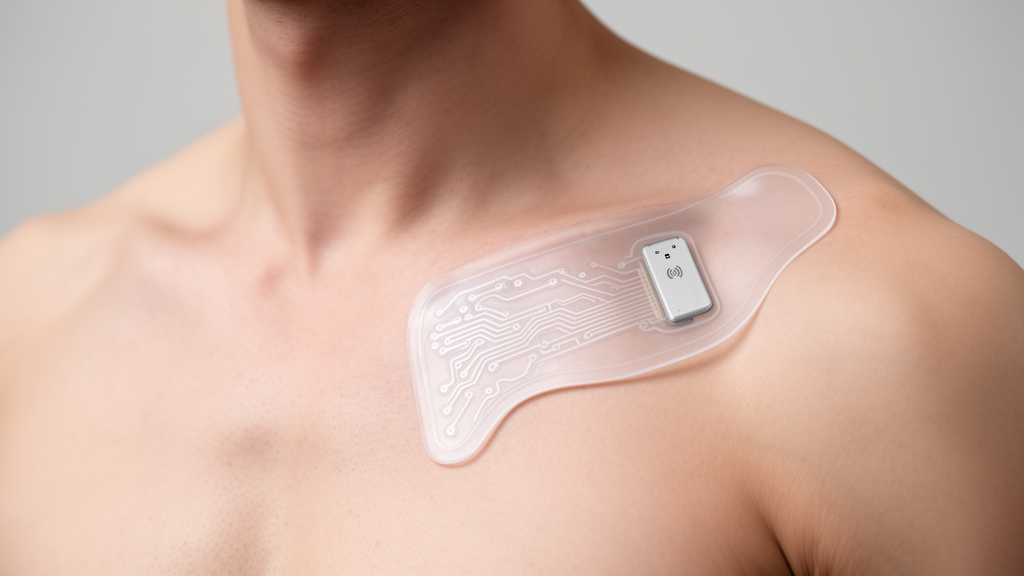
A team of researchers has now built and tested a wearable sensor patch that measures breathing non-invasively while deliberately engineering out one of the field’s most stubborn problems: motion artifacts. The work, published in the journal Biosensors and Biomolecular Electronics, describes a flexible array of printed carbon resistors that suppresses interference from body movement at the hardware level rather than relying on software filtering after the fact.
Conventional clinical respiratory monitoring tools such as electrical impedance tomography and respiratory inductance plethysmography depend on costly, specialized equipment that is often unavailable in resource-limited settings, and their signals are themselves vulnerable to motion artifacts. The low-cost Graseby capsule system, though cheaper, is equally prone to sensor misplacement and disturbance from body movement. Existing flexible wearable sensors face their own hurdles: some require cleanroom fabrication that raises cost and complexity, while screen-printed alternatives struggle with resolution limits that keep sensor sizes large. Most importantly, nearly all current approaches handle motion artifacts through signal post-processing or sensor fusion, which the new study set out to avoid.
The sensor patch was manufactured by combining standard flexible printed circuit board technology with printed carbon-paste resistors. A 25-micrometer polyimide substrate carries 18-micrometer copper tracks protected by cover layers, with windows left open for the sensing resistors, which were printed using a commercial carbon conductor paste. The key design move is a double-sided, quasi-half-bridge configuration: two carbon resistors sit at corresponding positions on opposite sides of the substrate, connected through copper tracks and vias. When the patch bends, one resistor experiences tensile strain while the other is compressed, so their resistance changes in opposite directions, amplifying the voltage response of the divider to bending. This double-sided arrangement also helps reduce the influence of temperature variations and saves circuit layout area.
Because the polyimide substrate itself is not stretchable, the researchers designed several layout geometries to introduce stretchability through mechanical structure alone. Five designs, each 126 millimeters long, were tested: Island, Serpentine, Kirigami spring, Segment, and a non-decoupled Straight reference. The goal was to decouple sensing from global body stretch so that the resistors respond only to the local abdominal bending caused by breathing. Fourteen sensing points were arranged along the patch’s length to provide continuous coverage, meaning that even a poorly positioned patch can still capture bending deformations somewhere along the abdomen, and the array keeps working even if some sensing points or part of the circuit are damaged. Sixteen contact pads connect to a custom readout board through a 3D-printed press-contact housing, making patch replacement simple.
The finished patch is a three-layer laminate. A medical silicone roll adhesive tape forms the top layer, a cotton-based kinesiology tape the bottom, and the sensor matrix sits encapsulated between them. The chosen materials give the patch good stretchability and adhesion, pointing toward skin-mounted use. Signal acquisition runs on a compact custom readout device built around a PSoC 6 microcontroller, which scans the 14 voltage dividers through a multiplexer, applies selectable amplification, compensates for resistor mismatch with a digitally controlled offset voltage, and streams the data over USB to a Python program that filters, scores, and selects the best channel. An initialization routine records ten-second phases of normal standing, maximum left torso rotation, and maximum right torso rotation, then automatically picks the channel with large amplitude, cross-posture stability, and a clear dominant spectral peak.
Benchtop characterization showed strong performance. Single-resistor gauge factors, extracted from the slope of relative resistance change against estimated bending strain, ranged from 5.60 to 7.43 across the five geometries, well above the roughly 2 typical of conventional metallic strain gauges. For the Island design, the ideal voltage-divider curvature sensitivity calculated from the gauge factor was 230.7 millivolts per inverse millimeter, closely matching the experimentally measured system sensitivity of 251.6 millivolts per inverse millimeter. In dynamic testing on a motor-driven bending platform, all five structures survived 10,000 bending cycles, roughly two hours and ten minutes of continuous operation, with no electrical failure observed in any of them.
Stretch testing revealed why the mechanical decoupling matters. To define a realistic upper limit, the researchers attached a sensor to a volunteer’s abdomen along the skin stretching direction and measured the elongation produced by maximum upper-body twisting: 3.5 millimeters, corresponding to about 6% engineering strain over the stretchable sensing segment. Under 6% tensile strain, some sensing points in the Segment, Kirigami spring, and Serpentine designs approached or reached the boundaries of the measurement range, leaving insufficient dynamic range for breathing signals. The Island design fared best, showing the smallest relative voltage change with a median of 0.182, compared with 0.975 for Segment, 0.431 for Kirigami spring, and 0.576 for Serpentine. Because each sensing point operates independently, monitoring can continue as long as some channels retain low stretch sensitivity.
The decisive proof-of-concept came from on-body measurements on a healthy 28-year-old volunteer, chosen over benchtop or simulator testing because simulators cannot reproduce human breathing, heartbeat, or muscle tremor. The patch was attached to the abdomen and monitored natural respiration under five postures: standing still, maximum left and right upper-body twisting, a full-body stretch leaning backward, and a forward bend with the abdomen held in a bent state. Respiratory waveforms remained clearly visible and stable in all five conditions. Left and right turning produced only slight baseline drifts of +0.094 and −0.043, with respiratory amplitudes of 0.184 and 0.193, meaning the breathing signal was roughly twice the offset during left turning and more than four times during right turning. Stretch and bending caused larger offsets of +0.140 and +0.517 with reduced amplitudes of 0.038 and 0.083, but the oscillations stayed identifiable throughout.
Additional in-vivo comparisons using the non-decoupled Straight design and a Graseby capsule as references demonstrated improved tolerance to placement inaccuracies and a clear advantage for the Island design in insensitivity to body movements. The authors argue the patch-based approach also outperforms textile-integrated sensors in practical flexibility, since it can simply be attached and repositioned rather than being fixed to a garment whose fit varies from person to person. Compared with prior wearable studies that relied on filters, custom algorithms, or inertial measurement unit fusion to handle motion during walking, running, or rotation, this work addresses the problem at the sensor level, before any channel selection or signal processing is applied.
The researchers see particular potential in neonatal monitoring, where patients cannot voluntarily hold still. Previous studies indicate the abdomen contributes more to tidal volume than the rib cage during quiet breathing in neonates and young infants, and the patch’s multi-channel array spanning the thoracoabdominal region can select the channel with the largest response. However, the authors are careful to note the limits: adult anatomy differs from newborns, preterm infants’ weaker diaphragmatic strength may demand higher sensitivity, and the much faster neonatal respiratory rate of 42 to 46 breaths per minute, against roughly 14 in adults, will test the patch’s dynamic response. Long-term skin compatibility also needs clinical validation, since prolonged coverage may restrict moisture evaporation and heat dissipation, and newborn skin is especially susceptible to damage from medical adhesives. Future work includes multi-volunteer studies, battery and wireless modules, real-time channel switching, and AI-based adaptation, with the patch concept also proposed for rehabilitation monitoring, posture tracking, and other motion-resistant surface-mounted sensing applications.
Subject of Research: A wearable flexible sensor array patch for non-invasive respiratory monitoring that suppresses motion artifacts through mechanical decoupling
Article Title: A low-cost, flexible sensor patch for non-invasive respiratory monitoring capable of suppressing motion artifacts
Article References: Jin, Z., Koch, E., Xu, H., Busse, J., & Dietzel, A. (2026). A low-cost, flexible sensor patch for non-invasive respiratory monitoring capable of suppressing motion artifacts. Biosensors and Biomolecular Electronics, 1(1), Article 10. https://doi.org/10.1186/s44510-026-00012-5
Image Credits: AI Generated
DOI: 10.1186/s44510-026-00012-5
Keywords: wearable sensors, respiratory monitoring, motion artifacts, flexible electronics, printed carbon resistors, flexible printed circuit board, polyimide substrate, gauge factor, neonatal monitoring, kinesiology tape, strain decoupling, vital signs
Cite Scienmag News
Denise Maddox. (October 27, 2026). Flexible Sensor Patch Tracks Breathing While Suppressing Motion Artifacts. Scienmag. https://scienmag.com/flexible-sensor-patch-tracks-breathing-while-suppressing-motion-artifacts/
Denise Maddox. "Flexible Sensor Patch Tracks Breathing While Suppressing Motion Artifacts." Scienmag, 27 October 2026, https://scienmag.com/flexible-sensor-patch-tracks-breathing-while-suppressing-motion-artifacts/. Accessed 28 October 2026.
Denise Maddox. "Flexible Sensor Patch Tracks Breathing While Suppressing Motion Artifacts." Scienmag. October 27, 2026. https://scienmag.com/flexible-sensor-patch-tracks-breathing-while-suppressing-motion-artifacts/