


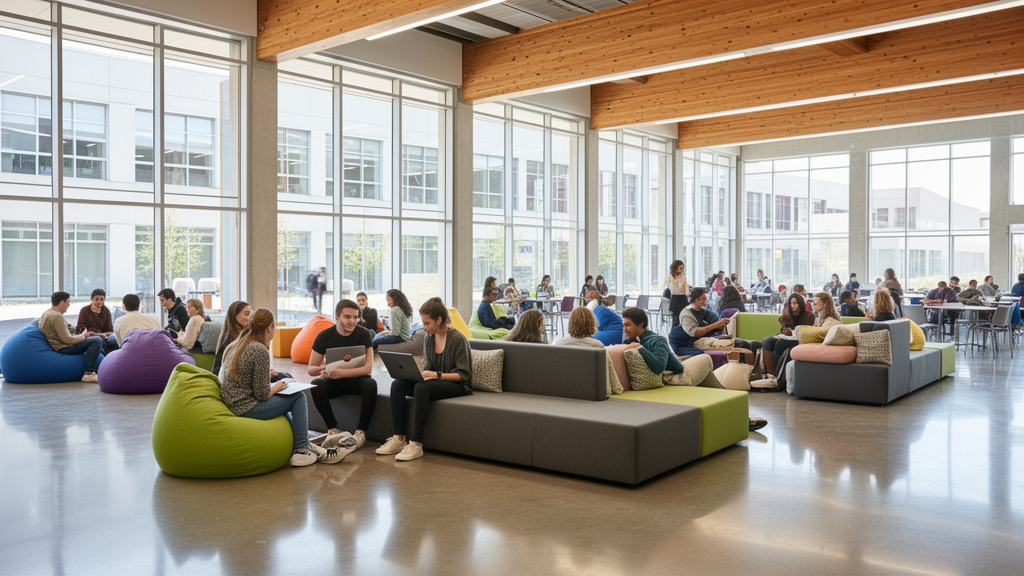
A mixed-methods study conducted at four universities in Zhejiang Province, China, found that students’ informal learning experiences in highly flexible public spaces are at a moderately high level. The research, published in Frontiers in Psychology, utilized an explanatory sequential design to examine how physical campus environments influence student learning outside of formal classrooms. The study focused on three specific sites with flexibility scores ranging from 80% to 90%, identifying significant positive correlations between learning satisfaction, self-efficacy, and learning engagement. These findings provide empirical evidence for the functional optimization of campus public spaces in higher education institutions.
The study was motivated by a broader paradigm shift in higher education from teaching-centered to learning-centered models. In this context, flexible public spaces, or FPS, have emerged as critical venues for informal learning. Informal learning is defined as learning that occurs outside the institutionalized curriculum structure, characterized by active learner participation and a lack of formal evaluation mechanisms. The research team aimed to address gaps in existing literature, which has largely focused on formal instructional contexts or objective spatial attributes, while lacking operational quantitative assessment tools for Chinese university public spaces.
To investigate these dynamics, the researchers employed a cross-sectional approach with a sample of 296 valid questionnaires and seven semi-structured interviews. The study was conducted between September and October 2025 at four universities of different types in Zhejiang Province. The sites included a student service center at a science and engineering university, a canteen at a normal university, and a library lobby at a comprehensive university. These sites were selected based on a pre-defined flexibility score threshold of 80%, ensuring that the study focused on highly flexible environments capable of supporting diverse informal learning activities.
The research team developed a five-dimensional characteristic framework to evaluate the flexible public spaces. This framework encompassed spatial variability, functional versatility, technological integration, environmental support, and social support. A 20-item binary observational checklist was used to score these dimensions, with each indicator coded as present or absent. The inter-rater reliability of this checklist was tested, yielding an average Cohen’s kappa of 0.78 and an intraclass correlation coefficient of 0.82 for the total score, indicating good agreement between observers. This instrument serves as an exploratory tool for assessing the flexibility of campus public spaces in mainland China.
For the quantitative phase, the researchers adapted three internationally validated scales to measure student experiences: learning satisfaction, self-efficacy, and learning engagement. These scales were modified to reflect the context of flexible public spaces rather than online learning platforms. The internal consistency reliability of the adapted questionnaire was high, with Cronbach’s alpha coefficients of 0.95 for learning satisfaction, 0.95 for learning engagement, and 0.93 for self-efficacy. The sample consisted of 296 full-time undergraduate and graduate students who had used the target sites at least twice within the past month. The demographic profile included a majority of female students and those in their early twenties, representing various academic disciplines.
The descriptive results indicated that students’ overall informal learning experiences were at a moderately high level, with mean scores above 3.88 on a 5-point scale across all three core dimensions. Learning satisfaction was generally high, with the highest scores associated with environmental comfort and facility accessibility. However, items related to the ability to focus without distraction and the availability of group discussion zones scored comparatively lower. This suggests that while the spaces are comfortable and accessible, there remains room for improvement in acoustic environment management and functional zoning to better support focused study and collaborative work.
Self-efficacy, which refers to students’ confidence in their ability to perform learning tasks, was also at a moderately high level. Items related to routine learning tasks received higher scores, indicating that the spaces provide good support for basic academic activities. In contrast, items related to higher-order cognition, such as trying challenging tasks or discussing difficult questions, scored lower. This pattern aligns with the inherent limitations of flexible public spaces, which may not offer the same level of acoustic isolation and spatial partitioning as dedicated study rooms, thus potentially limiting support for deep cognitive processing.
Learning engagement exhibited a clear stratification, with behavioral engagement scoring highest, followed by affective engagement, and cognitive engagement scoring the lowest. Behavioral engagement, which involves the actual investment of time and effort in learning, was strongly supported by the flexible spaces. Affective engagement, reflecting interest and belonging, was also high. However, cognitive engagement, which involves deep cognitive processing and the application of learning strategies, was comparatively lower. This finding suggests that while flexible public spaces are effective for routine study and social interaction, they may not be as conducive to deep, complex deliberation.
Spearman’s rank correlation analysis revealed strong positive correlations among the three dimensions of learning experience. The correlation coefficient between learning satisfaction and learning engagement was 0.742, between learning satisfaction and self-efficacy was 0.758, and between self-efficacy and learning engagement was 0.736. All correlations were statistically significant at p < 0.001. These results indicate that the three dimensions form a mutually reinforcing experiential pattern, where satisfaction with the environment boosts confidence, which in turn promotes greater investment in learning. The study emphasizes that these are statistical associations rather than causal inferences, as the design was cross-sectional.
Qualitative analysis of the seven semi-structured interviews identified three subjective perceptual pathways: atmospheric catalysis, autonomy enhancement, and social triggering. Atmospheric catalysis refers to the influence of the spatial atmosphere on learning satisfaction, where the presence of others studying can enhance focus. Autonomy enhancement relates to self-efficacy, as the ability to choose one’s study location and arrangement fosters a sense of control over the learning process. Social triggering connects to learning engagement, where open layouts facilitate peer encounters and spontaneous discussions. Additionally, the interviews revealed an inherent tension between spatial openness and learning focus, with students noting that while the spaces are conducive to casual study, they may be too lively for deep concentration.
The study also identified specific optimization demands from student feedback, including the need for zoned spatial layouts, improved acoustic environments, additional power outlets, and increased discussion booths. These findings provide a bottom-up evidence base for the functional optimization of campus public spaces. The researchers suggest that future design should incorporate adjustability and selectivity, allowing users to switch between social and quiet modes according to their current tasks. This approach aligns with the theoretical perspectives of environmental psychology, self-determination theory, and social constructivist learning theory.
Limitations of the study include its cross-sectional design, which precludes causal inferences, and the use of exploratory instruments that have not undergone full construct validation. The sample was limited to four universities in Zhejiang Province using convenience sampling, which may limit the external generalizability of the findings. Future research could adopt longitudinal tracking designs and include medium- and low-flexibility control groups to more rigorously examine the associations between spatial characteristics and learning experiences. Additionally, large-sample studies are needed to further validate the psychometric properties of the evaluation checklist and questionnaire.
In conclusion, the study demonstrates that highly flexible public spaces in higher education institutions support students’ informal learning experiences at a moderately high level. The strong positive correlations among learning satisfaction, self-efficacy, and learning engagement highlight the holistic nature of these experiences. The identified perceptual pathways and tensions provide valuable insights for the design and management of campus public spaces. By addressing the specific needs of students, universities can optimize these spaces to better support diverse informal learning activities, thereby enhancing the overall learning ecosystem in higher education.
Subject of Research: Characteristics and perceived pathways of students' informal learning experiences in highly flexible public spaces of higher education: a mixed-method study based on four universities in Zhejiang Province
Article Title: Characteristics and perceived pathways of students' informal learning experiences in highly flexible public spaces of higher education: a mixed-method study based on four universities in Zhejiang Province
Article References: Yang, J., Yang, X., & Kuo, Y.-P. (2026). Characteristics and perceived pathways of students' informal learning experiences in highly flexible public spaces of higher education: a mixed-method study based on four universities in Zhejiang Province. Frontiers in Psychology, 17, Article 1882283. https://doi.org/10.3389/fpsyg.2026.1882283
Image Credits: AI Generated
DOI: 10.3389/fpsyg.2026.1882283
Keywords: Characteristics, perceived, pathways, students', informal, learning, experiences, highly, flexible, public, spaces, higher
Cite Scienmag News
Glenn Wilkins. (November 10, 2026). Flexible Campus Spaces Support Student Informal Learning. Scienmag. https://scienmag.com/flexible-campus-spaces-support-student-informal-learning/
Glenn Wilkins. "Flexible Campus Spaces Support Student Informal Learning." Scienmag, 10 November 2026, https://scienmag.com/flexible-campus-spaces-support-student-informal-learning/. Accessed 11 November 2026.
Glenn Wilkins. "Flexible Campus Spaces Support Student Informal Learning." Scienmag. November 10, 2026. https://scienmag.com/flexible-campus-spaces-support-student-informal-learning/




