


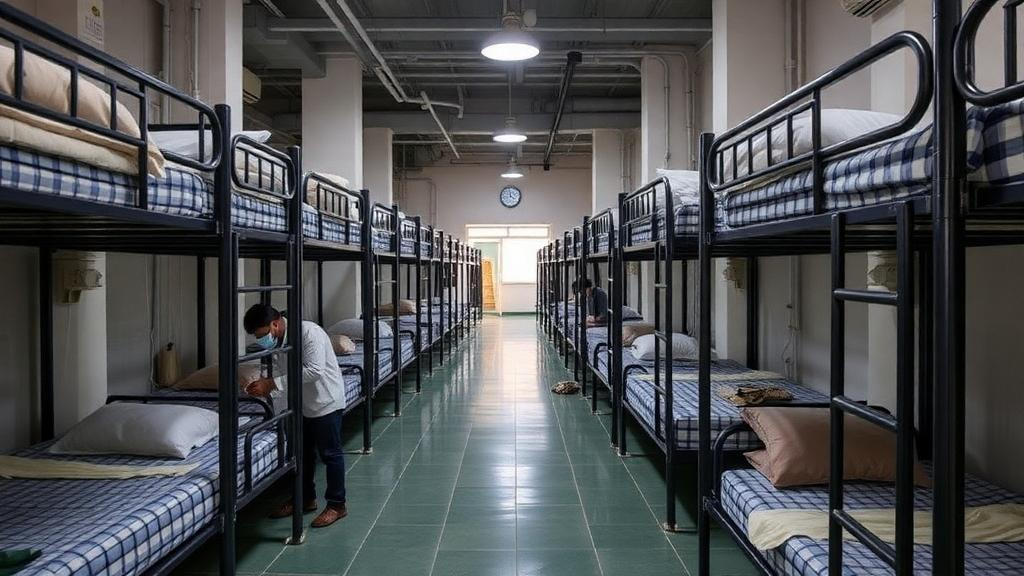
In the industrial corridors of central Thailand, where factory dormitories house thousands of workers who have migrated from rural provinces to fill persistent labor shortages, a new study has delivered a finding that runs counter to intuition: employees working five days a week reported significantly higher stress than those working six or more days. The research, published in BMC Public Health by a team led by Sangtawun Thongbai of Mahidol University’s Nakhonsawan Campus, examined the mental health of 212 industrial workers living in dormitories in Khan Ham Subdistrict, Uthai District, in Phra Nakhon Si Ayutthaya Province, one of Thailand’s most important manufacturing hubs. The study compared shift workers and non-shift workers, measuring stress with the Thai Stress Test (SPST-20) and depressive symptoms with the Patient Health Questionnaire (PHQ-9), two instruments widely used in occupational health research for their validated psychometric properties.
The headline result is striking precisely because it seems paradoxical. In the unadjusted bivariate analysis, the number of working days per week was the only variable showing a statistically significant association with stress levels, with a p-value of 0.032. Workers on five-day schedules reported markedly higher stress than colleagues working six or more days per week. At first glance, this appears to invert the common assumption that fewer working days should translate into better wellbeing. Yet the authors are careful to flag a critical complication: shift workers were disproportionately represented in the five-day group. This uneven distribution raises the possibility of confounding, meaning the elevated stress among five-day workers may partly reflect the physiological and psychological strain of rotating shift patterns rather than the shorter week itself. The researchers explicitly caution that multivariable adjustment for shift pattern is needed before firm conclusions or policy recommendations can be drawn.
The overall mental health picture that emerged from the survey is itself noteworthy. The most prevalent stress category among participants was high stress, affecting 48.1 percent of the sample, meaning nearly half of these dormitory-dwelling industrial workers were classified as highly stressed. By contrast, most participants, 61.3 percent, showed no depressive symptoms on the PHQ-9, suggesting a population under considerable strain but not, for the most part, crossing into clinical depression. This dissociation between stress and depression is a well-recognized phenomenon in occupational psychology: chronic workplace stress can remain subclinical, eroding sleep quality, concentration, and physical health, without necessarily manifesting as a diagnosable depressive disorder. The findings therefore paint a portrait of a workforce living close to a psychological threshold, resilient in one domain yet heavily burdened in another.
When the researchers compared shift and non-shift workers directly, the results defied another expectation. Non-shift workers actually demonstrated slightly higher mean stress scores than shift workers, 48.65 versus 45.10, and slightly higher mean depression scores, 6.75 versus 6.62. Neither difference reached statistical significance, with p-values of 0.070 for stress and 0.740 for depression. The absence of a significant shift-work effect is notable given the extensive international literature linking shift work to circadian disruption, metabolic dysfunction, and elevated risks of cardiovascular disease and mood disorders. The authors suggest several possible explanations rooted in the specific context of Thai industrial dormitories. Shift workers may develop adaptive coping strategies over time, or the social environment of shared dormitory housing, where colleagues on similar schedules live side by side, may buffer some of the isolating effects of irregular hours. Alternatively, the sample size of 212 may have limited statistical power to detect modest differences between the two groups.
Perhaps the most sobering finding is what did not predict mental health outcomes. No significant associations were found between stress or depression and gender, income, work type, employment duration, or underlying health conditions. In many occupational health studies, these demographic and socioeconomic variables emerge as meaningful predictors, with lower income, longer tenure in demanding roles, and chronic health conditions typically correlating with poorer psychological wellbeing. Their failure to register here underscores the possibility that in this particular population, the structural features of work itself, especially schedule intensity, may overwhelm individual-level factors. It also highlights the distinctive vulnerability of dormitory residents: workers who live where they work, often far from family networks, may experience a compressed social world in which workplace pressures follow them home in an unusually direct way, muting the protective effects that income or seniority might otherwise confer.
The study’s methodology reflects a pragmatic cross-sectional design appropriate for occupational surveillance. Data were collected through a structured questionnaire incorporating the SPST-20, a 20-item instrument developed in Thailand to quantify stress across cognitive, emotional, and physical dimensions, and the PHQ-9, a nine-item depression screen aligned with diagnostic criteria for major depressive disorder. Analysis proceeded through descriptive statistics to characterize the sample, Chi-square tests to examine associations between categorical variables, and Mann-Whitney U tests to compare score distributions between shift and non-shift workers, a non-parametric approach chosen because it does not assume normally distributed data. The research was approved by the Mahidol University Central Institutional Review Board and conducted in accordance with the Declaration of Helsinki, with written informed consent obtained from all participants before enrollment.
The broader context of the study is Thailand’s intensifying industrial labor shortage. As manufacturing sectors compete for workers and existing employees absorb heavier workloads, the mental health consequences for those on the factory floor have become an increasingly urgent public health concern. Dormitory living compounds the challenge. Workers housed in employer-provided or commercial dormitories often lack the extended family support systems that characterize Thai social life, and their proximity to the workplace can blur the boundary between labor and rest. The authors frame their investigation against this backdrop, arguing that understanding which factors drive stress and depression in this population is essential for designing interventions before workforce strain translates into higher turnover, absenteeism, and long-term illness burdens on Thailand’s healthcare system.
The five-day paradox deserves particular scrutiny because it may illuminate how schedule structure, not just schedule length, shapes psychological outcomes. One plausible interpretation is that five-day workers in this sample face compressed or intensified shifts, with the same production demands packed into fewer days, generating acute daily strain that accumulates faster than recovery can occur. Another is that the five-day group’s overrepresentation of shift workers means the observed stress reflects circadian disruption and irregular sleep rather than the five-day pattern itself. A third possibility involves the nature of the comparison: workers on six or more day schedules may represent a selected subgroup, perhaps healthier, more established, or financially motivated to sustain longer weeks, whose characteristics protect them against stress independently of hours worked. Disentangling these mechanisms requires the multivariable analysis the authors call for, ideally with longitudinal follow-up that tracks the same workers across schedule changes.
For occupational health policy, the study offers both a warning and a research agenda. The warning is that nearly half of the surveyed dormitory workers were highly stressed, a prevalence that warrants attention regardless of which variables explain it. The research agenda is the need to move beyond bivariate comparisons toward models that simultaneously adjust for shift pattern, working days, income, tenure, and health status, and toward designs capable of establishing temporal order. The authors are explicit that their finding of an association between five-day workweeks and higher stress is preliminary, pending confirmation by multivariable analysis, and that the confounding role of shift composition must be resolved. In a sector where labor shortages are pushing workloads upward, the distinction between these explanations is not academic: it determines whether employers should reconsider weekly schedule structures, redesign shift rotations, or address both.
What the study ultimately captures is a moment of transition in industrial Thailand, where the mental health of a mobile, dormitory-housed workforce has become measurable, and increasingly urgent, terrain for public health research. The tools are now in place: validated Thai-language instruments, institutional review oversight, and a growing body of evidence that workplace design choices ripple into psychological outcomes. The finding that schedule intensity, rather than shift status, income, or demographics, showed the strongest association with stress in this sample challenges both employers and researchers to look harder at how working weeks are constructed. As the authors conclude, the path forward runs through more rigorous, adjusted analyses, but the signal they have detected, that fewer days at work can coincide with more stress, is a provocation that Thailand’s industrial health community cannot afford to ignore.
Subject of Research: Occupational stress and depression among shift and non-shift industrial workers living in dormitories in Thailand
Article Title: Factors associated with stress and depression among Thai industrial workers living in dormitories: a comparison between shift and non-shift workers in Phra Nakhon Si Ayutthaya, Thailand
Article References: Thongbai, S., Punrasi, P., Thongbai, N., Matsee, C., Phugsachart, P., & Baubhom, T. (2026). Factors associated with stress and depression among Thai industrial workers living in dormitories: a comparison between shift and non-shift workers in Phra Nakhon Si Ayutthaya, Thailand. BMC Public Health. https://doi.org/10.1186/s12889-026-29749-0
Image Credits: AI Generated
DOI: 10.1186/s12889-026-29749-0
Keywords: occupational health, mental health, stress, depression, shift work, industrial workers, dormitory living, Thailand, PHQ-9, SPST-20, public health, work schedules
Cite Scienmag News
Glenn Wilkins. (October 2, 2026). Five-Day Workweeks Linked to Higher Stress in Thai Factory Dormitory Workers. Scienmag. https://scienmag.com/five-day-workweeks-linked-to-higher-stress-in-thai-factory-dormitory-workers/
Glenn Wilkins. "Five-Day Workweeks Linked to Higher Stress in Thai Factory Dormitory Workers." Scienmag, 2 October 2026, https://scienmag.com/five-day-workweeks-linked-to-higher-stress-in-thai-factory-dormitory-workers/. Accessed 4 October 2026.
Glenn Wilkins. "Five-Day Workweeks Linked to Higher Stress in Thai Factory Dormitory Workers." Scienmag. October 2, 2026. https://scienmag.com/five-day-workweeks-linked-to-higher-stress-in-thai-factory-dormitory-workers/


