

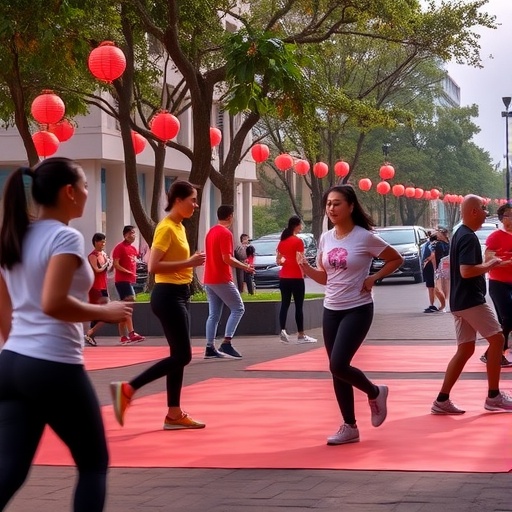
In recent years, the concept of accessible fitness environments within urban settings has surged to the forefront of public health discussions worldwide. A groundbreaking study by Shen, Lu, and Ma sheds light on the profound relationship between the accessibility of what they term the “15-minute fitness circle” and the physical activity levels among residents in China. This research, soon to be published in the International Journal for Equity in Health, explores not only the direct link between fitness accessibility and activity but also unveils the critical mediating role played by informal social support networks.
The “15-minute fitness circle” concept refers to the urban planning strategy that ensures residents have convenient, safe, and proximate access to physical activity resources within a 15-minute walk or bike ride from their homes. This approach is gaining momentum as cities worldwide grapple with the dual challenges of sedentary lifestyles and urban sprawl. Shen and colleagues compiled robust data across various Chinese cities representing diverse demographic and socioeconomic backgrounds to assess how perceived accessibility influences physical activity.
A key insight from this study reveals that merely providing physical spaces is insufficient to motivate consistent exercise behavior. Instead, subjective perceptions of access—how residents feel about the availability and convenience of fitness resources—play an outsized role in determining whether they utilize these spaces. This nuance indicates that urban planners and policymakers must prioritize visibility, safety, and community engagement in tandem with infrastructure development to boost physical activity.
Delving deeper, the research uncovers the pivotal function of informal social support networks as a mediating factor. Informal social support, encompassing encouragement from friends, family, neighbors, and community groups, amplifies the positive effects of perceived accessibility on physical activity. This finding suggests that social dynamics and communal bonds are catalysts that transform accessible spaces into active, health-promoting environments.
The methodology employed in this investigation is notable for its integration of quantitative surveys and qualitative interviews. Large-scale questionnaires captured individual perceptions of fitness circle accessibility and self-reported physical activity levels, while in-depth interviews elucidated the social support structures that surround participants. Statistical modeling techniques, including mediation analysis, confirmed that informal social support partially mediates the relationship between perceived accessibility and activity outcomes.
China’s rapid urbanization poses unique challenges, as sprawling metropolitan areas often marginalize lower-income communities from recreational facilities. Shen et al. highlight how equitable distribution of fitness resources within a reachable radius may significantly reduce health disparities by enabling more consistent physical engagement across socio-economic strata. Their findings advocate for urban designs that intertwine accessibility with inclusivity, emphasizing equitable health promotion strategies.
The implications of this work extend beyond China’s borders. Globally, sedentary lifestyles contribute overwhelmingly to the incidence of non-communicable diseases such as obesity, diabetes, and cardiovascular disorders. By fostering urban environments that are both physically accessible and socially supportive, municipalities worldwide can craft interventions with greater efficacy in promoting population-wide physical activity.
Beyond immediate health benefits, the research underscores how fitness circles serve as social conduits, facilitating meaningful interpersonal interactions. Such environments nurture a sense of belonging and community resilience, both critical for mental health and societal well-being. The interplay of physical infrastructure and social fabric thus emerges as a complex system whereby health improvements are synergistically achievable.
Nevertheless, the study acknowledges challenges in optimizing fitness circle implementation. Seasonal variations, safety concerns, and cultural attitudes toward exercise can hinder utilization. Tailored regional strategies that incorporate community feedback and local customs are therefore vital to overcome these barriers and sustain engagement over time.
Moreover, technological advancements could augment traditional fitness environments. The integration of digital platforms to foster virtual social support or organize group activities can complement physical proximity, magnifying the motivational impact. Shen and colleagues envision an ecosystem where accessibility, social support, and technology coalesce to redefine community health paradigms.
As urban planners and public health officials digest these insights, the question arises: How can cities pragmatically translate the 15-minute fitness circle philosophy into actionable policies? Early adopters might focus on zoning regulations that ensure green spaces and fitness centers are embedded within residential neighborhoods, partnered with community-driven programs to build social cohesion around physical activity.
From a behavioral science perspective, the study contributes richly to understanding how environmental perceptions shape health behaviors. Recognizing and manipulating these perceptions through targeted communication and design could nudge populations toward healthier lifestyles without coercion, aligning well with contemporary public health ethics.
In conclusion, this pioneering research from Shen, Lu, and Ma articulates a compelling paradigm—the fusion of physical accessibility and social support as keystones in elevating physical activity. It compels urban stakeholders to envision more holistic, people-centered environments where health is cultivated not solely by infrastructure but by interconnected community bonds.
The forthcoming publication promises to energize discussions in urban health equity and provide a data-driven blueprint for integrating social dimensions into physical activity promotion strategies. As cities worldwide seek sustainable solutions against chronic disease pandemics, the 15-minute fitness circle may well become a hallmark of resilient, healthy urban futures.
Subject of Research: The relationship between perceived accessibility of 15-minute fitness circles and physical activity levels in China, with a focus on the mediating impact of informal social support.
Article Title: The association between perceived 15-minute fitness circle accessibility and physical activity in China: the mediating role of informal social support.
Article References:
shen, Y., Lu, C. & Ma, Y. The association between perceived 15-minute fitness circle accessibility and physical activity in China: the mediating role of informal social support.
Int J Equity Health (2025). https://doi.org/10.1186/s12939-025-02745-3
Image Credits: AI Generated


