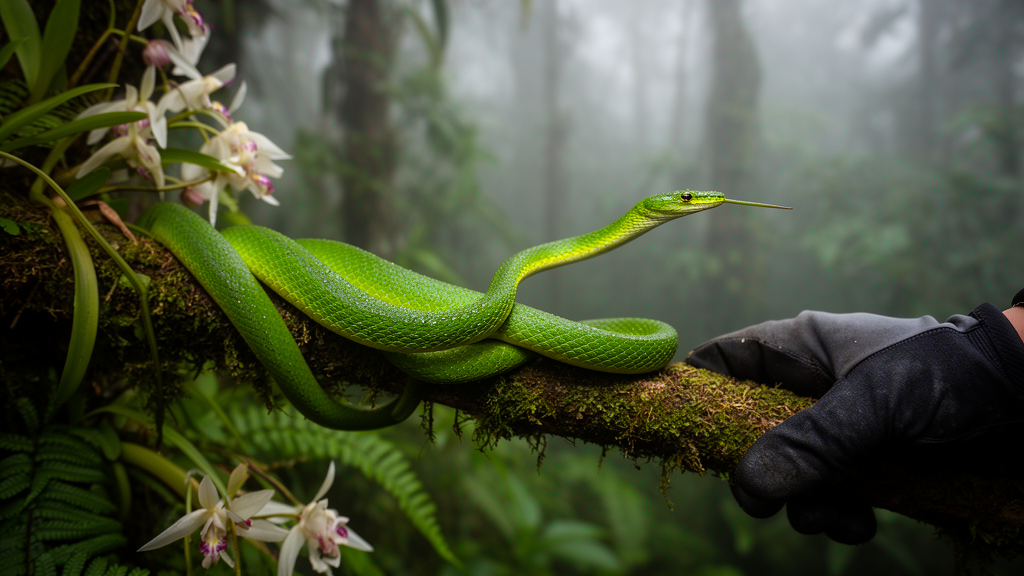
Deep in the Bolivian lowlands, a slender, cryptically patterned snake has been quietly slipping past scientists’ attention. A new study drawing on specimens held in four Bolivian herpetological collections has now confirmed, for the first time, that the vine snake Oxybelis inkaterra occurs in Bolivia, extending the species’ known range by approximately 207 kilometers at Río Sipia in La Paz and by approximately 628 kilometers at Campamento Guacharos in Cochabamba, both southeast of the type locality at Puerto Maldonado, Peru.
The research team examined specimens of Oxybelis aeneus, Oxybelis fulgidus and Oxybelis inkaterra, together with the sharpnose snakes Xenoxybelis argenteus and Xenoxybelis boulengeri, held in four collections: the Colección Boliviana de Fauna (CIRAH) of the Universidad Autónoma del Beni José Ballivián, the Colección Boliviana de Fauna (CBF) of the Museo Nacional de Historia Natural in La Paz, the Museo de Historia Natural Noel Kempff Mercado (MNKR) in Santa Cruz, and the Museo de Historia Natural Alcide d’Orbigny (MHNC-R) in Cochabamba. In total, the researchers examined nine specimens of O. aeneus, six of O. fulgidus, three of O. inkaterra, one of X. argenteus and seven of X. boulengeri, compiling new locality records, morphometric measurements, meristic scale counts and notes on coloration and behavior.
The taxonomic backdrop to the work is a story of long-standing confusion. The genus Oxybelis, whose members are widely known as vine snakes, has a convoluted nomenclatural history, and its internal taxonomy was disputed for decades. Keiser’s 1974 treatment maintained O. aeneus as a single species across its extensive range, but subsequent work presented compelling evidence for multiple species and considerable diversity, proposing an O. aeneus complex that now includes six species, with additional species described from Ecuador and Peru. Among these is O. inkaterra, described in 2021 by Jadin and colleagues, whose authors had already suggested that the species probably also occurs in Bolivia, Colombia and Brazil. The new Bolivian specimens now confirm that prediction for Bolivia, and the two documented localities constitute the eighth and ninth known localities of the species across its entire range.
Sharpnose snakes of the genus Xenoxybelis have their own tangled taxonomic past. The genus was described in 1993 and currently includes two species, X. argenteus and X. boulengeri, both of which were previously shuffled between the genera Oxybelis and Philodryas. Despite the superficial similarity, the two genera are not closely related: Oxybelis belongs to the family Colubridae while Xenoxybelis belongs to Dipsadidae. Their resemblance is instead a textbook case of convergent evolution, driven by a shared arboreal lifestyle that has shaped their morphology, coloration, diet and habitat use in parallel. Both groups are diurnal and predominantly arboreal, though they occasionally descend to the ground, and their cryptic coloration, elongated heads, attenuated slender bodies and long tails make them notoriously difficult to spot among vegetation.
For O. aeneus, the study examined nine specimens, seven of them adults exceeding 500 millimeters in snout-vent length, which ranged from 575 to 843 millimeters, with tail lengths of 345 to 520 millimeters. All displayed smooth dorsal scales in 17-17-13 rows, ventral scales numbering 182 to 192 with an average of 187, and subcaudal scales of 152 to 168 averaging 158. Every specimen had a divided cloacal plate and lacked a loreal scale. The coloration described from the Bolivian material, a golden brown to tan head with uniform cream supralabials separated by a dark brown preocular line, and a light brown body with scattered black spots, matches earlier descriptions of the species. The specimens were found resting on herbaceous plants and tree branches between 0 and 4 meters above the ground during nocturnal searches, in riparian forests of the Mamoré River sub-basin.
The green vine snake O. fulgidus proved considerably larger. The six examined adults ranged from 969 to 1,322 millimeters in snout-vent length, with tails of 531 to 587 millimeters, ventral scales of 202 to 220 averaging 211, and subcaudals of 145 to 156 averaging 152. Like O. aeneus, they showed smooth dorsal scales in 17-17-13 rows, though with keeled vertebral and paravertebral scales, and all had a divided cloacal plate and no loreal scale. One specimen, CIRAH-929, was observed capturing a bird in the crown of a pacay tree (Inga sp.) at an approximate height of 5.5 meters, in a rural village surrounded by secondary Amazonian forest where Brazil nut and açaí palm harvesting are common. The researchers note that this specimen’s unusually low subcaudal count of 128 scales likely reflects the loss of part of its tail at some point during its life.
The three O. inkaterra specimens, including an adult female from Campamento Guacharos in Parque Nacional Carrasco collected in March 2005, an adult male from Río Sipia in PNyANMI Madidi collected in June 2015, and a third specimen of unknown date and location, measured 580 to 810 millimeters in snout-vent length with tails of 385 to 544 millimeters. Their ventral scales numbered 181 to 200, averaging 193, with subcaudals of 160 to 170 averaging 164. Their coloration features brown and black mottling on the head, an irregular postocular stripe, and distinctive eyespot markings on some ventral scales, encircled with white pigment. The meristic characters and coloration of the Bolivian specimens are congruent with the original description of the species. One specimen, CBF-4275, was accidentally severed in two by local guides clearing work trails near the camp; the snake had remained motionless, mimicking a branch of the shrub it was on, a behavior that unfortunately rendered it invisible to the workers.
On the sharpnose snake side, the single examined X. argenteus specimen, an adult female collected at night from a branch of Piperaceae 1.9 meters off the ground in secondary forest near a stream in the TIPNIS region, measured 691 millimeters in snout-vent length with a 411-millimeter tail, 209 ventral scales, 182 subcaudals, an undivided cloacal plate and an absent loreal scale, the latter two characters being specific identifiers for the species. The seven X. boulengeri specimens, all from Pando, included six adults with snout-vent lengths of 615 to 728 millimeters and tails of 340 to 506 millimeters, plus a juvenile. These snakes were found coiled on tree branches between 0.5 and 2 meters above the ground during nocturnal searches in primary and secondary Amazonian forests of the Manuripi and Tahuamanu river sub-basins. Notably, the ventral scale counts and divided subcaudal counts of the male specimens came in slightly lower than previously reported, and the researchers counted two preocular scales in 29 percent of specimens, whereas earlier work had described one.
Xenoxybelis boulengeri is considered rare and poorly represented in scientific collections, which makes the seven new Bolivian records particularly valuable. The species’ type locality lies to the south, in the riparian forests of the Mamoré River at Trinidad, Beni, and the new records all come from the Amazonian forests of Beni and Pando. Overall, the study adds thirteen new records of O. aeneus and O. fulgidus for the departments of Beni, Cochabamba, La Paz, Pando and Santa Cruz, and eight new records for X. argenteus and X. boulengeri, alongside the three O. inkaterra specimens. The authors suggest that some of the records presented likely correspond to the southern distribution limits of these species, though this remains an inference to be tested by further fieldwork.
Perhaps the most telling behavioral insight from the study concerns how these snakes evade detection. The researchers observed that the mimicry of Oxybelis and Xenoxybelis with their environment is characteristic of the group, making the snakes very difficult to observe and capture during the day. As a result, 91 percent of the specimens examined from the CIRAH collection were collected at night, generally resting on branches or leaves of bushes at heights between 0 and 4 meters, with only a single specimen found at ground level. The new and first records, the authors argue, represent contributions that can improve understanding of the distribution and natural history of these snakes in Bolivia and across their South American range, while also constituting valuable voucher specimens for Bolivian herpetological collections.
Subject of Research: New distribution records and natural history of vine snakes (Oxybelis) and sharpnose snakes (Xenoxybelis) in the Bolivian lowlands, including the first records of Oxybelis inkaterra for Bolivia.
Article Title: Vine snakes ( Oxybelis ) and Sharpnose snakes ( Xenoxybelis ) ( Squamata , Serpentes ) from lowlands of Bolivia, with first records of Oxybelis inkaterra for the country
Article References: Rivas, L. R., Rey-Ortíz, G., Eversole, C. B., Powell, R. L., Navarro-Cornejo, G., Cortez, E., Ocampo, M., Callapa, G., & Muñoz, A. (2024). Vine snakes (Oxybelis) and Sharpnose snakes (Xenoxybelis) (Squamata, Serpentes) from lowlands of Bolivia, with first records of Oxybelis inkaterra for the country. Herpetozoa, 37, 201-211. https://doi.org/10.3897/herpetozoa.37.e120130
Image Credits: AI Generated
DOI: 10.3897/herpetozoa.37.e120130
Keywords: Bolivia, Oxybelis inkaterra, vine snakes, Xenoxybelis, sharpnose snakes, herpetology, range extension, museum specimens, Amazonia, snake taxonomy, new records, South America
Cite Scienmag News
Margaret Porter. (October 27, 2026). First records of a little-known vine snake extend its range deep into Bolivia. Scienmag. https://scienmag.com/first-records-of-a-little-known-vine-snake-extend-its-range-deep-into-bolivia/
Margaret Porter. "First records of a little-known vine snake extend its range deep into Bolivia." Scienmag, 27 October 2026, https://scienmag.com/first-records-of-a-little-known-vine-snake-extend-its-range-deep-into-bolivia/. Accessed 27 October 2026.
Margaret Porter. "First records of a little-known vine snake extend its range deep into Bolivia." Scienmag. October 27, 2026. https://scienmag.com/first-records-of-a-little-known-vine-snake-extend-its-range-deep-into-bolivia/