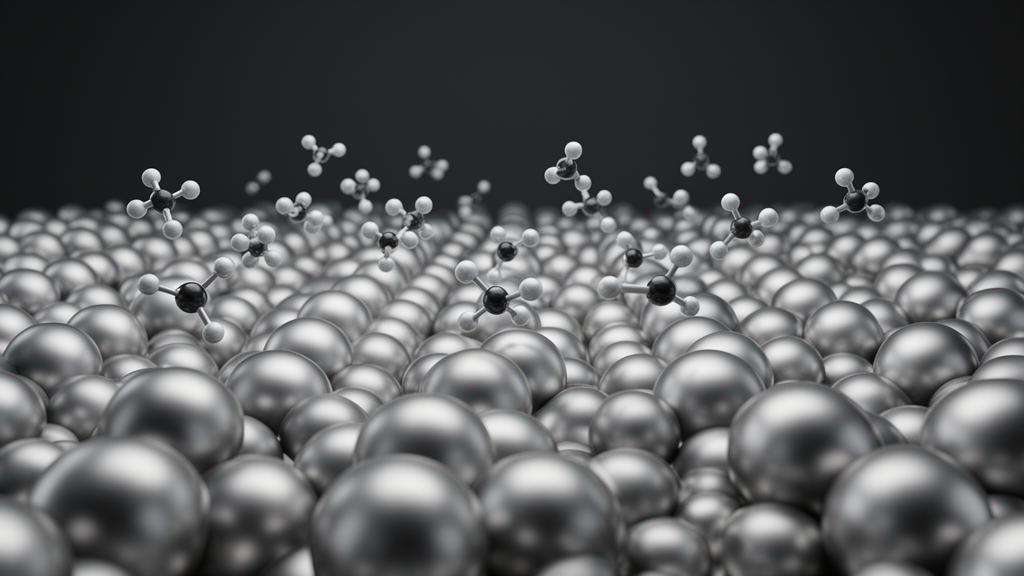
Using first-principles calculations, researchers examined how H2 and CO adsorb on the low-index (100), (110), and (111) surfaces of nickel, quantifying both the strength of the binding and the structural changes the molecules induce.
The study, published in the Journal of Materials Science, evaluated adsorption energies, the intramolecular bond lengths of the adsorbed molecules, and the distances between the molecular contact atoms and the nickel surface as a function of gas coverage. Tracking these quantities across different coverages allowed the team to see how the local environment of each molecule changes as more H2 or CO accumulates on a given surface, a factor that strongly influences how gases behave on real nickel components exposed to reactive atmospheres during service.
Beyond binding energies and geometry, the researchers quantified how adsorbed molecules affect the surface energy of nickel.
To classify the adsorption types systematically, the team combined adsorption energies and geometric parameters with electron localization function analysis. The result is a consistent framework for identifying how each molecule binds on a given crystal face rather than relying on a single descriptor.
According to the authors, the findings elucidate the synergistic interplay between gas coverage and the surface geometry of nickel, and they offer critical guidelines for the rational design of nickel-based alloys with enhanced resistance to gas adsorption and environmental degradation. Because the work is entirely computational, its conclusions describe predicted configurations and energetics rather than direct experimental measurements, but the systematic comparison across the (100), (110), and (111) surfaces provides a reference baseline for future studies of gas-surface interactions on nickel and its alloys.
Subject of Research: First-principles calculations of H2 and CO adsorption configurations and energetics on low-index nickel surfaces
Article Title: First-principles study of the configurations and energetics of H2 and CO adsorption on Ni surfaces
Article References: He, S., Chen, Y., Chen, X., Liu, Y., Xie, P., Tan, Q., Gorbatov, O. I., & Peng, P. (2026). First-principles study of the configurations and energetics of H2 and CO adsorption on Ni surfaces. Journal of Materials Science. https://doi.org/10.1007/s10853-026-13910-6
Image Credits: AI Generated
DOI: 10.1007/s10853-026-13910-6
Keywords: nickel surfaces, H2 adsorption, CO adsorption, first-principles calculations, adsorption energy, surface energy, electron localization function, low-index surfaces, gas coverage, Ni-based alloys, environmental degradation, computational materials science
Cite Scienmag News
Bethany Barker. (October 29, 2026). First-principles calculations map how H2 and CO adsorb on Ni surfaces. Scienmag. https://scienmag.com/first-principles-calculations-map-how-h2-and-co-adsorb-on-ni-surfaces/
Bethany Barker. "First-principles calculations map how H2 and CO adsorb on Ni surfaces." Scienmag, 29 October 2026, https://scienmag.com/first-principles-calculations-map-how-h2-and-co-adsorb-on-ni-surfaces/. Accessed 30 October 2026.
Bethany Barker. "First-principles calculations map how H2 and CO adsorb on Ni surfaces." Scienmag. October 29, 2026. https://scienmag.com/first-principles-calculations-map-how-h2-and-co-adsorb-on-ni-surfaces/