


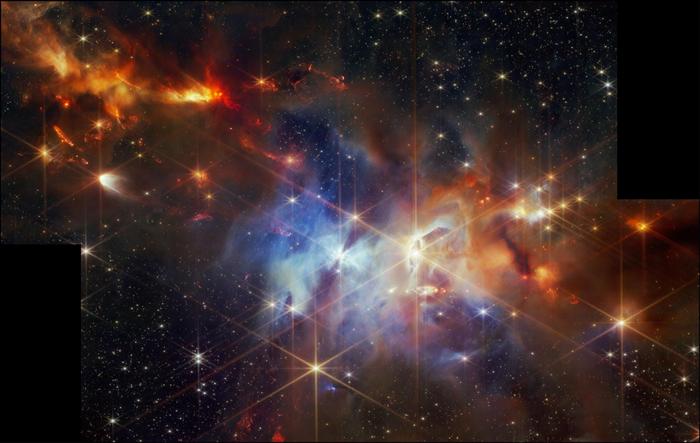
For the first time, a phenomenon astronomers have long hoped to directly image has been captured by NASA’s James Webb Space Telescope’s Near-Infrared Camera (NIRCam). In this stunning image of the Serpens Nebula, the discovery lies in the northern area (seen at the upper left) of this young, nearby star-forming region.

Credit: NASA, ESA, CSA, K. Pontoppidan (NASA’s Jet Propulsion Laboratory) and J. Green (Space Telescope Science Institute).
For the first time, a phenomenon astronomers have long hoped to directly image has been captured by NASA’s James Webb Space Telescope’s Near-Infrared Camera (NIRCam). In this stunning image of the Serpens Nebula, the discovery lies in the northern area (seen at the upper left) of this young, nearby star-forming region.
Astronomers found an intriguing group of protostellar outflows, formed when jets of gas spewing from newborn stars collide with nearby gas and dust at high speeds. Typically these objects have varied orientations within one region. Here, however, they are slanted in the same direction, to the same degree, like sleet pouring down during a storm.
The discovery of these aligned objects, made possible due to Webb’s exquisite spatial resolution and sensitivity in near-infrared wavelengths, is providing information into the fundamentals of how stars are born.
“Astronomers have long assumed that as clouds collapse to form stars, the stars will tend to spin in the same direction,” said principal investigator Klaus Pontoppidan, of NASA’s Jet Propulsion Laboratory in Pasadena, California. “However, this has not been seen so directly before. These aligned, elongated structures are a historical record of the fundamental way that stars are born.”
So just how does the alignment of the stellar jets relate to the rotation of the star? As an interstellar gas cloud crashes in on itself to form a star, it spins more rapidly. The only way for the gas to continue moving inward is for some of the spin (known as angular momentum) to be removed. A disk of material forms around the young star to transport material down, like a whirlpool around a drain. The swirling magnetic fields in the inner disk launch some of the material into twin jets that shoot outward in opposite directions, perpendicular to the disk of material.
In the Webb image, these jets are signified by bright clumpy streaks that appear red, which are shockwaves from the jet hitting surrounding gas and dust. Here, the red color represents the presence of molecular hydrogen and carbon monoxide.
“This area of the Serpens Nebula – Serpens North – only comes into clear view with Webb,” said lead author Joel Green of the Space Telescope Science Institute in Baltimore. “We’re now able to catch these extremely young stars and their outflows, some of which previously appeared as just blobs or were completely invisible in optical wavelengths because of the thick dust surrounding them.”
Astronomers say there are a few forces that potentially can shift the direction of the outflows during this period of a young star’s life. One way is when binary stars spin around each other and wobble in orientation, twisting the direction of the outflows over time.
Stars of the Serpens
The Serpens Nebula, located 1,300 light-years from Earth, is only one or two million years old, which is very young in cosmic terms. It’s also home to a particularly dense cluster of newly forming stars (~100,000 years old), seen at the center of this image. Some of these stars will eventually grow to the mass of our Sun.
“Webb is a young stellar object-finding machine,” Green said. “In this field, we pick up sign posts of every single young star, down to the lowest mass stars.”
“It’s a very complete picture we’re seeing now,” added Pontoppidan.
So, throughout the region in this image, filaments and wisps of different hues represent reflected starlight from still-forming protostars within the cloud. In some areas, there is dust in front of that reflection, which appears here with an orange, diffuse shade.
This region has been home to other coincidental discoveries, including the flapping “Bat Shadow,” which earned its name when 2020 data from NASA’s Hubble Space Telescope revealed a star’s planet-forming disk to flap, or shift. This feature is visible at the center of the Webb image.
Future Studies
The new image, and serendipitous discovery of the aligned objects, is actually just the first step in this scientific program. The team will now use Webb’s NIRSpec (Near-Infrared Spectrograph) to investigate the chemical make-up of the cloud.
The astronomers are interested in determining how volatile chemicals survive star and planet formation. Volatiles are compounds that sublimate, or transition from a solid directly to a gas, at a relatively low temperature – including water and carbon monoxide. They’ll then compare their findings to amounts found in protoplanetary disks of similar-type stars.
“At the most basic form, we are all made of matter that came from these volatiles. The majority of water here on Earth originated when the Sun was an infant protostar billions of years ago,” Pontoppidan said. “Looking at the abundance of these critical compounds in protostars just before their protoplanetary disks have formed could help us understand how unique the circumstances were when our own solar system formed.”
These observations were taken as part of General Observer program 1611. The team’s initial results have been accepted in the Astrophysical Journal.
The James Webb Space Telescope is the world’s premier space science observatory. Webb is solving mysteries in our solar system, looking beyond to distant worlds around other stars, and probing the mysterious structures and origins of our universe and our place in it. Webb is an international program led by NASA with its partners, ESA (European Space Agency) and CSA (Canadian Space Agency).
Journal
The Astrophysical Journal
Article Title
Why are (almost) all the protostellar outflows aligned in Serpens Main?
Cite Scienmag News
Grant Pearson. (June 23, 2024). First of its kind detection made in striking new Webb image. Scienmag. https://scienmag.com/first-of-its-kind-detection-made-in-striking-new-webb-image/
Grant Pearson. "First of its kind detection made in striking new Webb image." Scienmag, 23 June 2024, https://scienmag.com/first-of-its-kind-detection-made-in-striking-new-webb-image/. Accessed 9 September 2026.
Grant Pearson. "First of its kind detection made in striking new Webb image." Scienmag. June 23, 2024. https://scienmag.com/first-of-its-kind-detection-made-in-striking-new-webb-image/

