


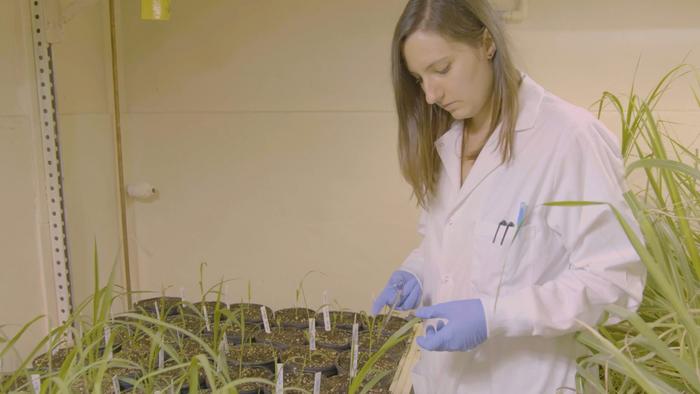
Sugarcane is the world’s largest crop by biomass yield, providing 80 percent of the sugar and 40 percent of the biofuel produced worldwide. The plant’s size and efficient use of water and light make it a prime candidate to produce advanced renewable, value-added bioproducts and biofuels.

Credit: Charles Keato
Sugarcane is the world’s largest crop by biomass yield, providing 80 percent of the sugar and 40 percent of the biofuel produced worldwide. The plant’s size and efficient use of water and light make it a prime candidate to produce advanced renewable, value-added bioproducts and biofuels.
However, as a hybrid of Saccharum officinarum and Saccharum spontaneum, sugarcane has the most complex genome of all crops. This complexity means that improving sugarcane through conventional breeding is challenging. Because of this, researchers turn to gene editing tools, such as the CRISPR/Cas9 system to precisely target the sugarcane genome for improvement.
In their new paper, published in Plant Biotechnology Journal, a team of researchers from the University of Florida at the Center for Advanced Bioenergy and Bioproducts Innovation (CABBI) has leveraged this genetic complexity to their advantage to use the CRISPR/Cas9 system to fine-tune leaf angle in sugarcane. These genetic tweaks allowed the sugarcane to capture more sunlight, which in turn increased the amount of biomass produced.
This work supports the DOE-funded CABBI Bioenergy Research Center’s “plants as factories” approach and the primary goal of its Feedstock Production research — to synthesize biofuels, bioproducts, and high-value molecules directly in the stems of plants such as sugarcane.
The sugarcane genome’s complexity is due in part to its high levels of redundancy: It possesses many copies of each gene. The phenotype that a sugarcane plant displays, therefore, typically depends on the cumulative expression of the multiple copies of a certain gene. The CRISPR/Cas9 system is perfect for this task because it can be designed to edit few or many copies of a gene at once.
This study focused on LIGULELESS1, or LG1, a gene that plays a major role in determining leaf angle in sugarcane. Leaf angle, in turn, determines how much light can be captured by the plant, which is critical for biomass production. Since sugarcane’s highly redundant genome contains 40 copies of LG1, the researchers were able to fine-tune the leaf angle by editing different numbers of copies of this gene, resulting in slightly different leaf angles depending on how many copies of LG1 were edited.
“In some of the LG1 edited sugarcanes, we just mutated a few of the copies,” said Fredy Altpeter, research team lead and Professor of Agronomy at the University of Florida. “And in doing so, we were able to tailor the leaf architecture until we found the optimal angle that resulted in increased biomass yield.”
When the researchers grew sugarcane in field trials, they found that the upright leaf phenotypes allowed more light to penetrate the canopy, which resulted in increased biomass yield. One sugarcane line in particular, which contained edits in ~12% of the LG1 copies and showed a 56% decrease in leaf inclination angle, had an 18% increase in dry biomass yield.
By optimizing sugarcane to capture more light, these gene edits increase biomass yield without having to add more fertilizer to the fields. In addition to that, building a stronger understanding of complex genetics and genome editing helps researchers work toward refined approaches for crop improvement.
“This is the first peer-reviewed publication describing a field trial of CRISPR-edited sugarcane,” Altpeter said. “And this work also shows unique opportunities for the editing of polyploid crop genomes, where researchers can fine-tune a specific trait.”
Co-authors on this study included CABBI researchers at the University of Florida Department of Agronomy, Eleanor Brant, Ayman Eid, Baskaran Kannan, and Mehmet Cengiz Baloglu.
— Article by CABBI Communications Specialist April Wendling
Journal
Plant Biotechnology Journal
Subject of Research
Not applicable
Article Title
The extent of multiallelic, co-editing of LIGULELESS1 in highly polyploid sugarcane tunes leaf inclination angle and enables selection of the ideotype for biomass yield
Article Publication Date
22-May-2024
COI Statement
The authors have no conflicts of interest to declare.
Cite Scienmag News
Juliet Wilcox. (June 10, 2024). Fine-tuning leaf angle with CRISPR improves sugarcane yield. Scienmag. https://scienmag.com/fine-tuning-leaf-angle-with-crispr-improves-sugarcane-yield/
Juliet Wilcox. "Fine-tuning leaf angle with CRISPR improves sugarcane yield." Scienmag, 10 June 2024, https://scienmag.com/fine-tuning-leaf-angle-with-crispr-improves-sugarcane-yield/. Accessed 4 September 2026.
Juliet Wilcox. "Fine-tuning leaf angle with CRISPR improves sugarcane yield." Scienmag. June 10, 2024. https://scienmag.com/fine-tuning-leaf-angle-with-crispr-improves-sugarcane-yield/

