


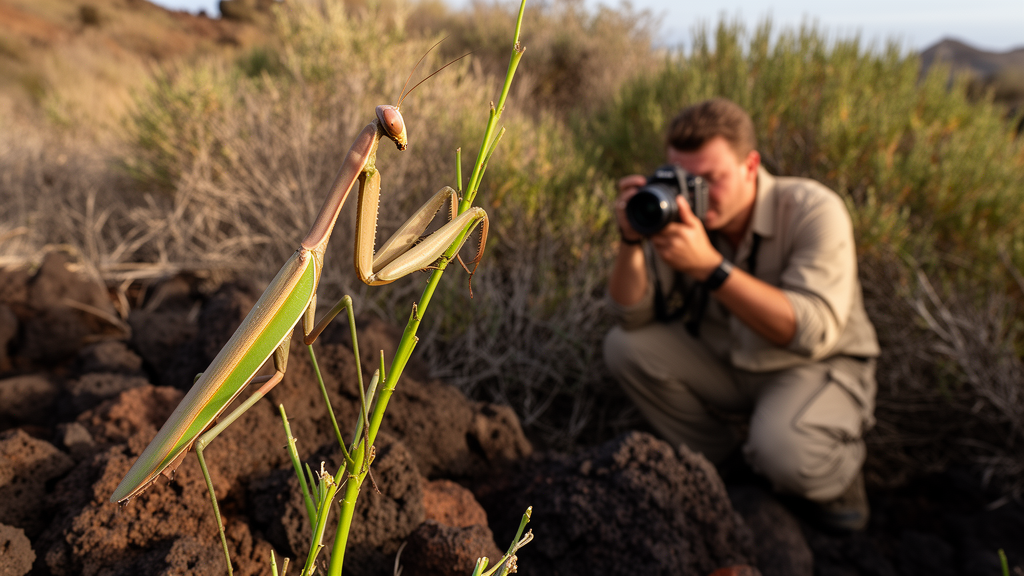
A field record has documented the giant African mantis, Sphodromantis viridis , at Aqualand Costa Adeje on Tenerife, providing the first reported occurrence of the species in the Canary Islands and on an island outside the Mediterranean basin. The observation site was a landscaped water park in southern Tenerife rather than a remote natural habitat. Researchers encountered an adult female, immature mantises and numerous egg cases, called oothecae, on ornamental plants.
Together, these records demonstrate that the species was present and reproducing or attempting to reproduce at the site, although the investigation could not determine when it arrived or how extensively it had spread beyond the park. The discovery began when one of the authors found the mantis while visiting Tenerife for an expedition. One adult specimen and eight oothecae were initially collected and examined using established identification guidance.
The authors also searched taxonomic resources, citizen-science databases such as iNaturalist and GBIF, and online information about the park’s vegetation. They sought additional observations from visitors and employees, photographed the insects with a smartphone and compact camera, and checked plant identifications against the Plants of the World Online resource of the Royal Botanic Gardens, Kew. The material examined ultimately included one adult female, one subadult male, five unsexed nymphs and 13 oothecae from the park at an elevation of 286 metres above sea level.
Additional oothecae and young mantises were observed but not all were collected because most were positioned high among the plants. The only adult collected was a female measuring 8.2 cm. Her identification rested on a combination of features, including a large head with rounded eyes, a frontal sclerite barely longer than it was high, a pronotum with a metazone-to-prozone ratio greater than two, and a well-marked supracoxal dilation.
Other diagnostic details included robust forelegs bearing three coxal spines, yellowish plates at their bases and black femoral spines restricted to the tips. The female also had well-developed flight organs, clearly visible whitish stigmata on the tegminae and transparent hind wings. The oothecae represented different stages: some were damaged, hatched and estimated to be one to two years old, while others were close to hatching.
One fertile ootheca contained a recently hatched nymph. These observations indicate repeated egg laying and, if the mantis was not introduced repeatedly from outside, reproduction by insects already present on Tenerife. The study did not, however, trace an arrival date or exclude the possibility of multiple introductions.
Sphodromantis viridis , often called the giant African mantis, is the northernmost-distributed species in a genus of 37 large mantises whose members occupy warm environments from equatorial forests to semi-desert regions. The species is particularly associated with xerothermophilous, or warm and dry, settings, yet the authors describe it as a generalist predatory insect capable of spreading rapidly in heavily modified places. Most specimens and egg cases were found on stems, branches and leaves, consistent with the reported oviposition preferences of the species.
The vegetation consisted largely of non-native plants adapted to warm or tropical climates, including oleander, Excoecaria cochinchinensis , hibiscus, banana, croton, Elaeagnus × submacrophylla , Iresine , pandanus and Washingtonia palm. Oothecae or specimens were associated with several of these plants, but not every non-native species in the park carried mantises. The records therefore document use of particular vegetation rather than demonstrating that any one plant was responsible for the presence or multiplication of the insect.
The Tenerife record extends a wider pattern of reported range expansion. S. viridis had been known from southern Spain since the nineteenth century and was subsequently reported from additional locations on the Iberian Peninsula, Mallorca, Sardinia, Sicily, Greece and Croatia. Prior studies described the mantis as adaptable enough to occupy heavily anthropized environments.
The Tenerife observations are the first from a non-Mediterranean island, but they do not by themselves establish that the same process produced every earlier expansion. They add an Atlantic island occurrence to the existing record and show that the insect was found reproducing in a small, intensively managed setting. The authors considered human-mediated arrival to be the most likely explanation, although the transport route and introduction date remain unknown.
They regarded an independent natural arrival as extremely unlikely. The insect is not adapted for flights across the distance from the African mainland, and analysis of earlier Mediterranean introductions found that passive transport of oothecae over open water was improbable because the journey would exceed a period compatible with the mantis’s annual life cycle. Ancient land connections have been proposed as a possible route for some African animals to reach the Canary archipelago, and the study notes that such a scenario cannot be completely excluded for S. viridis , even though the authors describe it as extremely unlikely.
Their evidence does not identify the individual or event responsible for this particular introduction. It also does not demonstrate that the species crossed an ocean unaided or that a broad population became established across Tenerife. What is directly documented is a restricted set of observations in one developed site, including adults, immature stages and egg cases of different apparent ages.
The ecological significance of the occurrence remains uncertain. The Canary Islands are home to ten native mantis species, some endemic and others also distributed in North Africa and the Middle East. The newcomer is a large, adaptable predator, and the abundance of individuals and oothecae at the park raises the possibility of rapid population growth if additional introductions are excluded.
Further monitoring will be needed to determine whether the Tenerife occurrence represents a localized population, a wider distribution across the island or repeated human transport events. Until that evidence is available, the verified findings are limited but notable: S. viridis was present in the Canary Islands for the first reported time, with an adult female, immature individuals and multiple oothecae documented at a warm, landscaped site on Tenerife. The record provides evidence of local reproduction at Aqualand Costa Adeje, while leaving the arrival route, arrival date, wider spread and ecosystem-level effects unresolved.
Subject of Research: First field record of the giant African mantis Sphodromantis viridis in the Canary Islands
Article Title: Alien mantids in a tropical paradise: First record of the giant mantis Sphodromantis viridis ( Insecta , Mantodea ) for the Canary Islands (Spain)
Article References: Fasano, A., & De Martino, A. (2023). Alien mantids in a tropical paradise: First record of the giant mantis Sphodromantis viridis (Insecta, Mantodea) for the Canary Islands (Spain). Journal of Orthoptera Research, 32(2), 143-147. https://doi.org/10.3897/jor.32.96183
Image Credits: AI Generated
DOI: 10.3897/jor.32.96183
Keywords: Sphodromantis viridis, giant African mantis, Tenerife, Canary Islands, praying mantis, field record, non-native insects, human-mediated dispersal, insect ecology, oviposition, Alien, mantids
Cite Scienmag News
Gavin Prescott. (October 20, 2026). Field record documents giant African mantis on Tenerife. Scienmag. https://scienmag.com/field-record-documents-giant-african-mantis-on-tenerife/
Gavin Prescott. "Field record documents giant African mantis on Tenerife." Scienmag, 20 October 2026, https://scienmag.com/field-record-documents-giant-african-mantis-on-tenerife/. Accessed 20 October 2026.
Gavin Prescott. "Field record documents giant African mantis on Tenerife." Scienmag. October 20, 2026. https://scienmag.com/field-record-documents-giant-african-mantis-on-tenerife/


