


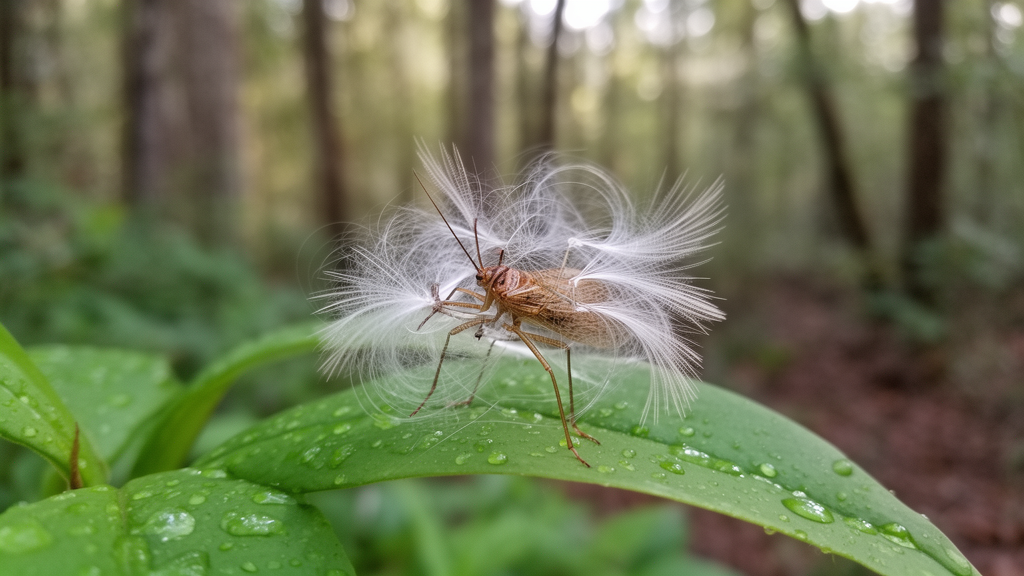
A specimen-based field investigation documented the first recorded occurrence of the footspinner Haploembia solieri in Georgia. Researchers collected four female specimens at two locations: Mijniskure in Vashlovani National Park during an expedition in 2022 and Shulaveri in the Qvemo Qartli region during a reconnaissance visit in 2023. Before these collections, no species of the order Embioptera had been recorded from the country. The investigation establishes a country record through field collection and morphological identification; it was not an experiment or a long-term ecological survey.
The first specimen was collected on 15 April 2022 during an expedition organized within the Caucasus Barcode of Life. One female was recovered from leaf litter near the Alazani River at 41.1113° N, 46.6455° E, and 95 metres above sea level. The second sampling visit was a one-day reconnaissance trip to Shulaveri on 3 June 2023. Three females were collected at 41.3681° N, 44.8219° E, and 479 metres above sea level, from soil cracks beneath rocks in steppe on a hill covered with Paliurus spina-christi. Daytime sampling involved collecting leaf litter with an entomological soil sifter and searching by hand for silk galleries in soil crevices beneath rocks. The specimens were preserved in 96% ethanol, deposited in the ISU collection for further genetic studies and assigned CaBOL identifiers. Identification followed published keys by Rimsky-Korsakov, Bey-Bienko, Ross, Murányi and Kovács, and Kelly and colleagues.
The Georgian material was identified as H. solieri from external anatomical features. Females were readily distinguished from other European footspinner species by the presence of two rather than one ventral papilla on the hind basitarsus. A pale prothorax, uncarinated mandibles that were slightly elevated basolaterally, and the specimens’ overall coloration also supported the identification. Although the researchers did not collect males, they considered the species identity supported by the diagnostic morphology and by the presence of several individuals beneath a single rock. The live specimens were photographed with a Canon EOS 550D camera, a 60 mm macro lens and a Canon Macro Twin Lite. Digital images were prepared using Zerene Stacker and Adobe Photoshop CS6. Separately, diagnostic drawings were based on microscope photographs and prepared with Krita and Photoshop using a Wacom tablet.
The report also discusses a recent integrative reassessment in which a population long regarded as a parthenogenetic form of H. solieri was recognized as a separate species, H. tarsalis. That reassessment considered external differences, including contrasting coloration between the venter and dorsum of the abdomen, differences in social behavior and chromosome number; the asexual species was described as displaying antisocial behavior. The source notes that reports of an asexual form in other countries may require reassessment because the absence of males in collections does not directly demonstrate that a population is asexual, particularly as most males reportedly die shortly after mating and are rarely found in the field. For regional context, the source reports H. solieri from Azerbaijan, where it was described as not uncommon in the Sheki-Zaqatala and Mingachevir areas, and from Turkey, with the southern coast of the Crimean Peninsula considered its northernmost range limit.
The country record has a limited sampling scope: four females were obtained during two collection events at separate sites, and the 2023 visit was explicitly reconnaissance in nature. These observations document occurrence at the two sampled localities but do not establish population size, abundance, seasonality, distribution across Georgia or ecological effects. The authors additionally suggest that the confirmed Georgian presence of H. solieri may indicate possible future records in Georgia of its associated tachinid fly, Rossimyiops longicornis. That is a prediction based on the fly’s association with the footspinner, not an additional observation from Georgia.
Subject of Research: The first field-documented record of the footspinner Haploembia solieri in Georgia
Article Title: The first record of Haploembia solieri (Rambur, 1842) ( Insecta , Embioptera ) in Georgia
Article References: Seropian, A., Bulbulashvili, N., & Zukakishvili, A. (2023). The first record of Haploembia solieri (Rambur, 1842) (Insecta, Embioptera) in Georgia. Caucasiana, 2, 161-164. https://doi.org/10.3897/caucasiana.2.e107920
Image Credits: AI Generated
DOI: 10.3897/caucasiana.2.e107920
Keywords: Haploembia solieri, Embioptera, Georgia, field record, morphological identification, Vashlovani National Park, Shulaveri, Caucasus Barcode of Life, insect collection, entomology, first, record
Cite Scienmag News
Gavin Prescott. (October 20, 2026). Field investigation documents Georgia’s first record of the footspinner Haploembia solieri. Scienmag. https://scienmag.com/field-investigation-documents-georgias-first-record-of-the-footspinner-haploembia-solieri/
Gavin Prescott. "Field investigation documents Georgia’s first record of the footspinner Haploembia solieri." Scienmag, 20 October 2026, https://scienmag.com/field-investigation-documents-georgias-first-record-of-the-footspinner-haploembia-solieri/. Accessed 20 October 2026.
Gavin Prescott. "Field investigation documents Georgia’s first record of the footspinner Haploembia solieri." Scienmag. October 20, 2026. https://scienmag.com/field-investigation-documents-georgias-first-record-of-the-footspinner-haploembia-solieri/


