


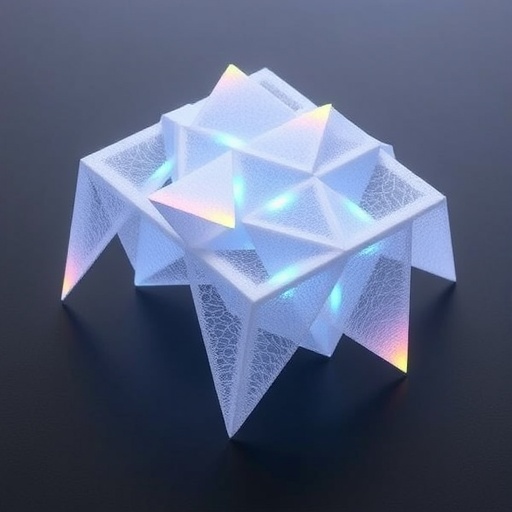
In a groundbreaking advancement at the intersection of materials science and electronics, researchers have unveiled a novel approach to origami-inspired electronic devices that showcases a remarkable blend of rigidity and flexibility. Published in npj Flexible Electronics, the study introduces fiber-reinforced origami electronics designed specifically for display applications, marking a significant leap forward in the development of foldable and wearable technologies. This innovation promises to redefine the standards for durability and performance in flexible displays, a sector that has long grappled with the trade-off between mechanical robustness and pliability.
The essence of this breakthrough lies in the strategic incorporation of fiber reinforcements within the origami structures of the electronic devices. Traditional origami electronics typically prioritize flexibility, allowing devices to bend, fold, or twist without compromising function. However, this flexibility often comes at the cost of mechanical integrity, leading to fragility and reduced lifespan. By embedding high-performance fibers into the origami folds, the research team has engineered electronics that benefit from enhanced mechanical strength without sacrificing the essential flexibility required for sophisticated folding mechanisms.
Critically, the reinforced fiber network acts as a scaffold that distributes mechanical stresses more evenly throughout the origami device. This distribution drastically reduces localized strain and the risk of mechanical failure during repeated folding and unfolding cycles. The fibers themselves are selected for their unique combination of tensile strength and compatibility with flexible substrates, ensuring seamless integration into the electronic architecture. The resulting composite structure integrates rigid and flexible elements harmoniously, allowing for unprecedented design possibilities in wearable displays and foldable interfaces.
The research taps into advanced materials engineering techniques to fabricate these hybrid structures. Utilizing state-of-the-art fiber weaving and patterning methods, the team can precisely tailor the mechanical properties of the origami electronics at a microstructural level. This level of control enables the development of devices that can maintain their shape and structural stability even when subjected to complex deformations inherent in origami folding patterns. Moreover, such a design enhances longevity, addressing one of the most pressing challenges in the market for flexible electronics.
This approach also navigates the delicate balance required in electronic display technology: achieving high rigidity to prevent unintended bending during normal use while maintaining the flexibility necessary for dynamic shape changes. The fiber reinforcements provide stiffness where needed—around fold lines and junctions—without hindering the overall device mobility. The result is an origami electronic that can switch between a rigid display mode and a compact folded form, suited to both protective transport and active use scenarios.
Beyond the mechanical enhancements, the research provides comprehensive insights into the integration of functional materials within these fiber-reinforced substrates. The design supports the incorporation of conductive materials necessary for electronic operation, maintaining electrical continuity and performance through repetitive folding cycles. This feature is essential for display applications, where uninterrupted signal transmission ensures display integrity and user experience.
One particularly compelling aspect of the study is its potential impact on wearable electronics, an industry where comfort, durability, and functionality must converge. The fiber-reinforced origami electronics offer a pathway to lighter, more robust wearable displays that conform to the human body while resisting damage from daily movements and environmental stresses. This could revolutionize everything from smart clothing to medical monitoring devices, enabling devices that adapt seamlessly to the wearer’s lifestyle.
The researchers employed rigorous mechanical testing to validate their designs, subjecting the devices to thousands of folding cycles while monitoring performance degradation. The fiber-reinforced structures consistently outperformed non-reinforced counterparts, demonstrating a marked improvement in mechanical endurance. This result not only confirms the theoretical advantages of the composite design but also underscores the practical viability for commercial applications where reliability is paramount.
Moreover, the research sheds light on the scalability of the proposed fabrication techniques. By utilizing materials and processes compatible with existing manufacturing technologies, the study suggests a clear pathway from laboratory prototypes to industrial-scale production. This is pivotal for the widespread adoption of fiber-reinforced origami electronics, bridging the gap between innovative research and market-ready products.
The advancement aligns well with contemporary trends in consumer electronics, where foldable smartphones and flexible displays are rapidly gaining traction. Yet, the current market offerings often suffer from durability issues arising from the inherent weaknesses in flexible materials. The introduction of fiber reinforcement addresses these challenges head-on, promising devices that not only fold elegantly but also endure real-world usage without premature wear or failure.
Additionally, the research opens doors to broader applications beyond display technology. Structural electronics with combined rigidity and flexibility could find uses in aerospace, robotics, and structural health monitoring, where adaptable yet robust electronic skins and interfaces are increasingly needed. The principles demonstrated in this work could serve as a foundational platform for multifunctional devices that must withstand extreme mechanical demands.
An exciting implication of this work lies in the design freedom it affords engineers and product designers. By tuning fiber orientation, density, and material properties, devices can be customized for specific applications, balancing flexibility and stiffness according to functional requirements. This level of customization enhances the appeal of origami electronics across a diverse range of market sectors, from consumer products to industrial and medical devices.
The team’s contribution is not merely incremental; it represents a paradigm shift in how flexible electronics can be conceptualized and realized. Moving away from uniform substrates toward hybrid composites that intelligently combine softness and strength could inspire a new generation of smart devices integrating complex mechanical functions with advanced electronic performance.
In conclusion, the introduction of fiber-reinforced origami electronics with high rigidity and flexibility stands to transform the future of display and wearable technologies. By overcoming longstanding mechanical limitations and enabling durable, foldable electronic interfaces, this research paves the way for devices that effortlessly blend form and function. As the commercial landscape embraces foldable and wearable devices, innovations like this will be critical in defining the next era of interactive electronics.
Cite Scienmag News
Denise Maddox. (November 3, 2025). Fiber-Reinforced Origami Electronics: Rigid Yet Flexible Displays. Scienmag. https://scienmag.com/fiber-reinforced-origami-electronics-rigid-yet-flexible-displays/
Denise Maddox. "Fiber-Reinforced Origami Electronics: Rigid Yet Flexible Displays." Scienmag, 3 November 2025, https://scienmag.com/fiber-reinforced-origami-electronics-rigid-yet-flexible-displays/. Accessed 4 September 2026.
Denise Maddox. "Fiber-Reinforced Origami Electronics: Rigid Yet Flexible Displays." Scienmag. November 3, 2025. https://scienmag.com/fiber-reinforced-origami-electronics-rigid-yet-flexible-displays/


