

Wednesday, November 4, 2026
Science
No Result
View All Result
  • Login
  • HOME
  • SCIENCE NEWS
  • CONTACT US
  • HOME
  • SCIENCE NEWS
  • CONTACT US
No Result
View All Result
Scienmag
No Result
View All Result
Home Science News Medicine

Fetal day-night rhythms in the womb predict infant sleep patterns

October 29, 2026
in Medicine
Harold Sullivan
By Harold Sullivan Scienmag Editorial Profile - Maternal and Child Health
Reading Time: 3 mins read
0
Fetal day-night rhythms in the womb predict infant sleep patterns

Fetal day-night rhythms in the womb predict infant sleep patterns

65
SHARES
587
VIEWS
Share on FacebookShare on Twitter
ADVERTISEMENT

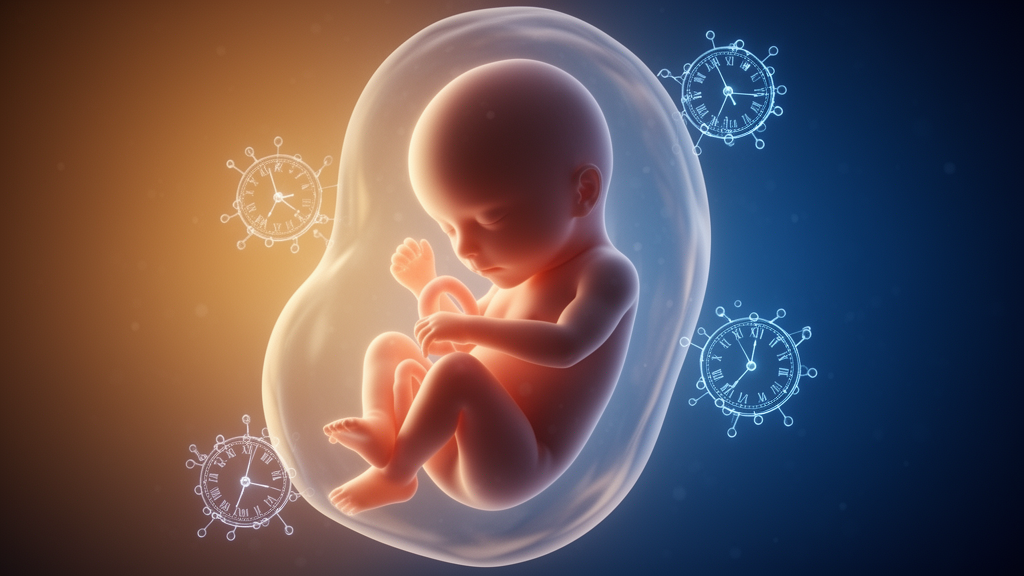
Long before birth, the human circadian clock begins to oscillate, and a new study suggests that the sleep preferences a fetus establishes in the womb may carry over into infancy. Researchers report that fetuses showing a stronger preference for nighttime sleep tended to maintain that preference after birth, pointing to a possible prenatal origin of early sleep behavior.

The study, published in Nature Communications, tracked fetal activity using continuous monitoring during the third trimester of pregnancy. Each recording lasted at least five days, a substantial extension over the short ultrasound snapshots that have historically been used to describe fetal behavioral states. The analysis included 32 mother-child pairs and generated more than 20,000 combined hours of wearable sensor data.

The sensors captured maternal acceleration and temperature alongside fetal acceleration, allowing the team to examine how fetal activity aligned with the day-night cycle, a pattern known as a diurnal rhythm. The authors note that such alignment had remained poorly understood precisely because long-term fetal monitoring has been lacking.

Using multi-level modeling, the researchers identified diurnal rhythms in the fetuses that appeared to align with maternal activity and circadian rhythms. This suggests that the developing fetal clock may be synchronized with signals from the mother, although the observational design of the study cannot establish the mechanisms behind that alignment.

To probe whether these prenatal patterns matter after birth, the team followed the infants to 6 months of age and assessed sleep at three postnatal time points: the first weeks, 3 months, and 6 months. Sleep was measured with sleep diaries and questionnaires completed by the parents.

A machine learning approach, Random Forest analysis, was used to identify which prenatal factors best predicted postnatal infant sleep. The strongest predictor was the fetal day/night sleep duration ratio, described by the authors as a simplified proxy for fetal circadian entrainment. Fetuses that preferred nighttime sleep maintained that preference after birth, according to the study.

Maternal behavior during pregnancy also appeared to leave a mark. Maternal sleep regularity, defined as consistent sleep patterns characterized by low day-to-day variability in sleep timing, predicted infant sleep as well. Specifically, more regular maternal sleep was associated with a stronger preference for nighttime sleep in the infants.

The authors highlight maternal sleep as an actionable target that could potentially improve infant sleep and family well-being, framing the findings as evidence that intrauterine and maternal factors may influence early circadian entrainment. However, they caution that the cohort of 32 mother-child pairs is relatively small, and they advise that the findings should be interpreted with caution until they are replicated in larger, independent cohorts.

The study also tracked diurnal pattern development continuously from in utero to 6 months of age, offering a rare longitudinal view of how circadian rhythms emerge across the transition from fetal to infant life. Because the article is being shared early as a peer-reviewed, accepted manuscript subject to further edits, some details may change in the final version of record.

Subject of Research: Prenatal fetal activity rhythms and their association with postnatal infant sleep behavior

Article Title: Association of fetal activity patterns in utero with postnatal sleep behavior

Article References: Markovic, A., Blume, C., Mühlematter, C., Zimmermann, P., & Kurth, S. (2026). Association of fetal activity patterns in utero with postnatal sleep behavior. Nature Communications. https://doi.org/10.1038/s41467-026-78754-9

Image Credits: AI Generated

DOI: 10.1038/s41467-026-78754-9

Keywords: fetal development, circadian rhythms, infant sleep, pregnancy, wearable sensors, diurnal rhythm, maternal sleep, sleep regularity, third trimester, Nature Communications, Association, fetal

Cite Scienmag News

Harold Sullivan. (October 29, 2026). Fetal day-night rhythms in the womb predict infant sleep patterns. Scienmag. https://scienmag.com/fetal-day-night-rhythms-in-the-womb-predict-infant-sleep-patterns/

Harold Sullivan. "Fetal day-night rhythms in the womb predict infant sleep patterns." Scienmag, 29 October 2026, https://scienmag.com/fetal-day-night-rhythms-in-the-womb-predict-infant-sleep-patterns/. Accessed 4 November 2026.

Harold Sullivan. "Fetal day-night rhythms in the womb predict infant sleep patterns." Scienmag. October 29, 2026. https://scienmag.com/fetal-day-night-rhythms-in-the-womb-predict-infant-sleep-patterns/

Tags: associationcircadian rhythmsdiurnal rhythmearly sleep pattern inheritanceFetalfetal activity monitoringfetal circadian clock formationfetal day-night cyclefetal developmentfetal sleep patternsfetal sleep preference predictioninfant sleeplong-term fetal behavior trackingmaternal sleepmaternal-fetal circadian synchronizationNature Communications.Pregnancyprenatal circadian rhythm developmentprenatal origins of infant sleep behaviorsleep regularitythird trimesterthird trimester fetal behavior studywearable sensor fetal monitoringwearable sensors
Share26Tweet16
Previous Post

Oral JAK inhibitors rapidly calmed severe drug eruptions in small hospital study

Next Post

Neuropsychiatric Symptoms in Alzheimer’s Disease Linked to Amyloid and Heat Shock Proteins

Related Posts

B7-H3 staining patterns in salivary gland carcinomas reveal compartment-specific biomarker clues
Medicine

B7-H3 staining patterns in salivary gland carcinomas reveal compartment-specific biomarker clues

November 4, 2026
Day-one MRI after pituitary surgery shows 93% sensitivity for spotting leftover tumor
Medicine

Day-one MRI after pituitary surgery shows 93% sensitivity for spotting leftover tumor

November 4, 2026
Senescence-Like States in Sensory Neurons May Explain Why Pain Fails to Resolve
Medicine

Senescence-Like States in Sensory Neurons May Explain Why Pain Fails to Resolve

November 4, 2026
Symptom questionnaire shows strong agreement with autonomic neuropathy tests in Zanzibar diabetes clinic
Medicine

Symptom questionnaire shows strong agreement with autonomic neuropathy tests in Zanzibar diabetes clinic

November 4, 2026
Long Noncoding RNA LINC00626 Drives Oxaliplatin Resistance in Liver Cancer Cells
Cancer

Long Noncoding RNA LINC00626 Drives Oxaliplatin Resistance in Liver Cancer Cells

November 4, 2026
Parkinson’s hallucinations: who patients sense may signal disease stage
Medicine

Parkinson’s hallucinations: who patients sense may signal disease stage

November 4, 2026
Next Post
Neuropsychiatric Symptoms in Alzheimer’s Disease Linked to Amyloid and Heat Shock Proteins

Neuropsychiatric Symptoms in Alzheimer's Disease Linked to Amyloid and Heat Shock Proteins

  • Mothers who receive childcare support from maternal grandparents show more optimized

    Mothers who receive childcare support from maternal grandparents show more parental warmth, finds NTU Singapore study

    27656 shares
    Share 11059 Tweet 6912
  • University of Seville Breaks 120-Year-Old Mystery, Revises a Key Einstein Concept

    1061 shares
    Share 424 Tweet 265
  • Bee body mass, pathogens and local climate influence heat tolerance

    682 shares
    Share 273 Tweet 171
  • Researchers record first-ever images and data of a shark experiencing a boat strike

    546 shares
    Share 218 Tweet 137
  • Groundbreaking Clinical Trial Reveals Lubiprostone Enhances Kidney Function

    531 shares
    Share 212 Tweet 133
Science

Embark on a thrilling journey of discovery with Scienmag.com—your ultimate source for cutting-edge breakthroughs. Immerse yourself in a world where curiosity knows no limits and tomorrow’s possibilities become today’s reality!

RECENT NEWS

  • Gd-Rich Magnesium Alloy Gains Strength and Stretchiness at Once
  • Breast and Leg Muscle Stem Cells in Chicks Follow Surprisingly Different Career Paths
  • Social Jetlag Shows Non-Linear Links to Depression and Suicidal Ideation in Exploratory US Survey
  • Magnetic carbon nitride photocatalyst strips dye from water under visible light

Categories

  • Agriculture
  • Anthropology
  • Archaeology
  • Athmospheric
  • Biology
  • Biotechnology
  • Blog
  • Bussines
  • Cancer
  • Chemistry
  • Climate
  • Earth Science
  • Editorial Policy
  • Marine
  • Mathematics
  • Medicine
  • Pediatry
  • Policy
  • Psychology & Psychiatry
  • Science Education
  • Science News
  • Social Science
  • Space
  • Technology and Engineering

Subscribe to Blog via Email

Enter your email address to subscribe to this blog and receive notifications of new posts by email.

Join 5,150 other subscribers

© 2025 Scienmag - Science Magazine

Welcome Back!

Login to your account below

Forgotten Password?

Retrieve your password

Please enter your username or email address to reset your password.

Log In
No Result
View All Result
  • HOME
  • SCIENCE NEWS
  • CONTACT US

© 2025 Scienmag - Science Magazine

Discover more from Science

Subscribe now to keep reading and get access to the full archive.

Continue reading

