

Sunday, November 8, 2026
Science
No Result
View All Result
  • Login
  • HOME
  • SCIENCE NEWS
  • CONTACT US
  • HOME
  • SCIENCE NEWS
  • CONTACT US
No Result
View All Result
Scienmag
No Result
View All Result
Home Science News Technology and Engineering

Federated Unlearning System Removes Drone Data Without Full Network Retraining

November 5, 2026
in Technology and Engineering
Denise Maddox
By Denise Maddox Scienmag Editorial Profile - Mechanical Engineering
Reading Time: 2 mins read
0
Federated Unlearning System Removes Drone Data Without Full Network Retraining

Federated Unlearning System Removes Drone Data Without Full Network Retraining

65
SHARES
587
VIEWS
Share on FacebookShare on Twitter
ADVERTISEMENT

A novel federated unlearning framework, FedUnlearn-HetFL, successfully erased target drone data during collaborative intrusion detection while cutting communication rounds by 95.0 percent and achieving a 1.70-fold execution speedup compared to retraining from scratch. Evaluated on the ISOT Drone benchmark under Dirichlet non-IID partitioning, the framework collapsed target node accuracy from 99.16 percent to 15.98 percent, with the receiver operating characteristic area under the curve dropping from 0.9999 to 0.4842. Concurrently, retained network clients maintained anomaly detection accuracy above 99.2 percent, and black-box membership inference audits confirmed empirical data erasure.

Collaborative intrusion detection across Flying Ad-Hoc Networks allows Unmanned Aerial Vehicles to identify distributed network anomalies, but deploying such systems under privacy regulations like the General Data Protection Regulation Right to be Forgotten faces two primary bottlenecks. First, structural feature heterogeneity stemming from diverse onboard sensor suites causes standard federated learning algorithms like FedAvg to fail. Second, retraining models from scratch imposes a severe computational burden when an individual drone departs the network or requests data retraction.

To handle asymmetric sensor inputs, the framework integrates localized attention-gated autoencoders that project asymmetric client feature dimensions of 40, 45, 50, and 62 features into a unified 64-dimensional latent space coupled with a shared 1D-CNN backbone. When an unlearning request is initiated, FedUnlearn-HetFL executes targeted unlearning via selective layer-frozen gradient ascent on the classification head, resets local input projections, and applies rapid stabilization fine-tuning across retained nodes to support bandwidth- and energy-constrained drone swarms.

Subject of Research: Federated unlearning for feature-heterogeneous drone network anomaly detection

Article Title: A novel federated unlearning framework with feature-heterogeneity-aware aggregation for privacy-preserving UAV anomaly detection

Article References: Ishak, M. K., Ghosh, K. P., Bithi, M., Silamane, J. B., & Hossain, M. A. (2026). A novel federated unlearning framework with feature-heterogeneity-aware aggregation for privacy-preserving UAV anomaly detection. Applied Intelligence, 56(16), Article 546. https://doi.org/10.1007/s10489-026-07570-x

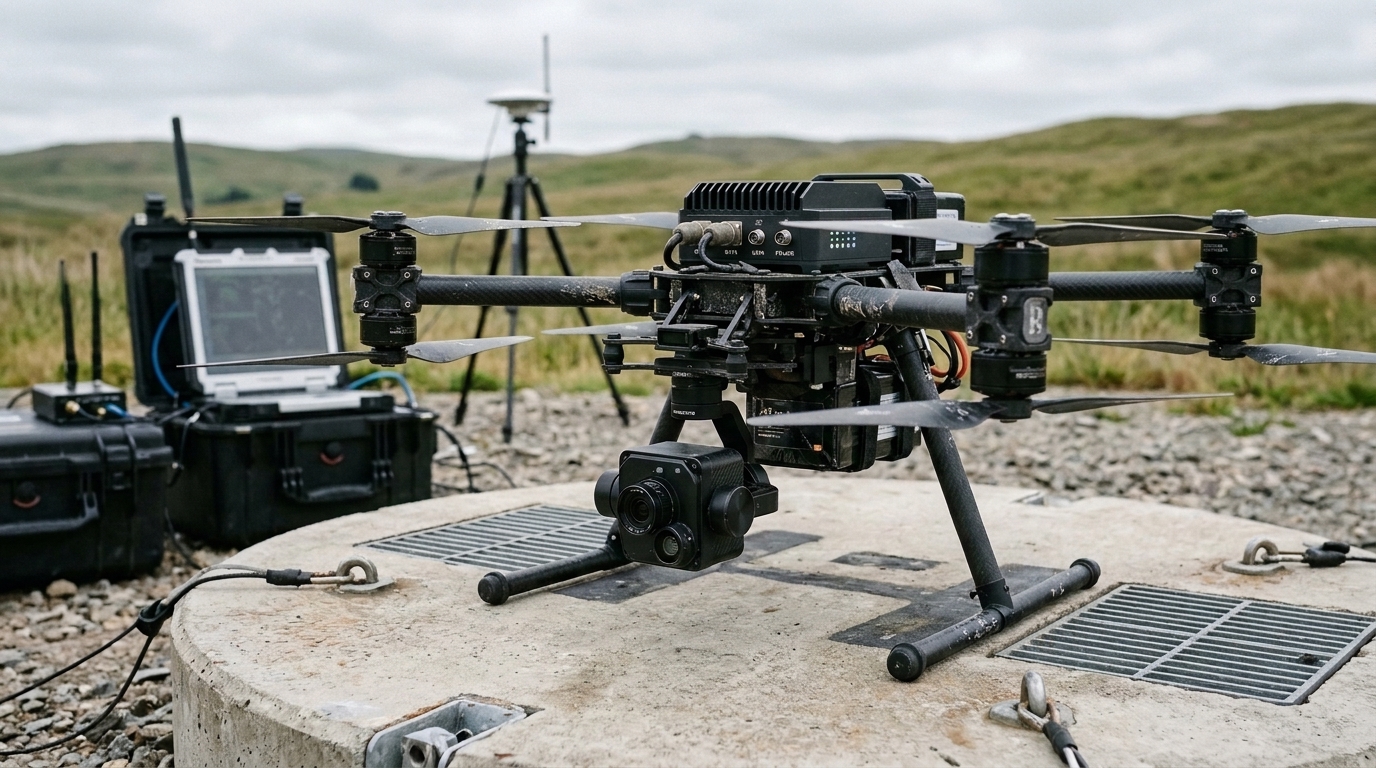
Image Credits: AI Generated

DOI: 10.1007/s10489-026-07570-x

Keywords: unmanned aerial vehicles, flying ad-hoc networks, federated unlearning, anomaly detection, feature heterogeneity, machine learning privacy, gradient ascent, ISOT drone benchmark, novel, federated, unlearning, framework

Cite Scienmag News

Denise Maddox. (November 5, 2026). Federated Unlearning System Removes Drone Data Without Full Network Retraining. Scienmag. https://scienmag.com/federated-unlearning-system-removes-drone-data-without-full-network-retraining/

Denise Maddox. "Federated Unlearning System Removes Drone Data Without Full Network Retraining." Scienmag, 5 November 2026, https://scienmag.com/federated-unlearning-system-removes-drone-data-without-full-network-retraining/. Accessed 8 November 2026.

Denise Maddox. "Federated Unlearning System Removes Drone Data Without Full Network Retraining." Scienmag. November 5, 2026. https://scienmag.com/federated-unlearning-system-removes-drone-data-without-full-network-retraining/

Tags: anomaly detectionfeature heterogeneityfederatedfederated unlearningflying ad-hoc networksframeworkgradient ascentISOT drone benchmarkmachine learning privacynovelUnLearningunmanned aerial vehicles
Share26Tweet16
Previous Post

EMS Students Report Educational Challenges in Obstetric and Gynecologic Emergency Training

Next Post

Rozanolixizumab Reaches a Broad Real-World Myasthenia Gravis Population in the USA

Related Posts

Review: Numerical Simulation of Supersonic Fuel Film Cooling
Technology and Engineering

Review: Numerical Simulation of Supersonic Fuel Film Cooling

November 8, 2026
UKRI Backs Five Research Hubs Developing Health Technologies With £52 Million
Technology and Engineering

UKRI Backs Five Research Hubs Developing Health Technologies With £52 Million

November 8, 2026
KAIST Co-Leads ERC Project Investigating Brain Activity in Freely Moving Monkeys
Technology and Engineering

KAIST Co-Leads ERC Project Investigating Brain Activity in Freely Moving Monkeys

November 8, 2026
Wind Tunnel Study Shows How Counter-Rotating Dual Turbines Steer Wakes
Technology and Engineering

Wind Tunnel Study Shows How Counter-Rotating Dual Turbines Steer Wakes

November 8, 2026
Scientists finally see hydrogen hiding between metal atoms
Technology and Engineering

Scientists finally see hydrogen hiding between metal atoms

November 8, 2026
Dye-Functionalized Collagen Fibers Enable High-Capacity Lysozyme Separation and Purification
Technology and Engineering

Dye-Functionalized Collagen Fibers Enable High-Capacity Lysozyme Separation and Purification

November 8, 2026
Next Post
Rozanolixizumab Reaches a Broad Real-World Myasthenia Gravis Population in the USA

Rozanolixizumab Reaches a Broad Real-World Myasthenia Gravis Population in the USA

  • Mothers who receive childcare support from maternal grandparents show more optimized

    Mothers who receive childcare support from maternal grandparents show more parental warmth, finds NTU Singapore study

    27656 shares
    Share 11059 Tweet 6912
  • University of Seville Breaks 120-Year-Old Mystery, Revises a Key Einstein Concept

    1061 shares
    Share 424 Tweet 265
  • Bee body mass, pathogens and local climate influence heat tolerance

    682 shares
    Share 273 Tweet 171
  • Researchers record first-ever images and data of a shark experiencing a boat strike

    546 shares
    Share 218 Tweet 137
  • Groundbreaking Clinical Trial Reveals Lubiprostone Enhances Kidney Function

    531 shares
    Share 212 Tweet 133
Science

Embark on a thrilling journey of discovery with Scienmag.com—your ultimate source for cutting-edge breakthroughs. Immerse yourself in a world where curiosity knows no limits and tomorrow’s possibilities become today’s reality!

RECENT NEWS

  • Satellite Analysis Tracks Surface Temperatures and Vegetation Dynamics Across Thanjavur District
  • Iodine Measurements on Photon-Counting CT Track CA 19-9 in Pancreatic Cancer
  • Review: Numerical Simulation of Supersonic Fuel Film Cooling
  • Survey Assesses Syrian Parents’ Knowledge of Pediatric Epistaxis First Aid

Categories

  • Agriculture
  • Anthropology
  • Archaeology
  • Athmospheric
  • Biology
  • Biotechnology
  • Blog
  • Bussines
  • Cancer
  • Chemistry
  • Climate
  • Earth Science
  • Editorial Policy
  • Marine
  • Mathematics
  • Medicine
  • Pediatry
  • Policy
  • Psychology & Psychiatry
  • Science Education
  • Science News
  • Social Science
  • Space
  • Technology and Engineering

Subscribe to Blog via Email

Enter your email address to subscribe to this blog and receive notifications of new posts by email.

Join 5,150 other subscribers

© 2025 Scienmag - Science Magazine

Welcome Back!

Login to your account below

Forgotten Password?

Retrieve your password

Please enter your username or email address to reset your password.

Log In
No Result
View All Result
  • HOME
  • SCIENCE NEWS
  • CONTACT US

© 2025 Scienmag - Science Magazine

Discover more from Science

Subscribe now to keep reading and get access to the full archive.

Continue reading

