

Sunday, November 15, 2026
Science
No Result
View All Result
  • Login
  • HOME
  • SCIENCE NEWS
  • CONTACT US
  • HOME
  • SCIENCE NEWS
  • CONTACT US
No Result
View All Result
Scienmag
No Result
View All Result
Home Science News Technology and Engineering

Federated Learning Lets IoT Devices Cluster Time Series Without Sharing Raw Data

October 24, 2026
in Technology and Engineering
Veronica Carney
By Veronica Carney Scienmag Editorial Profile - Federated Learning
Reading Time: 3 mins read
0
Federated Learning Lets IoT Devices Cluster Time Series Without Sharing Raw Data

Federated Learning Lets IoT Devices Cluster Time Series Without Sharing Raw Data

65
SHARES
587
VIEWS
Share on FacebookShare on Twitter
ADVERTISEMENT

Internet of Things networks generate torrents of sensor data around the clock, but the standard way to find patterns in that data — shipping every raw reading to a central server for clustering — carries a double penalty. It exposes potentially sensitive information and it floods the network with traffic. A study published in the International Journal of Machine Learning and Cybernetics on 24 October 2026 proposes a way around both problems with a framework the authors call FedAE-KMeans.

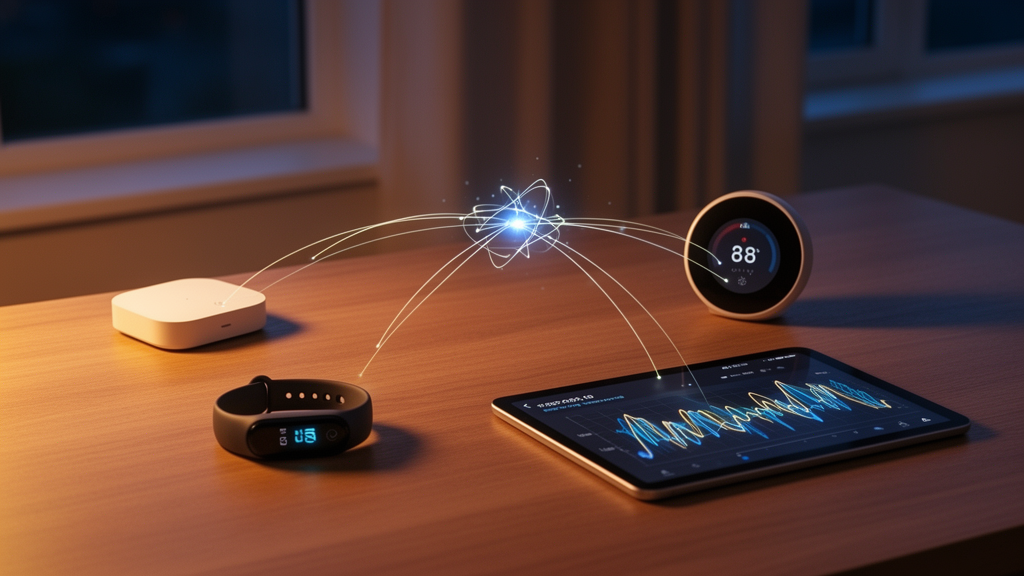
The core idea is to split the work between the devices and the server. Each IoT device trains a small autoencoder on its own local time series, learning to compress high-dimensional raw signals into compact latent vectors. Only those compressed representations, not the underlying sensor data, are transmitted to a central server, which then runs standard KMeans clustering in the shared latent space.

This architecture means the server never sees a single raw sample. Sensitive measurements stay on the device where they were produced, while the server still gains access to features rich enough to group devices and time windows into meaningful clusters. The design also attacks the communication bottleneck, because latent embeddings are far smaller than the raw data streams that centralized pipelines would normally move across the network.

The researchers evaluated the framework under non-IID data distributions, the heterogeneous conditions that mirror real deployments where each device sees a different slice of the world. On the MNIST benchmark, FedAE-KMeans reached a silhouette score of 0.677 and a clustering purity of 89.3 percent, improving purity by more than 16 percent compared with standard KMeans applied without the learned representations. The more demanding CIFAR-10 dataset stressed the method further.

There the framework attained a clustering purity of 78.6 percent and reduced the Davies–Bouldin Index to 1.08, a metric where lower values indicate better cluster compactness and separation. The authors interpret these numbers as evidence that the autoencoder-derived latent space remains effective even when the data held by individual devices are far from uniformly distributed. Communication efficiency proved to be one of the most striking results.

By transmitting only latent embeddings instead of raw samples, the framework reduced communication overhead to less than 8 percent of the data volume typically required by centralized methods. That reduction follows directly from the size difference between compressed latent vectors and the raw samples centralized approaches must transmit. The balance the framework strikes is threefold.

Clustering accuracy is preserved or improved through learned representations, privacy is protected because raw data never leave the device, and network load is reduced because only compressed vectors travel. The authors present this triad as the central contribution of the work for distributed IoT environments. It is worth noting the scope of the evidence.

The reported experiments were conducted on MNIST and CIFAR-10 under non-IID conditions rather than on live deployments of physical sensor networks, so the results demonstrate clustering effectiveness and robustness on benchmark data rather than field performance. The abstract describes the evaluation as extensive, but readers should treat the benchmarks as a proxy for the heterogeneous data conditions found in IoT networks. Within that scope, the study offers a concrete recipe for distributed pattern discovery: devices learn useful representations locally and hand up only distilled features, so clustering across large fleets of sensors no longer requires surrendering the raw data.

Subject of Research: Federated privacy-preserving time series clustering for distributed IoT devices

Article Title: Cross-device privacy preservation time series clustering in IoT networks space with federated learning algorithm

Article References: Rajpar, S. A., Chen, H., & Ashiru, A. (2026). Cross-device privacy preservation time series clustering in IoT networks space with federated learning algorithm. International Journal of Machine Learning and Cybernetics, 17(11), Article 506. https://doi.org/10.1007/s13042-026-03338-4

Image Credits: AI Generated

DOI: 10.1007/s13042-026-03338-4

Keywords: federated learning, IoT, time series clustering, autoencoder, KMeans, privacy preservation, non-IID data, latent representations, communication efficiency, MNIST, CIFAR-10, Cross-device

Cite Scienmag News

Veronica Carney. (October 24, 2026). Federated Learning Lets IoT Devices Cluster Time Series Without Sharing Raw Data. Scienmag. https://scienmag.com/federated-learning-lets-iot-devices-cluster-time-series-without-sharing-raw-data/

Veronica Carney. "Federated Learning Lets IoT Devices Cluster Time Series Without Sharing Raw Data." Scienmag, 24 October 2026, https://scienmag.com/federated-learning-lets-iot-devices-cluster-time-series-without-sharing-raw-data/. Accessed 15 November 2026.

Veronica Carney. "Federated Learning Lets IoT Devices Cluster Time Series Without Sharing Raw Data." Scienmag. October 24, 2026. https://scienmag.com/federated-learning-lets-iot-devices-cluster-time-series-without-sharing-raw-data/

Tags: autoencoderautoencoder-based data compression in IoTCIFAR-10communication efficiencyCross-devicedecentralized time series clustering methodsfederated KMeans clustering in IoT systemsfederated learningFederated learning for IoT device data clusteringIoTKMeanslatent representationslatent space representations for sensor datalocal feature extraction for IoT devicesminimizing data transmission in IoT networksMNISTnon-IID dataprivacy preservationprivacy-aware machine learning for IoTprivacy-preserving sensor data analysisreducing network traffic with federated learningscalable clustering of IoT sensor streamssecure IoT network data processingtime-series clustering
Share26Tweet16
Previous Post

Yak defensin plasmid reduces mastitis inflammation in cell and mouse models

Next Post

Immunochemotherapy before surgery doubles pathologic response in advanced cervical cancer

Related Posts

Participatory Poster Design Translates Youth Flood Experiences into Local Disaster Risk Communication
Technology and Engineering

Participatory Poster Design Translates Youth Flood Experiences into Local Disaster Risk Communication

November 15, 2026
Standardized Frequency Filter Optimization Reduces Motion Sickness in Autonomous Vehicle Simulations
Technology and Engineering

Standardized Frequency Filter Optimization Reduces Motion Sickness in Autonomous Vehicle Simulations

November 15, 2026
Blended Carbonate and Hydroxide Activators Accelerate Slag Mine Backfill Strength
Technology and Engineering

Blended Carbonate and Hydroxide Activators Accelerate Slag Mine Backfill Strength

November 15, 2026
AI Pipeline Maps Operational Artifacts to NIST Controls with High Accuracy
Technology and Engineering

AI Pipeline Maps Operational Artifacts to NIST Controls with High Accuracy

November 14, 2026
Implanted Brain-Computer Interfaces Help Paralyzed Clinical Trial Participants Restore Expressive Communication
Technology and Engineering

Implanted Brain-Computer Interfaces Help Paralyzed Clinical Trial Participants Restore Expressive Communication

November 14, 2026
Portable Fabric Sensor Quickly and Accurately Detects Forever Chemicals in Water
Technology and Engineering

Portable Fabric Sensor Quickly and Accurately Detects Forever Chemicals in Water

November 14, 2026
Next Post
Immunochemotherapy before surgery doubles pathologic response in advanced cervical cancer

Immunochemotherapy before surgery doubles pathologic response in advanced cervical cancer

  • Mothers who receive childcare support from maternal grandparents show more optimized

    Mothers who receive childcare support from maternal grandparents show more parental warmth, finds NTU Singapore study

    27656 shares
    Share 11059 Tweet 6912
  • University of Seville Breaks 120-Year-Old Mystery, Revises a Key Einstein Concept

    1061 shares
    Share 424 Tweet 265
  • Bee body mass, pathogens and local climate influence heat tolerance

    682 shares
    Share 273 Tweet 171
  • Researchers record first-ever images and data of a shark experiencing a boat strike

    546 shares
    Share 218 Tweet 137
  • Groundbreaking Clinical Trial Reveals Lubiprostone Enhances Kidney Function

    531 shares
    Share 212 Tweet 133
Science

Embark on a thrilling journey of discovery with Scienmag.com—your ultimate source for cutting-edge breakthroughs. Immerse yourself in a world where curiosity knows no limits and tomorrow’s possibilities become today’s reality!

RECENT NEWS

  • Super-Resolution MRI Enhances Preoperative Prediction of Cervical Cancer Vascular Invasion
  • Participatory Poster Design Translates Youth Flood Experiences into Local Disaster Risk Communication
  • Standardized Frequency Filter Optimization Reduces Motion Sickness in Autonomous Vehicle Simulations
  • Study Investigates Nontrivial Solutions for Nonlocal Neumann Problems

Categories

  • Agriculture
  • Anthropology
  • Archaeology
  • Athmospheric
  • Biology
  • Biotechnology
  • Blog
  • Bussines
  • Cancer
  • Chemistry
  • Climate
  • Earth Science
  • Editorial Policy
  • Marine
  • Mathematics
  • Medicine
  • Pediatry
  • Policy
  • Psychology & Psychiatry
  • Science Education
  • Science News
  • Social Science
  • Space
  • Technology and Engineering

Subscribe to Blog via Email

Enter your email address to subscribe to this blog and receive notifications of new posts by email.

Join 5,150 other subscribers

© 2026 Scienmag - Science Magazine

Welcome Back!

Login to your account below

Forgotten Password?

Retrieve your password

Please enter your username or email address to reset your password.

Log In
No Result
View All Result
  • HOME
  • SCIENCE NEWS
  • CONTACT US

© 2026 Scienmag - Science Magazine

Discover more from Science

Subscribe now to keep reading and get access to the full archive.

Continue reading

