


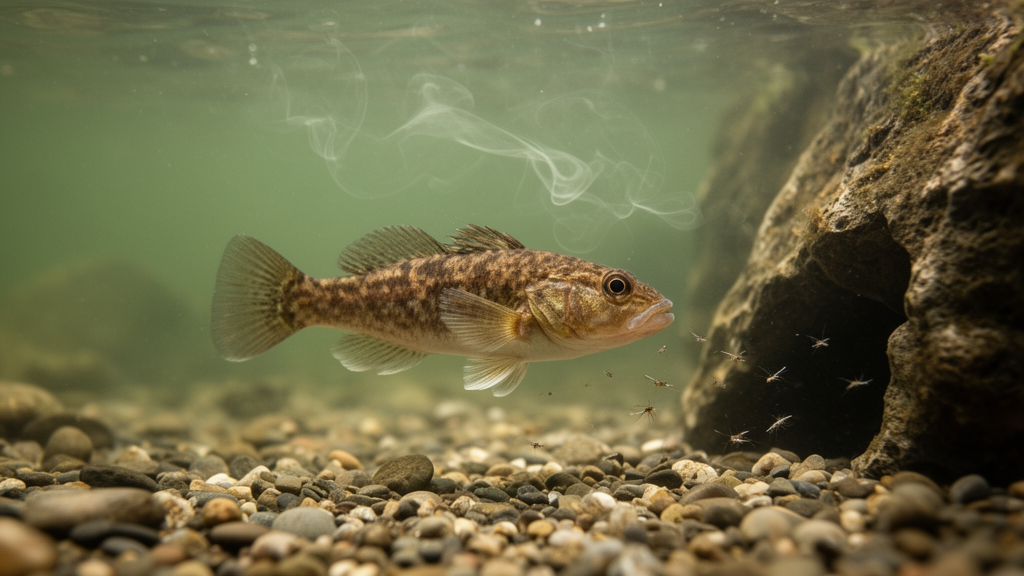
The round goby (Neogobius melanostomus) has earned its reputation as one of the most troublesome aquatic invaders in the world. Originating from the Ponto-Caspian region, this small benthic fish has colonized river basins and lakes across Europe and North America, earning a place among the 100 worst invasive species in Europe. Its success is built on a formidable combination of traits: high consumption rates, multiple spawning events within a single season, and a non-selective appetite that allows it to exploit nearly anything edible on the riverbed. Once established, populations often become dominant, displacing native fish through dietary overlap, restructuring benthic communities, opening new trophic pathways for pollutants, and destabilizing entire food webs.
A new experimental study published in the journal NeoBiota offers a surprising twist to this grim story. Researchers set out to determine whether the mere smell of a predator could dampen the goby’s voracity, using a framework known as the functional response, which links prey density to the amount of prey consumed. Their findings provide the first experimental evidence that predation risk alone, conveyed entirely through chemical cues in the water, can measurably reduce the foraging activity of the round goby. The implications reach beyond the laboratory: they suggest that restoring populations of native predators such as the European eel could help blunt the invader’s ecological impact without a single goby being eaten.
The logic behind the experiment rests on a well-established principle in ecology. Predators affect their prey in two distinct ways. The consumptive effect is the obvious one: prey are eaten. But predators also exert non-consumptive effects, in which prey, sensing danger through visual or chemical signals, change their behavior. They hide more, forage less, and become more vulnerable to other threats. Studies across many systems have shown that these non-consumptive effects can be equal to or even stronger than direct predation in shaping ecosystems. In water, where visibility is often poor, chemical cues are the primary channel for transmitting such information, and fish possess among the most sensitive olfactory systems of any vertebrate group.
To test whether the round goby responds to this underwater warning system, the researchers collected 1,033 gobies from the Elbe River in the Czech Republic and acclimatized them in a recirculating aquaculture system. As the model predator they chose the European eel (Anguilla anguilla), a critically endangered native fish that shares the goby’s benthic lifestyle, similar temperature preferences, and the same structural habitat of rocky riprap. The two species coexist in the Elbe, gobies regularly appear in eel stomachs, and the eel’s elongated body allows it to pursue prey into the very shelters that gobies favor. Fourteen eels were divided into two groups: one was fed round gobies, the other earthworms, for a ten-week acclimatization period.
This dietary split was the crux of the design. Water from the eel tanks flowed continuously into tanks holding experimental arenas, each containing a single goby. In the conspecific treatment, the water carried chemical cues from eels digesting round gobies, enriched with alarm cues extracted from goby skin. In the heterospecific treatment, the water carried cues from eels that had eaten only earthworms. A control treatment used plain filtered water with no cues at all. The researchers then offered each goby live chironomid larvae, a staple of the goby’s natural diet, at six densities ranging from 20 to 650 milligrams per arena, and recorded how much prey was consumed over 24 hours. A total of 108 gobies were tested across six trials, and each fish was used only once.
The data revealed something subtle and important. In every treatment, including the risk-free control, the goby’s predation on chironomid larvae followed a Type II functional response, meaning the proportion of prey consumed declines as prey density rises, an unsaturating pattern that can destabilize predator-prey dynamics because the predator concentrates disproportionately on scarce prey. But the parameters underlying that curve changed dramatically with the scent of danger. When gobies were exposed to the combination of eel chemical cues and alarm cues from their own kind, their attack rate, which governs how efficiently they find and consume prey at low densities, dropped significantly compared with both the control and the heterospecific treatment.
The heterospecific treatment produced a different signature. Rather than reducing the attack rate, cues from eels fed earthworms lengthened the gobies’ handling time, the time needed to capture, ingest, and digest each prey item, which in turn lowered the maximum feeding rate achievable at high prey densities. Intriguingly, the handling times in the control and conspecific treatments were nearly identical, and the maximum observed food intake, measured at the two highest prey densities, did not differ among treatments at all. The researchers caution that they cannot yet determine whether the heterospecific effect arose from alarm cues released by the earthworms, from chemicals produced by eels digesting them, or perhaps even from earthworm-derived cues acting as a feeding stimulus.
Why should the two kinds of risk produce such different effects? The authors suggest that the conspecific alarm cues, chemical signals released from the skin of injured gobies, indicate a particularly acute danger: a predator that is actively eating round gobies nearby. Faced with this double warning, the fish appear to adopt avoidance behavior, cutting their foraging effort precisely in habitats where prey is scarce and the perceived risk is extreme. The heterospecific cues, by contrast, seem to slow prey processing rather than prey searching, a distinction that maps neatly onto the two classic parameters of functional response theory. The study also confirmed that handling time declines with goby body size, consistent with the influence of gape size and digestive capacity, while attack rate remained independent of size, reflecting the species’ generally efficient searching ability.
The findings matter because the round goby’s dominance over native benthic communities has long been attributed almost entirely to direct consumption. Previous research had documented physiological and behavioral stress responses in gobies exposed to alarm cues, including elevated cortisol and increased operculum movement, but no study had connected predation risk to the actual strength of the goby’s trophic interactions. By showing that fear alone reshapes the functional response, the study closes a critical gap and lends quantitative support to the idea of predator-driven biotic resistance against invasive species. It also aligns with earlier evidence that eels can effectively control populations of invasive crayfish and that burbot exert heavy consumptive pressure on gobies in the Great Lakes region.
There are important caveats. The experiment ran for only 24 hours per fish, used a single prey species and a single predator species, and employed eel densities that exceed those typical of most European rivers today. The gobies also came from an established population, and behavioral studies suggest that individuals at the leading edge of an invasion tend to be bolder and may respond less strongly to risk. Yet even bold individuals carry higher metabolic rates and foraging demands that expose them to predation, meaning the total suppressive effect, consumptive plus non-consumptive, may remain substantial across population types. In the wild, gobies are eaten by many predators, from burbot to piscivorous birds, and the cumulative non-consumptive pressure could equal or exceed what was measured here.
The conservation message is sobering but constructive. Native predator populations in Central Europe have collapsed under pressure from river modification, habitat homogenization, angling, commercial fisheries, and cormorant predation, leaving many invaded waters functionally predator-free and therefore highly invasible. This study suggests that rebuilding those populations would do more than restore a missing link in the food web: it would actively suppress the foraging impact of the round goby on native macrozoobenthos, reduce its competition with native benthic fish, and limit the transfer of accumulated pollutants up the food chain. Habitat restoration and sensible fisheries regulation, the same tools needed to save the critically endangered European eel, may thus double as a quiet, chemical form of invasion control, letting fear itself defend the riverbed.
Subject of Research: Non-consumptive effects of native predator chemical cues on the functional response of the invasive round goby
Article Title: Diet-specific predation risk cues modulate the functional response of the round goby ( Neogobius melanostomus )
Article References: Franta, P., Szydłowska, N. Z., Boukal, D. S., Kolář, V., Gebauer, R., Mikšovská, V., & Drozd, B. (2026). Diet-specific predation risk cues modulate the functional response of the round goby (Neogobius melanostomus). NeoBiota, 109, 157-176. https://doi.org/10.3897/neobiota.109.201021
Image Credits: AI Generated
DOI: 10.3897/neobiota.109.201021
Keywords: round goby, Neogobius melanostomus, European eel, functional response, non-consumptive effects, chemical cues, invasive species, biological invasions, predation risk, freshwater ecology, benthic communities, biotic resistance
Cite Scienmag News
Patricia Pace. (October 15, 2026). Fear on the Riverbed: Eel Chemical Cues Curb the Foraging of Invasive Round Goby. Scienmag. https://scienmag.com/fear-on-the-riverbed-eel-chemical-cues-curb-the-foraging-of-invasive-round-goby/
Patricia Pace. "Fear on the Riverbed: Eel Chemical Cues Curb the Foraging of Invasive Round Goby." Scienmag, 15 October 2026, https://scienmag.com/fear-on-the-riverbed-eel-chemical-cues-curb-the-foraging-of-invasive-round-goby/. Accessed 15 October 2026.
Patricia Pace. "Fear on the Riverbed: Eel Chemical Cues Curb the Foraging of Invasive Round Goby." Scienmag. October 15, 2026. https://scienmag.com/fear-on-the-riverbed-eel-chemical-cues-curb-the-foraging-of-invasive-round-goby/


