


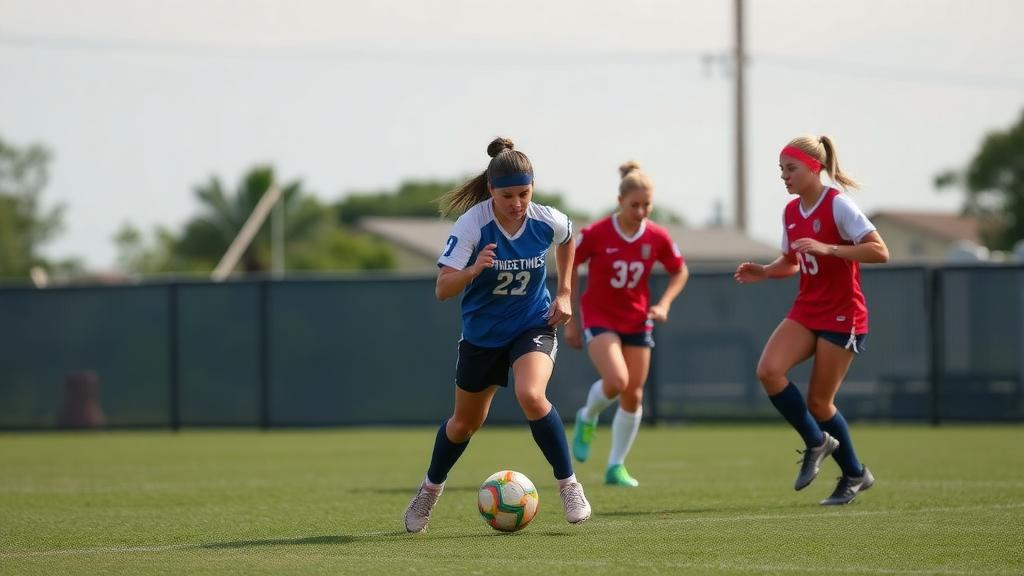
For a female footballer, tearing an anterior cruciate ligament is one of the most devastating moments a career can hold. The knee gives way during a cutting movement, surgery or months of rehabilitation follow, and the athlete begins the long climb back toward the pitch. Yet a growing body of evidence suggests that the hardest part of that journey may not be rebuilding muscle or restoring range of motion. It may be rebuilding the mind. A new scoping review published in Sports Medicine – Open by researchers at Bond University and Flinders University has systematically mapped how psychological and social factors shape whether female football players return to sport and physical activity after an ACL injury, and the findings reveal a recovery process far more complex than any physical milestone can capture.
The scale of the problem is striking. ACL injury rates have doubled over the past two decades in both sexes, despite widespread adoption of injury prevention programmes, and Australia now records the highest and fastest-growing rate of ACL reconstruction surgery in the world. Female athletes carry a disproportionate share of this burden. In team sports, women face two to eight times greater risk of ACL injury than men, and the incidence in female soccer players is roughly 2.5 times higher than in their male counterparts. In Australian football, the relative risk for women, adjusted for season length and exposure hours, is 6.6 times that of men. As female participation in sport has grown more than tenfold over four decades, so too has the population of athletes navigating this injury.
Recovery outcomes are equally uneven. Irrespective of whether the injury is managed surgically or non-surgically, many athletes never return to their previous level of competition, if they return at all. One cited study found that only 37.3 percent of female athletes returned to their preinjury level of sport, and only 56 percent reported satisfaction with their physical activity levels. A recent meta-analysis also revealed that women report inferior activity and knee-related outcomes after ACL injury compared with men. Standard rehabilitation, meanwhile, remains anchored to objective physical milestones such as strength and hop tests, often leaving psychological and social dimensions unexamined. The new review set out to close that gap for female footballers specifically, drawing on the biopsychosocial model of athletic injury rehabilitation, which frames recovery as a dynamic interplay of biological, psychological, and social factors.
Methodologically, the review was rigorous. The researchers searched six electronic databases, including SCOPUS, CINAHL, MEDLINE, SPORTDiscus, PsycInfo, and Embase, on 1 May 2025, following the PRISMA extension for scoping reviews with a prospectively registered protocol on the Open Science Framework. Two reviewers independently screened 582 titles and abstracts, then assessed 74 full-text articles against eligibility criteria requiring female athletes with a mean age of 18 or older, participation in any football code, ACL injury managed surgically or non-surgically, and investigation of psychosocial influences on return to sport or physical activity. Just seven studies made the cut, encompassing 403 female players aged 16 to 56, with time since injury ranging from 1.5 to 24 years. Five of the seven used qualitative methods such as interviews and focus groups; two used questionnaires, including the ACL-Return to Sport after Injury scale and the Tegner Activity Score.
The numbers within those seven studies tell their own story. Of the 403 players, 222, or 55.1 percent, returned to sport, while 181, or 44.9 percent, did not. Among those who did return, competition levels ranged from elite international athletes to recreational players, and several dropped to lower levels than before their injury. Of the women who never returned to football, only ten, about 5.5 percent of non-returners, resumed other physical activities such as running, walking, or cycling, and even they fell short of their desired activity levels. Notably, six of the seven studies included both sexes, with female participants representing roughly 10 percent of samples, and 17 otherwise eligible studies were excluded because results were not reported separately for women, a stark illustration of the gendered gaps in sports science research.
From the synthesis, six psychosocial themes emerged: uncertainty, confidence, fear, motivation, social support, and athletic identity. Four operated predominantly as barriers. Uncertainty, the lack of knowledge about how to progress through rehabilitation or resume activity, pushed some players to lower competition levels or out of soccer entirely. One participant’s faltering recollection of being told simply to quit soccer captured the disorientation. Lack of confidence, present in six of the seven studies, manifested as distrust in the reconstructed knee; one player said she did not think she would ever quite have the confidence to perform sideways movements again. Fear of reinjury or pain emerged across five studies as the predominant barrier, with some athletes altering, limiting, or avoiding activity even decades later, and even those who knew their knees were structurally stable could not overcome it.
Social support, or the lack of it, cut both ways. Women who felt abandoned by healthcare professionals, or like outsiders unable to maintain peer relationships while injured, described social isolation that contributed to quitting sport or dropping down a level. Some said they had given up on physiotherapists because nobody seemed able to help them. Conversely, players embedded in supportive networks of teammates, coaches, family, and clinicians were more likely to return at their preinjury level. One athlete described teammates deliberately working at a lower technical intensity to expose her to contact situations in training, and being just as excited for her on game day as she was. That sense of being valued, the review suggests, reinforces identity and mitigates fear, creating a virtuous cycle that supports return.
The facilitators formed a coherent psychological toolkit. Confidence, when it developed through trust in clinicians and achievement of physical milestones, helped players return at or near their previous level; one described training fully with contact and cutting for three months before feeling ready, free of knee awareness. Motivation, the love of the game and the conviction of having matches left to play, drove others past their fear, with one cross-sectional study finding that players who returned scored significantly higher on motivation measures than those who did not. Athletic identity, the degree to which football was central to a player’s sense of self, pushed strong-identifying athletes back onto the field, though the review cautions it can be a double-edged sword, offering short-term motivational benefits while posing longer-term psychological risks if not balanced with a broader sense of self.
The clinical implications are significant. The authors argue that psychosocial screening should be incorporated routinely into rehabilitation and return-to-sport decision-making for female footballers, alongside physical testing. Fear of reinjury, in particular, may require strategies beyond physical rehabilitation, such as graded exposure to feared movements, with cutting and direction change, the very mechanisms of ACL injury, identified as common fear-evoking tasks. Referral to a sport psychologist may be warranted when risk factors surface. The stakes extend well beyond sport: female athletes with prior ACL injury face four to six times greater risk of knee osteoarthritis and more than double the risk of total joint replacement within 15 years, making sustained physical activity a long-term health imperative, not merely an athletic one.
What the review ultimately exposes is a research culture still calibrated to male athletes. Only about 6 percent of sport and exercise science studies focus exclusively on females, and women face sociocultural headwinds their male counterparts do not, including lower pay, reduced access to allied health support, short-term contracts, financial insecurity, and punishing schedules, with injured female players competing in nearly twice as many back-to-back fixtures. Females have a 25 percent lower rate of return to sport within five years of reconstruction, alongside greater psychological distress. The authors call for high-quality, female-focused research with longitudinal and quantitative designs to establish causality, and for future mixed-sex studies to report data separately by sex. Until then, the message for clinicians, coaches, and teammates is clear: a knee may heal on a timetable, but the mind returns to sport on its own, and it needs to be trained just as deliberately.
Subject of Research: Psychosocial factors influencing return to sport and physical activity in female football players after anterior cruciate ligament injury
Article Title: The Role of Psychosocial Factors in Returning to Physical Activity and Sport Among Female Football Players After Anterior Cruciate Ligament Injury: A Scoping Review
Article References: Meredith, S., Farley, J. B., Hunt, J., & Dent, E. (2026). The Role of Psychosocial Factors in Returning to Physical Activity and Sport Among Female Football Players After Anterior Cruciate Ligament Injury: A Scoping Review. Sports Medicine – Open, 12(1), Article 148. https://doi.org/10.1186/s40798-026-01118-6
Image Credits: AI Generated
DOI: 10.1186/s40798-026-01118-6
Keywords: ACL injury, female footballers, return to sport, fear of reinjury, psychosocial factors, sports rehabilitation, athletic identity, social support, women's soccer, scoping review, sports psychology, knee injury
Cite Scienmag News
Glenn Wilkins. (October 3, 2026). Fear, Confidence and Teammates: The Hidden Forces Shaping Women’s Football Comebacks After ACL Injury. Scienmag. https://scienmag.com/fear-confidence-and-teammates-the-hidden-forces-shaping-womens-football-comebacks-after-acl-injury/
Glenn Wilkins. "Fear, Confidence and Teammates: The Hidden Forces Shaping Women’s Football Comebacks After ACL Injury." Scienmag, 3 October 2026, https://scienmag.com/fear-confidence-and-teammates-the-hidden-forces-shaping-womens-football-comebacks-after-acl-injury/. Accessed 4 October 2026.
Glenn Wilkins. "Fear, Confidence and Teammates: The Hidden Forces Shaping Women’s Football Comebacks After ACL Injury." Scienmag. October 3, 2026. https://scienmag.com/fear-confidence-and-teammates-the-hidden-forces-shaping-womens-football-comebacks-after-acl-injury/


