


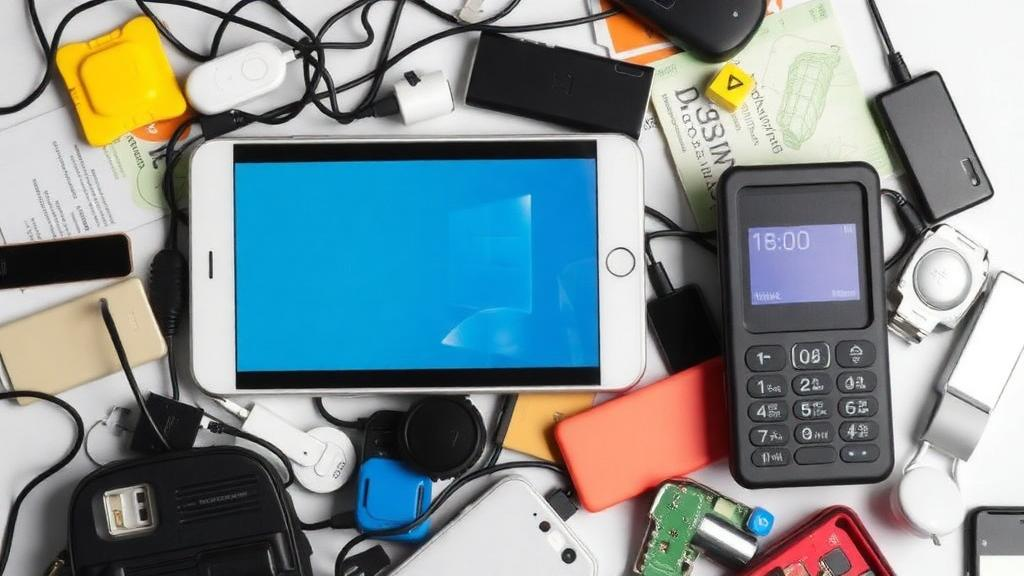
Just weeks before Black Friday unleashes one of the biggest electronics shopping sprees of the year, a new European survey has put a number on one of the fastest-growing and least visible waste streams on the planet. Researchers call it Fast Tech: the flood of USB adapters, mini fans, LED string lights, wireless earbuds, electronic toys and other small, inexpensive gadgets that flow into homes by the billions and then vanish into drawers, rubbish bins and, increasingly, the waste stream. According to a survey of 10,245 adults across 12 European countries, commissioned by the WEEE Forum and conducted by Bellegarde Scientific Consulting, nearly 90 percent of European consumers own at least one such device, and 78 percent bought one in the past year alone. What happens to those devices when they break, bore their owners or simply stop being wanted is emerging as one of the defining environmental blind spots of the digital age.
The scale of the phenomenon is staggering. Separate research by Material Focus found that in the United Kingdom alone, more than half a billion small Fast Tech electrical items were purchased in a single year, roughly 16 items every second. The term itself is a deliberate echo of fast fashion: products that are cheap, ubiquitous, used briefly and replaced without much thought. The survey suggests consumers have fully internalized that bargain. Fifty-eight percent of buyers could recall a Fast Tech product they used for no more than six months, including 39 percent who recalled discarding one unused, after a single use or within a month of purchase. Yet satisfaction remains remarkably high, with 61 percent of Fast Tech consumers saying they are content overall and only 8 percent dissatisfied. Low price, cited by 55 percent of buyers, and convenience appear to trump nearly every other consideration.
Perhaps the most revealing finding is a paradox at the heart of consumer attitudes. Shoppers understand perfectly well that these products are disposable. Forty-six percent expect Fast Tech to have a shorter lifespan than more expensive alternatives. But the environmental implications barely register: only 21 percent consider Fast Tech more environmentally harmful than costlier products, and just 16 percent simultaneously associate it with both a shorter life and greater environmental harm. As Dimitri Naczaj, co-founder of Bellegarde Scientific Consulting, put it, consumers understand that an inexpensive electronic product may not last forever; far less visible is what happens when millions of individual purchasing decisions become millions of discarded cables, earbuds, lights, toys and gadgets. That gap between awareness of fragility and awareness of consequence is precisely where the waste crisis grows.
So where do dead Fast Tech devices actually go? The survey found no single dominant route, and that fragmentation is itself part of the problem. Keeping devices at home was the most common outcome, reported by 29 percent of buyers, meaning drawers and cupboards across Europe are quietly filling with dormant electronics. Just 27 percent took products to recycling centres or municipal facilities, and 19 percent used in-store collection points. Incorrect disposal was widespread: 23 percent reported putting Fast Tech into household waste, 21 percent into plastics recycling, and 7 percent into street bins. Overall, 27 percent of buyers reported using only waste-disposal routes for unwanted devices, while 32 percent used only recycling or reuse routes. Some survey questions allowed multiple responses, but the pattern is clear: a large share of small electronics never reaches the systems built to recover their materials.
Strikingly, incorrect disposal is not always deliberate. Among respondents who reported using only waste-disposal routes, 21 percent said they did so to protect the environment, a figure that points to deep confusion about where small electronics belong. Habit was the most commonly cited reason for end-of-life choices overall, followed by environmental protection and convenience. The materials at stake are far from trivial. Fast Tech products contain plastics, metals and other recoverable resources that are simply lost when devices are thrown into general waste. And a growing proportion contain lithium-ion batteries, which introduce a hazard that extends far beyond wasted resources.
When battery-powered devices are discarded with household rubbish, they can be crushed or punctured inside collection vehicles, sorting plants and waste-treatment facilities, potentially igniting fires that endanger workers, damage equipment and disrupt waste services. The problem is not hypothetical. Findings from the WEEE Forum’s Batteries Roundtable show that 36 percent of e-waste operators surveyed reported experiencing a battery-related fire at their facilities during the previous year. In France, the number of fires at waste-treatment facilities linked to lithium batteries doubled between 2019 and 2023. Single-use vapes, wireless earbuds, small electronic toys and other battery-powered products are singled out as items of particular concern. As Magdalena Charytanowicz of the WEEE Forum and coordinator of International E-Waste Day warned, a tiny battery-powered gadget tossed into a household bin may seem inconsequential, but multiplied by millions of products it becomes a serious problem, both in lost resources and in fire risks for the people and facilities handling waste.
Behind the consumer behaviour lies a structural problem that the WEEE Forum argues deserves urgent regulatory attention: electronics sold online by companies that may not be registered under national producer-responsibility legislation. Where sellers fail to comply, the required recycling fees may never be paid, take-back responsibilities go unmet, and collection and recycling systems are left to handle the products at end of life without the corresponding financing. Public awareness of these obligations is strikingly low. Only 29 percent of those surveyed knew that online platforms selling electronics are legally required to contribute financially to e-waste collection and recycling; 14 percent had heard of the requirement but did not know the details, while 57 percent were entirely unaware of it. In effect, online marketplaces may be providing a back door through which electronics enter a market without anyone taking financial responsibility for what happens to them afterwards.
The WEEE Forum frames this as both an environmental issue and a question of fairness. Companies that comply with extended producer responsibility requirements bear costs that non-compliant competitors can avoid, potentially putting responsible businesses at a competitive disadvantage. Pascal Leroy, Director General of the WEEE Forum, argued that the principle should be straightforward: if a company makes money selling electrical and electronic products into a country, it should contribute to the cost of collecting and recycling those products when consumers are finished with them. He added that consumers shopping online this Black Friday should not have to investigate the environmental compliance of every seller, and that the platforms facilitating those sales are in a powerful position to ensure sellers comply with the rules and that recycling costs are covered. With 64 percent of surveyed consumers saying they do not intend to reduce their Fast Tech purchasing, the pressure on those systems is only set to grow.
The age dynamics embedded in the data suggest the trend will not reverse on its own. Ninety-three percent of respondents aged 18 to 29 had purchased Fast Tech during the previous year, declining steadily to 61 percent among those aged 65 and older. Nor is there much evidence of social pressure against the habit: only 14 percent expect people important to them to disapprove of buying Fast Tech, almost half of respondents believe more people are buying it than before, and nearly three-quarters of buyers encounter Fast Tech products at least weekly. Yet the survey also reveals an appetite for better products, with 80 percent saying they would have paid more for a longer-lasting alternative to at least some items, even as 59 percent would still replace a broken Fast Tech product with another inexpensive one. That tension between willingness to pay for durability and the gravitational pull of cheap convenience defines the policy challenge.
International E-Waste Day, which falls on 14 October and is now in its ninth year, is being used this cycle to deliver a simple three-part message: recognise, return and demand responsibility. Recognise that anything with a plug, cable, circuit board or battery is electronic waste at the end of its useful life, regardless of how small or inexpensive it is, and should never go into general household waste. Return unwanted devices to official collection points, retailer take-back locations or dedicated drop-off sites, with retailers in the European Union carrying take-back obligations, and donation, repair and reuse offering circular alternatives. And demand that regulators, retailers and online marketplaces ensure sellers meet producer-responsibility requirements and contribute to the collection and recycling systems their products rely on. The campaign has grown rapidly since its launch by the WEEE Forum and its members in 2018; in 2025, more than 140 organisations in 50 countries across six continents took part, generating an estimated 1.8 billion potential media impressions across 55 countries. As the holiday shopping season approaches, the message from the e-waste community is that the true cost of a two-euro gadget is not printed on its price tag, and that the drawer full of forgotten cables and dead earbuds in almost every home is where that hidden bill is quietly accumulating.
Subject of Research: Consumer disposal behaviour and environmental impacts of small, inexpensive electronics known as Fast Tech
Article Title: ‘Fast tech’ fuels growing e-waste concern as millions of small, low-cost electronics flood world markets
Article References: ‘Fast tech’ fuels growing e-waste concern as millions of small, low-cost electronics flood world markets. (n.d.). Original publication
Image Credits: AI Generated
DOI: Not provided
Keywords: e-waste, Fast Tech, WEEE Forum, International E-Waste Day, lithium-ion batteries, extended producer responsibility, online marketplaces, consumer behaviour, recycling, Black Friday, waste fires, circular economy
Cite Scienmag News
Denise Maddox. (October 13, 2026). Fast Tech: How Cheap Gadgets Are Quietly Fueling a Mounting E-Waste Crisis. Scienmag. https://scienmag.com/fast-tech-how-cheap-gadgets-are-quietly-fueling-a-mounting-e-waste-crisis/
Denise Maddox. "Fast Tech: How Cheap Gadgets Are Quietly Fueling a Mounting E-Waste Crisis." Scienmag, 13 October 2026, https://scienmag.com/fast-tech-how-cheap-gadgets-are-quietly-fueling-a-mounting-e-waste-crisis/. Accessed 13 October 2026.
Denise Maddox. "Fast Tech: How Cheap Gadgets Are Quietly Fueling a Mounting E-Waste Crisis." Scienmag. October 13, 2026. https://scienmag.com/fast-tech-how-cheap-gadgets-are-quietly-fueling-a-mounting-e-waste-crisis/


