


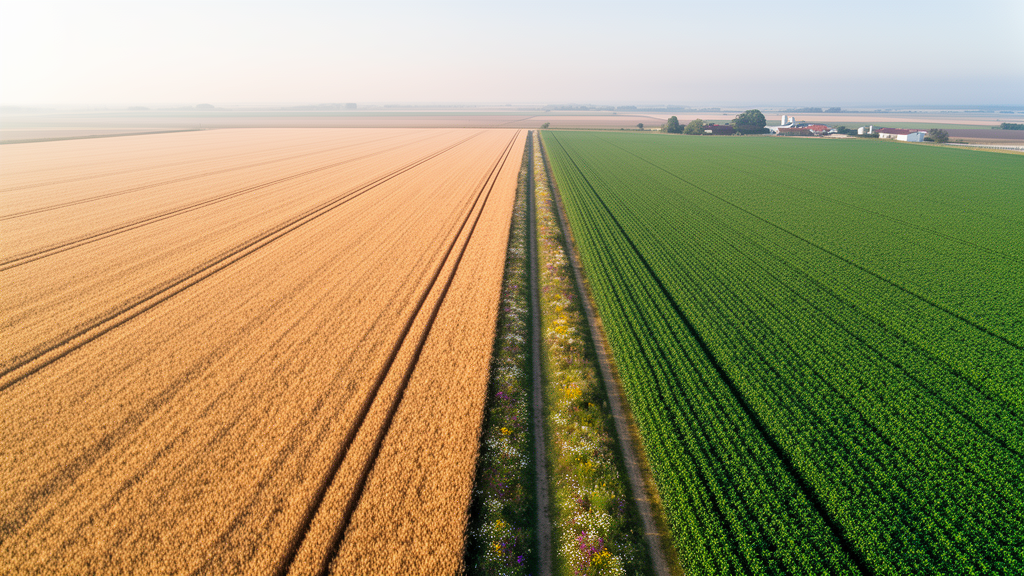
A global synthesis of land consolidation projects has found that reorganizing farmland into larger operations reliably boosts agricultural capacity, land-use efficiency, income and farm infrastructure, but frequently comes at the expense of biodiversity and rural equity. The review, published online on 15 October 2026 in Environmental Science and Ecotechnology, systematically screened 972 records and analyzed 137 peer-reviewed studies covering 148 cases across 28 countries. Biodiversity declined in 81% of the assessed cases, and 57% reported increased social inequality, with smallholders and rural communities often bearing the costs of reorganization designed around economic targets.
The research team, drawn from Nanjing University, Fujian Agriculture and Forestry University, Fuzhou University and The University of Queensland, coded economic, environmental and social outcomes across the case set and mapped them to the United Nations Sustainable Development Goals. Positive outcomes clustered around SDG 1 on No Poverty, SDG 2 on Zero Hunger, SDG 8 on Decent Work and Economic Growth and SDG 9 on Industry, Innovation and Infrastructure, while negative outcomes concentrated around SDG 10 on Reduced Inequalities and SDG 15 on Life on Land. The authors classified each case as producing benefits, negative impacts, trade-offs or synergies, then examined how project type, governance arrangements and rural population change related to those outcomes.
A central weakness the review identifies is the narrowness of most existing evaluations. Across the 148 cases, 65% assessed only one dimension of sustainability, most commonly the economic one, while just 23% documented synergies spanning multiple dimensions and 15% documented trade-offs. Because the same reorganization of parcels and tenure can generate gains in one dimension and losses in another, the authors argue that single-outcome assessments systematically obscure the cross-dimensional interactions that determine whether consolidation actually advances sustainable intensification or merely relocates its costs.
Project design emerged as the decisive variable. Consolidation schemes that combined intensification with ecological conservation reported synergies in 42% of cases and negative impacts in only 12%, whereas intensification-only projects produced benefits and negative impacts at similar rates, 35% each. Projects pairing intensification with village renewal generated synergies and trade-offs in equal measure, at 30% each.
The authors conclude that land consolidation is not automatically a pathway to sustainable intensification: outcomes depend on whether ecological and social objectives are built into project design from the outset rather than appended after economic goals are fixed. Geography also shaped what the evidence captured. Higher-income countries more often reported outcomes linked to environmental goals, while lower-income countries focused on people-centered goals, leaving planetary-boundary effects in those settings less documented.
Subject of Research: Global review of land consolidation outcomes across economic, environmental and social dimensions
Article Title: Land consolidation can lift economies while deepening biodiversity and social deficits, global review finds
Article References: Land consolidation can lift economies while deepening biodiversity and social deficits, global review finds. Original publication (Bibliographic details unavailable.)
Image Credits: AI Generated
DOI: Not provided
Keywords: land consolidation, sustainable intensification, biodiversity loss, social inequality, Sustainable Development Goals, agricultural policy, rural livelihoods, smallholders, ecological conservation, land-use efficiency, environmental science, Land
Cite Scienmag News
Margaret Porter. (October 26, 2026). Farmland Consolidation Delivers Economic Gains but Biodiversity Falls in 81% of Cases. Scienmag. https://scienmag.com/farmland-consolidation-delivers-economic-gains-but-biodiversity-falls-in-81-of-cases/
Margaret Porter. "Farmland Consolidation Delivers Economic Gains but Biodiversity Falls in 81% of Cases." Scienmag, 26 October 2026, https://scienmag.com/farmland-consolidation-delivers-economic-gains-but-biodiversity-falls-in-81-of-cases/. Accessed 26 October 2026.
Margaret Porter. "Farmland Consolidation Delivers Economic Gains but Biodiversity Falls in 81% of Cases." Scienmag. October 26, 2026. https://scienmag.com/farmland-consolidation-delivers-economic-gains-but-biodiversity-falls-in-81-of-cases/


