

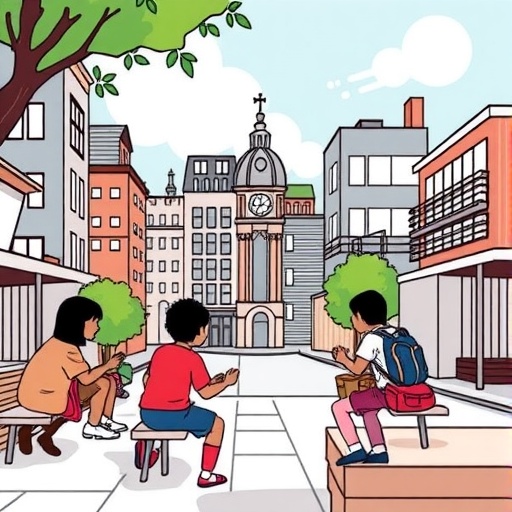
In the quest for sustainable urban development, the integration of family-friendly policies within city planning has emerged as a pivotal challenge and opportunity. A groundbreaking study led by Zhang, H., Niu, Q., Zhou, D., and colleagues advances this discourse by proposing a comprehensive theoretical and methodological framework centered on the dynamic interactions between families and their urban environments. Published in the influential journal npj Urban Sustainability, this research delves deeply into the conceptualization of family-friendly cities, aligning the findings with the United Nations Sustainable Development Goal 11 (SDG11), which aims to make cities inclusive, safe, resilient, and sustainable.
Urban environments today are rapidly evolving, presenting complex challenges that disproportionately affect families, particularly those with children, elders, and dependents who require specialized social infrastructure. Zhang et al.’s study innovatively situates families at the core of sustainable urban design, casting light on the multifaceted interactions that influence residents’ quality of life. Central to their approach is an understanding that families do not merely inhabit cities; they actively shape and are shaped by their surroundings in a continuous, reciprocal process. This insight challenges conventional top-down urban planning narratives and encourages a more participatory, human-centered model.
The theoretical foundation offered by the researchers draws from interdisciplinary perspectives including urban sociology, environmental psychology, and human geography. It posits that the family-environment interface is governed by spatial, social, and policy-driven factors that collectively mediate access to essential resources such as housing, transportation, education, healthcare, and public spaces. By articulating these relationships, the framework enables a nuanced assessment of how urban environments can be optimized to support diverse family structures and needs, underscoring equity and inclusivity alongside sustainability.
Methodologically, the study is notable for its sophisticated integration of quantitative and qualitative data sources, leveraging advanced spatial analysis techniques alongside ethnographic fieldwork. This mixed-methods approach facilitates a granular examination of the lived experiences of families across varying urban contexts. Utilizing Geographic Information Systems (GIS) and participatory mapping, the researchers effectively demonstrate spatial disparities and community assets, providing actionable insights for policymakers aiming to calibrate urban interventions at neighborhood and city scales.
An essential contribution of this work lies in its identification of core dimensions that characterize family-friendly cities. These dimensions encompass safe and accessible public spaces conducive to intergenerational interaction, affordable and adequately sized housing, reliable and inclusive transportation systems, as well as robust social support networks. The proposed model also highlights the role of environmental quality — including air quality, noise regulation, and green space availability — as critical determinants of family health and wellbeing, emphasizing the interdependence between physical environment and social cohesion.
In addressing SDG11, Zhang and colleagues articulate a vision where cities serve as enablers rather than barriers to family stability and growth. Importantly, their framework advocates for policy integration, where urban sustainability is not compartmentalized but is synergistically linked with social policies that address childcare, eldercare, and work-life balance. This holistic lens encourages urban governance that is adaptive, inclusive, and resilient in the face of rapid demographic and climatic changes.
Another groundbreaking aspect of this study is its attention to diversity within family populations. By explicitly acknowledging variations in family composition—such as single-parent households, multigenerational families, and immigrant families—the research underscores the necessity for tailored urban strategies. This inclusive perspective challenges one-size-fits-all paradigms prevalent in current city planning, advocating instead for flexible frameworks that can accommodate socioeconomic and cultural heterogeneity.
The implications for urban policy and planning are profound. By providing a robust theoretical and methodological toolkit, the study equips city planners and decision-makers with evidence-based strategies that prioritize family well-being within sustainability agendas. Such data-driven insights promote investments in infrastructures like community centers, playgrounds, and multi-generational housing projects, ultimately fostering urban environments where families can thrive economically, socially, and health-wise.
Moreover, the research emphasizes the importance of participatory urban governance, suggesting that effective family-friendly city development requires active engagement with residents. Through community co-design processes and stakeholder collaborations, cities can better identify local needs and leverage indigenous knowledge, thus ensuring that interventions are both culturally appropriate and sustainable over the long term.
Zhang et al. also confront the challenge of climate resilience within family-friendly urbanism. They argue that mitigating climate risks—from extreme heat to flooding—must be integrated with family-oriented designs, ensuring that vulnerable populations are protected through adaptive architecture, emergency preparedness, and green infrastructure. This intersection of climate adaptation and family support represents an innovative frontier in urban sustainability research.
Technological innovation features prominently in the proposed methodological system, with the study showcasing the use of smart city tools and digital platforms to monitor and enhance family-environment interactions. These technologies facilitate real-time data collection on accessibility, safety, and satisfaction, enabling responsive governance and continuous improvement in urban services geared toward families.
The study also calls into question prevailing metrics for evaluating urban sustainability by proposing new indicators that center family inclusivity and intergenerational equity. These metrics aim to capture dimensions often overlooked in traditional assessments, such as childcare availability, neighborhood cohesion, and psychological wellbeing, thereby expanding the evaluative scope of sustainable development frameworks.
In synthesis, the research by Zhang, Niu, Zhou, and their team reshapes how urban sustainability is conceptualized and operationalized—by placing families at the heart of city life and policy-making. This paradigm shift promises to unlock healthier, more equitable, and resilient urban futures aligned with the ambitious targets of SDG11, ensuring cities are not only engines of economic activity but nurturing spaces for generations to come.
This innovative framework not only charts a path for future academic inquiry but also resonates with practitioners, advocates, and citizens dedicated to crafting family-centric urban landscapes. Its broad applicability across diverse urban contexts offers a replicable model that can be tailored to the unique challenges and opportunities of cities worldwide, heralding a new era where sustainable development and family welfare are intrinsically linked.
As urban populations continue to swell globally, the urgency of developing family-friendly sustainable cities becomes ever more critical. The insights from this transformative study provide an indispensable knowledge base, urging comprehensive, systemic change in how we design, govern, and inhabit urban spaces—to the benefit of families everywhere.
Subject of Research: Family-friendly urban development within the framework of Sustainable Development Goal 11 (SDG11), focusing on theoretical and methodological systems that explore family-environment interactions.
Article Title: Insights into family-friendly cities for SDG11: a theoretical and methodological system based on family-environment interaction.
Article References:
Zhang, H., Niu, Q., Zhou, D. et al. Insights into family-friendly cities for SDG11: a theoretical and methodological system based on family-environment interaction. npj Urban Sustain (2025). https://doi.org/10.1038/s42949-025-00331-8
Image Credits: AI Generated


