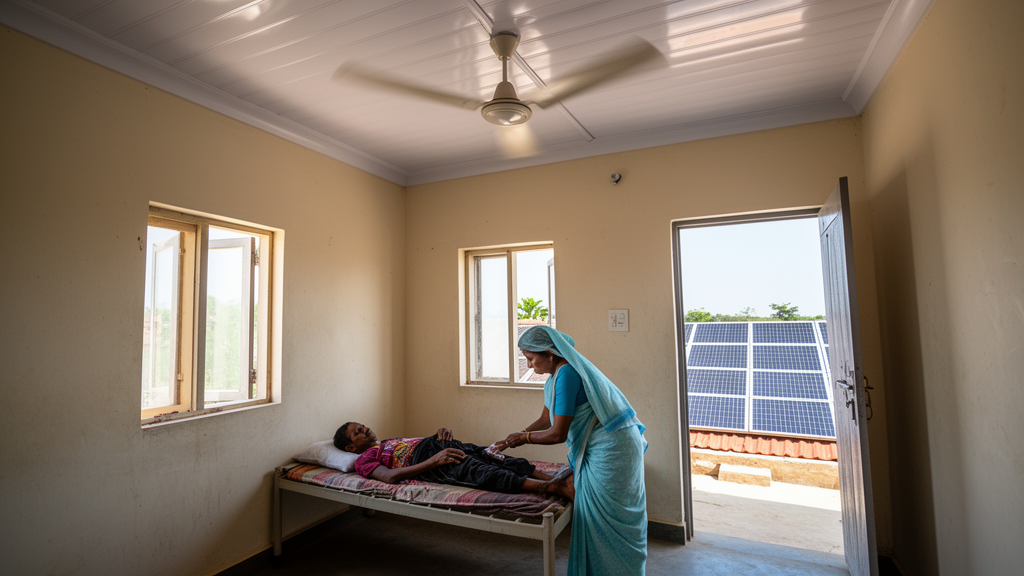
Rural community clinics in Bangladesh often rely on little more than electric fans to keep patients comfortable through a hot, humid season, while unreliable electricity supplies and rising energy prices make mechanical cooling hard to sustain. A new numerical study argues that a combination of three relatively simple rooftop interventions — a false ceiling with a ventilated air gap, scheduled mechanical ventilation, and rooftop solar panels — could cut the mean indoor temperature of such a clinic by nearly 5 °C and reduce its total annual energy consumption by more than a third compared with a building that has none of these features.
The study, published in the journal Discover Energy, modelled the Rahimnogor Community Clinic in Khulna, Bangladesh, a single-storey government facility with a height of 3.5 metres that houses two rooms, two toilets and a patient waiting space. The researchers built a three-dimensional model of the building in DesignBuilder, using the EnergyPlus simulation engine to run a full annual simulation of 8,760 hours with local weather data. Heat conduction through the opaque envelope was calculated with the conduction transfer function method, and the model accounted for beam and diffuse solar radiation, surface reflections and shading cast by the rooftop photovoltaic array.
Before applying the model to the clinic, the team validated it against a previously published DesignBuilder study of a building in a comparable hot and humid climate. The reproduced hourly indoor temperatures deviated from the reference data with a root-mean-square error of 0.9045 °C and a coefficient of variation of 2.52%, while annual energy consumption showed a coefficient of variation of 3.55%. The authors consider these deviations acceptable for whole-building energy simulation and treat them as evidence that the modelling approach can reliably capture both short-term thermal behaviour and long-term energy performance.
The first strategy tested was purely passive: installing a gypsum plasterboard false ceiling beneath the roof, leaving an air gap between the two. Four gap thicknesses were examined — 0.15, 0.20, 0.30 and 0.40 metres. In free-running simulations with the HVAC system switched off, the mean indoor temperature fell by 2.4 °C, 2.54 °C, 2.71 °C and 2.9 °C respectively compared with the base case of no false ceiling. The air gap acts as a thermal buffer, and the larger the gap, the more air it contains and the more heat it intercepts before that heat can reach the occupied space below. The base case mean indoor temperature was 35.67 °C; with a 0.15 m gap it dropped to 33.26 °C, and with a 0.40 m gap to 32.77 °C.
The second strategy added active ventilation to that buffer zone. An exhaust fan was modelled to draw ambient air through the gap and expel the heated air, operating on a fixed schedule from 8:00 a.m. to 5:00 p.m. at rates of 3, 4.5 or 6 air changes per hour (ACH). Rather than resolving the airflow field explicitly, the simulation prescribed these airflow rates, with the fan power included in the annual electricity tally. At the largest 0.40 m gap, mean indoor temperature reductions rose from 3.25 °C at 3 ACH to 3.59 °C at 4.5 ACH and 3.88 °C at 6 ACH. The mechanism is straightforward: faster air exchange removes accumulated heat from the roof cavity before it can conduct downward through the false ceiling.
The energy results follow the same pattern but with an important caveat about diminishing returns. The base case consumed 8,479.89 kWh per year under a 25 °C cooling setpoint. A false ceiling alone cut this by 10.25% to 15.54% depending on gap size. Adding ventilation pushed the savings higher — at the 0.40 m gap with 6 ACH, total annual consumption fell to 6,331.82 kWh, a 25.33% reduction. However, the marginal benefit of each extra increment of airflow shrank: for the 0.15 m gap, moving from 0 to 3 ACH saved 5.39%, while the steps from 3 to 4.5 ACH and from 4.5 to 6 ACH added only 3.74% and 2.35% respectively. As the cavity air cools, less heat remains to be removed, so each additional unit of airflow yields progressively less.
The third strategy mounted photovoltaic panels on the roof, tilted at 23° and facing south as appropriate for the northern hemisphere, with inter-row spacing calculated from a sun-path analysis for the worst-case shading date of late December. The panels work in two ways: they shade the roof surface, reducing solar heat gain into the building, and they generate on-site electricity that offsets part of the clinic’s demand. Because the shading effect already provides strong thermal protection, the authors found that enlarging the air gap beyond 0.30 m no longer justified the extra construction cost once panels were installed — going from 0.30 m to 0.40 m at 6 ACH bought only an additional 0.21 °C of mean temperature reduction.
The best combined configuration — a 0.30 m air gap, 6 ACH mechanical ventilation and rooftop solar — reduced the mean indoor temperature by 4.68 °C relative to the base case, from 35.67 °C to 30.99 °C, with the panels contributing 1.01 °C beyond the ceiling-and-ventilation system alone. Peak indoor temperature on the simulated day fell from 37.98 °C in the base case to 32.35 °C. Total annual energy consumption dropped to 5,511.26 kWh, a 35.01% reduction. The rooftop array generated 958.93 kWh of electricity over the year, and the authors note this figure represents total generation, not electricity exported to the grid or a separate net balance after fan consumption.
A thermal comfort assessment using the Predicted Mean Vote and Predicted Percentage Dissatisfied indices under ASHRAE Standard 55 reinforced the picture. In the base case, monthly PMV climbed from 0.45 in January to 2.69 in May, with the percentage of dissatisfied occupants rising from 12.2% to 83.6%. The integrated configuration kept PMV between 0.74 and 1.18 and PPD between 17.9% and 35.5% throughout the year — a substantial improvement, though discomfort still peaks in the warm months. An economic screen using a local tariff of BDT 7.93/kWh including VAT estimated a simple payback period of 6.14 years for the PV-assisted configuration, versus 7.82 years for the ceiling-and-ventilation system without panels.
The authors are careful to frame these as simulation results for one representative clinic, with ventilation modelled through prescribed airflow rates rather than resolved airflow physics, and they recommend detailed cost-benefit analysis and testing across Bangladesh’s different climatic regions before the approach is generalised. Still, the message is that for the country’s more than 14,000 community clinics — facilities that mostly serve rural populations and often have fans as their only cooling — a layered strategy of roof-level shading, a ventilated ceiling cavity and on-site solar generation could deliver meaningful comfort and energy gains with comparatively modest, locally available components.
Subject of Research: Simulation of passive and active roof cooling strategies with rooftop solar panels to improve thermal comfort and energy efficiency in a rural community clinic in Bangladesh.
Article Title: Numerical analysis of passive and active cooling strategies with rooftop solar integration for indoor comfort and energy efficiency of community clinics in Bangladesh
Article References: Muna, F. R., Fahim, G. S., Alam, M. M., Shahriar, K., & Ali, M. H. (2026). Numerical analysis of passive and active cooling strategies with rooftop solar integration for indoor comfort and energy efficiency of community clinics in Bangladesh. Discover Energy, 6(1), Article 95. https://doi.org/10.1007/s43937-026-00196-7
Image Credits: AI Generated
DOI: 10.1007/s43937-026-00196-7
Keywords: Bangladesh, community clinics, false ceiling, mechanical ventilation, rooftop solar panels, EnergyPlus, thermal comfort, energy efficiency, passive cooling, building simulation, air gap, photovoltaics
Cite Scienmag News
Denise Maddox. (October 28, 2026). False ceilings, fans and rooftop solar could cool Bangladesh’s rural clinics. Scienmag. https://scienmag.com/false-ceilings-fans-and-rooftop-solar-could-cool-bangladeshs-rural-clinics/
Denise Maddox. "False ceilings, fans and rooftop solar could cool Bangladesh’s rural clinics." Scienmag, 28 October 2026, https://scienmag.com/false-ceilings-fans-and-rooftop-solar-could-cool-bangladeshs-rural-clinics/. Accessed 29 October 2026.
Denise Maddox. "False ceilings, fans and rooftop solar could cool Bangladesh’s rural clinics." Scienmag. October 28, 2026. https://scienmag.com/false-ceilings-fans-and-rooftop-solar-could-cool-bangladeshs-rural-clinics/