


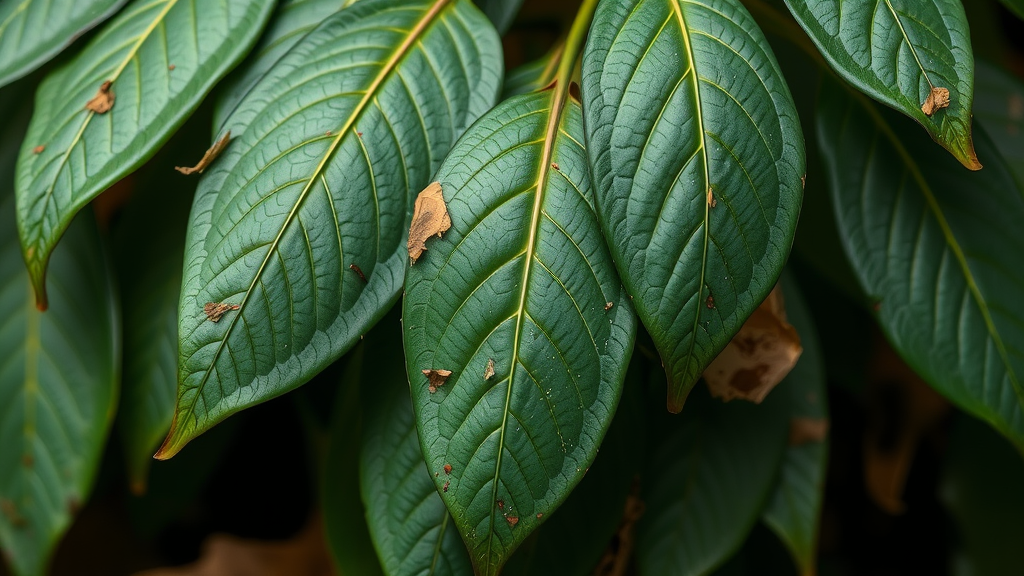
Every autumn, cities across the tropics sweep up mountains of fallen mango leaves and send them to landfill or incineration, treating one of nature’s most abundant carbon sources as pure waste. A team at the National University of Singapore has now demonstrated that this overlooked biomass can be fed directly into a lightweight structural metal, producing what they describe as the first known metal-plus-biomass composite in which the plant material is embedded intact rather than converted into a separate phase. By blending pulverized fallen mango leaves into magnesium powder and processing the mixture through powder metallurgy, the researchers created a material that is lighter, better at absorbing vibration, and thermally stable, all while sacrificing only a modest fraction of its mechanical strength. The result, published in the Journal of Materials Science: Metallurgy, points toward a new class of sustainable structural materials built on the marriage of waste biomass and lightweight metals.
Magnesium has long been championed as one of the greenest structural metals available. It is the lightest of all practical engineering metals, with reserves in the earth’s crust more than sufficient for current and future demand, and substituting it for heavier metals in automobiles can cut component weight by anywhere from 22 percent to more than 60 percent. Because fuel economy improves by roughly half a liter per 100 kilometers for every 100 kilograms of vehicle weight removed, the case for magnesium in transport is compelling from an energy standpoint. Yet conventional reinforcements for magnesium composites, typically synthetic ceramics, carry their own environmental and energy costs. The Singapore group saw an opportunity: instead of adding engineered particles, why not add carbon that nature has already manufactured and that society has already discarded?
The team, led by Apoorva Gautam and Michael Johanes under the supervision of Manoj Gupta, chose fallen waste mango leaves as their biomass feedstock precisely because leaves are rich in carbon and have demonstrated measurable mechanical character of their own. Previous studies have shown that plant leaves can reach hardness values of up to 38 HV and ultimate tensile strengths of about 5.9 megapascals, particularly in species high in cellulose and lignin. Biomass-derived carbons have already proven their worth as ceramic precursors, catalysts, supercapacitor electrodes, and even microwave-absorbing materials. What had never been attempted, the researchers note, was the direct incorporation of raw biomass into a bulk metallic matrix, as opposed to the layered plant-fiber composites reported elsewhere in the literature.
Creating the composite demanded careful control of temperature, because the very organic compounds that give leaves their value are destroyed at conventional magnesium sintering temperatures. The process began with drying the leaves in a 900-watt microwave oven for just eight minutes, a step that removed roughly 10 percent of the leaf mass as moisture and consumed more than 95 percent less energy than a conventional oven, which would need four hours at 90 degrees Celsius to achieve the same weight loss. The dried leaves were then ball milled with stainless steel media at a 20-to-1 ball-to-powder ratio for one hour, and dried again at 90 degrees Celsius to drive off a further 4 percent of moisture. The resulting dried leaf powder averaged just 6.8 micrometers in particle diameter after drying-induced shrinkage, fine enough to blend uniformly with magnesium powder of 60 to 300 micrometers in a mixture containing 5 weight percent leaf powder, designated Mg-5DLP.
Compaction followed under a hydraulic press at 600 psi, and here the process departed sharply from standard practice. Rather than the roughly 640 degrees Celsius typically used to sinter magnesium, the billet was sintered at only 150 degrees Celsius using hybrid microwave heating. Thermogravimetric analysis of the leaf powder had revealed that decomposition and evaporation peak at around 300 degrees Celsius, with maximum mass loss occurring at that temperature, so the low sintering route was essential to keep the carbon locked in its natural, undecomposed form as compounds such as ethane-like and phenolic species rather than releasing it as pyrolysis products. After sintering, the billets were coated in colloidal graphite, homogenized at 400 degrees Celsius for one hour, and hot extruded at 350 degrees Celsius through a die with an extrusion ratio of 20.25 to 1, yielding dense rods for testing. A reference sample of pure magnesium was processed identically, minus the leaf addition.
Microstructural analysis told a nuanced story. X-ray diffraction of the composite showed dominant magnesium peaks with no distinct carbon peaks, indicating that essentially all of the carbon remained chemically locked within organic molecules rather than converting to free graphite or reacting with the matrix. Energy-dispersive spectroscopy confirmed the presence of elements characteristic of the leaf powder, particularly clustered near pores, verifying that the biomass particles had survived processing intact. Notably, the addition of leaf particles left grain size and morphology essentially unchanged, a departure from the grain growth or refinement usually triggered by secondary phases or ceramic reinforcements. Porosity, however, told a different tale: the composite exhibited 1.56 percent porosity, more than triple the 0.44 percent measured in pure magnesium, a consequence of moisture and volatile evaporation during sintering and of the inherently weaker metal-to-leaf bonding compared with metal-to-metal cold welding.
Thermally, the composite held up remarkably well. Ignition temperature dropped by only 4 degrees Celsius, a negligible penalty, and differential scanning calorimetry showed no meaningful change in thermal response up to approximately 530 degrees Celsius, a temperature well beyond the practical operating range of non-ignition-resistant magnesium alloys. The coefficient of thermal expansion remained essentially fixed at 25.3 times 10 to the minus 6 per kelvin. For engineers accustomed to reinforcements that degrade thermal stability, this absence of adverse effects is itself a headline result, suggesting the biomass phase is truly dormant within the metal matrix.
Mechanically, the composite paid a modest price in strength while gaining a striking advantage in vibration damping. Compressive yield strength fell by 7.9 percent, ultimate compressive strength by 12.0 percent, ductility by 10.7 percent, specific strength by 11.4 percent, and work of fracture by 20.5 percent relative to the reference magnesium, losses the authors attribute chiefly to the tripled porosity interfering with load transfer. Yet the damping improvements were substantial: the attenuation coefficient rose by 24.0 percent and damping capacity by 12.9 percent, thanks to air pockets and voids left behind by evaporated organics dissipating vibrational energy as heat, compounded by the intrinsic ability of biomass itself to absorb vibration. Importantly, the smaller drop in yield strength than in ultimate strength signals improved plasticity and reduced strain hardening, which the researchers suggest could translate into energy savings during manufacturing and forming operations.
One of the most intriguing implications lies in biomedicine. Human cortical bone has a Young’s modulus of roughly 13 to 27 gigapascals, and implants that are far stiffer than bone can cause stress shielding, in which the skeleton is deprived of mechanical loading and resorbs over time. The softened mechanical response of the magnesium-leaf composite, combined with magnesium’s established biocompatibility and biodegradability, could make such materials attractive for implant applications where property matching with bone promotes better recovery. The authors also note that the same logic of waste reinforcement echoes the growing use of recycled materials in concrete, extending the concept from civil construction into lightweight structural metals.
The study opens a pathway the authors describe as inviting further exploration: a new family of metal-plus-biomass composites in which carbon remains locked in its natural state, synthetic reinforcements become unnecessary, and abundant agricultural waste finds a higher-value destination. Beyond the immediate material performance, the process itself embodies sustainability, with microwave drying delivering over 95 percent energy savings and low-temperature sintering cutting thermal budgets dramatically. As industries confront simultaneous pressures to decarbonize manufacturing and to lighten vehicles, the idea that a handful of crushed mango leaves could replace energy-intensive ceramic additives, while simultaneously making magnesium quieter and lighter, may prove one of the more elegant recycling stories in modern materials science.
Subject of Research: Direct integration of waste mango leaf biomass into magnesium to form ecofriendly metal-biomass composites with locked carbon
Article Title: Creation and characteristics of new ecofriendly metal (Magnesium) + biomass (Locked carbon) composites
Article References: Gautam, A., Johanes, M., & Gupta, M. (2026). Creation and characteristics of new ecofriendly metal (Magnesium) + biomass (Locked carbon) composites. Journal of Materials Science: Metallurgy, 1(1), Article 8. https://doi.org/10.1007/s44492-026-00007-z
Image Credits: AI Generated
DOI: 10.1007/s44492-026-00007-z
Keywords: magnesium, biomass, composites, mango leaves, locked carbon, powder metallurgy, sustainability, vibration damping, lightweight materials, microwave sintering, porosity, biomedical implants
Cite Scienmag News
Denise Maddox. (September 22, 2026). Fallen Mango Leaves Turned Into Ecofriendly Magnesium Composites With Locked Carbon. Scienmag. https://scienmag.com/fallen-mango-leaves-turned-into-ecofriendly-magnesium-composites-with-locked-carbon/
Denise Maddox. "Fallen Mango Leaves Turned Into Ecofriendly Magnesium Composites With Locked Carbon." Scienmag, 22 September 2026, https://scienmag.com/fallen-mango-leaves-turned-into-ecofriendly-magnesium-composites-with-locked-carbon/. Accessed 5 October 2026.
Denise Maddox. "Fallen Mango Leaves Turned Into Ecofriendly Magnesium Composites With Locked Carbon." Scienmag. September 22, 2026. https://scienmag.com/fallen-mango-leaves-turned-into-ecofriendly-magnesium-composites-with-locked-carbon/


