

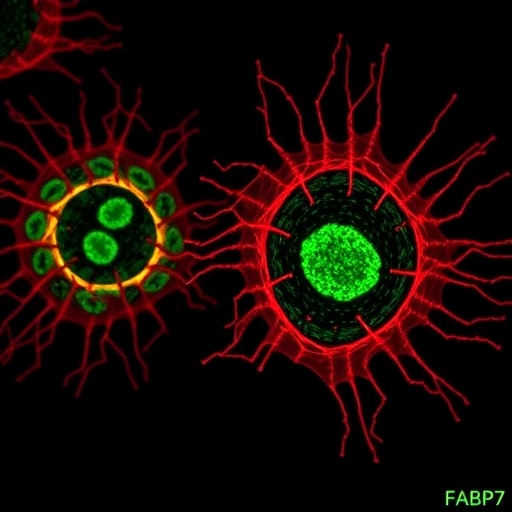
A recent study has unveiled groundbreaking insights into the role of FABP7, a fatty acid-binding protein, in advancing our understanding of endometrial cancer. The investigation, conducted by Xu, Wang, Tang, and colleagues, highlights FABP7’s significant influence on cancer cell dynamics, particularly in relation to cell migration and stemness. This intricate interplay between FABP7 and the Wnt/β-catenin signaling pathway could offer novel therapeutic avenues in combating this malignancy.
Endometrial cancer is a significant health concern, notably among women worldwide, with rising incidence rates. As research continues to unearth the molecular mechanisms driving cancer progression, the identification of key regulatory proteins, such as FABP7, becomes paramount. This study posits FABP7 as a crucial player in endometrial cancer cell behavior, thus providing pivotal insights that can potentially reshape treatment strategies.
FABP7 functions primarily as a transport protein within the cytoplasm, facilitating the transport of long-chain fatty acids. However, emerging evidence suggests that its role transcends mere lipid metabolism. The researchers demonstrated that FABP7 significantly enhances endometrial cancer cell migration and stemness—two critical characteristics associated with tumor metastasis and recurrence. This dual functionality indicates a shift in our understanding of FABP7, positioning it as a potential marker and therapeutic target in endometrial cancer.
One of the most compelling aspects of this research is the activation of the Wnt/β-catenin pathway by FABP7. The Wnt signaling cascade is known for its pivotal role in cell proliferation and differentiation in various cancers. This study demonstrates that FABP7 is not merely associated with the Wnt pathway; it actively participates in its activation, further linking metabolic dysregulation to oncogenic processes. The activation of β-catenin in the nucleus underscores a critical mechanism through which FABP7 enhances cancer cell traits, including increased migratory potential and stemness attributes.
Through a series of in vitro experiments, the researchers elucidated the precise mechanisms by which FABP7 modulates endometrial cancer cell behavior. Overexpression of FABP7 notably increased cell migration in various endometrial cancer cell lines, confirming its role as a pro-migratory factor. In contrast, silencing FABP7 expression resulted in the inhibition of cell migration, thereby supporting the hypothesis that FABP7 is integral to the metastatic capability of these cancer cells.
Another pivotal finding emerged surrounding the stemness properties of cancer cells. Cancer stem cells are recognized as a population within tumors that contribute to therapeutic resistance and tumor recurrence. The study found that FABP7 overexpression correlated with an increase in stem cell markers, suggesting that FABP7 may be influencing the stem cell-like characteristics within endometrial tumor cells. This observation adds a new layer of complexity to the role of FABP7 in cancer biology, as it intertwines metabolic factors with stem cell dynamics.
The implications of these findings extend to potential therapeutic strategies. Targeting the FABP7-Wnt/β-catenin axis may offer a novel approach for overcoming endometrial cancer treatment resistance. As the field of cancer therapy shifts towards precision medicine, identifying specific molecular targets such as FABP7 could enhance treatment efficacy and reduce side effects associated with conventional therapies. This study not only illuminates the underlying mechanisms of endometrial cancer progression but also sets the stage for innovative therapeutic interventions.
Furthermore, the research emphasizes the necessity of further investigations into how FABP7 interacts with other signaling pathways. The multifaceted role of FABP7 in cellular processes suggests that it may contribute to a broader network of regulatory mechanisms in cancer biology. Understanding these interactions is essential for developing comprehensive therapeutic strategies that target multiple facets of tumor behavior.
Additionally, consideration of the tumor microenvironment is crucial when examining the implications of FABP7 in endometrial cancer. The interaction between cancer cells and surrounding stromal cells, as well as immune cells, can significantly influence tumor behavior and response to therapies. Future studies should aim to explore how FABP7 contributes to these interactions and to what extent its activity is modulated by external stimuli within the tumor microenvironment.
In conclusion, the study by Xu et al. represents a significant advancement in our understanding of the molecular mechanisms underpinning endometrial cancer. By elucidating the role of FABP7 in augmenting cancer cell migration and stemness via the Wnt/β-catenin pathway, the researchers provide crucial insights that could inform future therapeutic approaches. The potential to target FABP7 not only opens doors to new treatment modalities but also underscores the importance of dissecting the complex cellular communications that characterize cancer progression. As we move forward, the research community must capitalize on these findings to develop targeted interventions that could transformative outcomes for patients with endometrial cancer.
In this era of rapid scientific advancement, the exploration of previously unrecognized roles of metabolic proteins like FABP7 may lead to significant breakthroughs in the personalized treatment of cancer. Continued research in this direction promises to enrich our understanding of cancer biology, ultimately translating into improved clinical outcomes.
Subject of Research: FABP7’s role in endometrial cancer progression through Wnt/β-catenin pathway activation.
Article Title: FABP7 Enhances Endometrial Cancer Cell Migration and Stemness by Activating the Wnt/β-catenin Pathway.
Article References:
Xu, Y., Wang, X., Tang, L. et al. FABP7 Enhances Endometrial Cancer Cell Migration and Stemness by Activating the Wnt/β-catenin Pathway.
Biochem Genet (2025). https://doi.org/10.1007/s10528-025-11302-0
Image Credits: AI Generated
DOI: https://doi.org/10.1007/s10528-025-11302-0
Keywords: FABP7, endometrial cancer, Wnt/β-catenin pathway, cancer cell migration, cancer stemness.


