


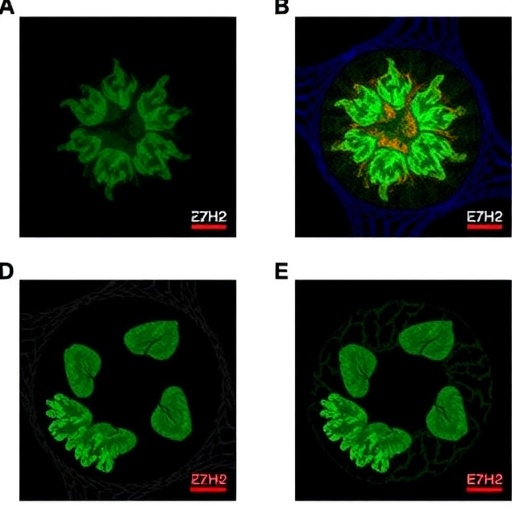
In an era where personalized medicine is rapidly evolving, understanding the cellular underpinnings of diseases such as hepatocellular carcinoma (HCC) is paramount. A recent study led by researchers including Zhou, Xu, and Ye sheds light on the intricate regulatory roles of EZH2 in T cell dynamics and their relationship with the MIF-CD74 axis in HCC. This comprehensive analysis utilized integrated single-cell RNA sequencing (scRNA-seq) techniques to unveil how epigenetic factors influence immune responses during cancer progression. The insights gained could potentially lead to improved therapeutic strategies for managing HCC and other malignancies with similar immune evasion mechanisms.
At the core of this research is the essential protein EZH2, a component of the polycomb repressive complex 2 (PRC2), known for its role in gene silencing through methylation. EZH2’s involvement in cancer has been noted in various studies, linking its expression levels to tumor aggressiveness. This study emphasizes the importance of EZH2 not just in the context of tumor cells, but also in modulating immune cell behaviors—specifically, T cell activation and exhaustion states, which are critical in tumor immunity.
The MIF-CD74 axis represents a novel focus in the realm of immune interactions within the tumor microenvironment. Macrophage migration inhibitory factor (MIF) is a pro-inflammatory cytokine that plays an important role in immune regulation and has been implicated in various types of cancer. CD74, its receptor, facilitates MIF’s actions and can influence T cell responses. By examining the interplay between EZH2 and the MIF-CD74 axis, the research provides significant revelations about how tumors evade immune surveillance, a key challenge in successful cancer treatments.
Utilizing single-cell RNA sequencing allowed the researchers to dissect the heterogeneity within the tumor microenvironment at an unprecedented resolution. Each cell’s transcriptomic profile was analyzed, revealing distinct subpopulations of T cells with varying degrees of activation and exhaustion. This granularity is crucial as it helps in identifying specific cellular states that are more susceptible or resistant to therapeutic interventions. The findings suggest that higher EZH2 expression correlates with increased T cell exhaustion, indicating a potential target for therapeutic strategies aimed at rejuvenating the immune response in HCC.
Moreover, the study provides compelling evidence that inhibiting EZH2 could counteract this exhaustion. This is particularly significant considering that T cell exhaustion is a major hurdle in cancer therapies, particularly in the context of immunotherapy. By downregulating EZH2, there may be a possibility to reinvigorate exhausted T cells, restoring their function and enhancing the body’s anti-tumor immune response. These findings not only open new avenues for targeting EZH2 in HCC but also raise the question of its potential role in a broader range of cancers characterized by similar immune evasion mechanisms.
The therapeutic implications derived from these insights are profound. Not only does the study clarify the molecular dynamics involved in T cell behavior, but it also proposes a dual-targeting approach that could be employed in treatment regimens. Combining EZH2 inhibitors with existing immunotherapy protocols might yield synergistic effects, ultimately leading to improved patient outcomes in hepatocellular carcinoma and possibly other malignancies as well.
Furthermore, the findings underscore an evolving landscape in cancer treatment where integrative approaches are becoming increasingly critical. The research emphasizes that epigenetic modulation is an important factor to consider alongside traditional therapeutic modalities. As our understanding of immune-tumor interactions deepens, it becomes clear that approaches must be multifaceted, addressing not only the tumor itself but also the surrounding immune environment that it exploits.
In the broader context of cancer immunotherapy, this study highlights the necessity to decipher the molecular markers associated with T cell functionality. With an emphasis on functional and phenotypic profiling, it becomes evident that not all T cells are created equal; their effectiveness in combating tumors is highly contextual. By focusing on the EZH2 and MIF-CD74 axis, researchers are taking steps toward a more nuanced understanding of how to enhance T cell responses and convert immunologically cold tumors into hot ones, which is a critical consideration in the development of successful immunotherapeutic strategies.
As researchers continue to explore the depths of the tumor microenvironment, the significance of cell-cell interactions cannot be understated. This study serves as a testament to the importance of characterizing the cellular landscape of HCC. The use of cutting-edge techniques like scRNA-seq provides the granularity needed to uncover hidden relationships between tumor cells and immune participants. It not only furthers our understanding of HCC but also contributes valuable knowledge applicable across various cancers.
In conclusion, the intricate balance between tumor progression and immune evasion highlights the urgent need for innovative therapeutic strategies. The regulatory role of EZH2 on the MIF-CD74 axis presents a promising target for therapeutic intervention in HCC, and therapies designed to modulate these pathways could be groundbreaking. As the field moves toward more personalized and targeted treatment approaches, harnessing the findings from this research may pave the way for significant advancements in combating liver cancer and enhancing the effectiveness of immunotherapy.
Thus, as we dissect the complexities of T cell interactions within tumors, the necessity for integrated approaches in cancer therapy becomes evident. Studies like the one conducted by Zhou et al. underline the potential that personalized medicine holds in transforming cancer care, offering hope for enhanced treatment outcomes and improved quality of life for patients battling aggressive forms of cancer.
Zhou, Y., Xu, Y., Ye, M. et al. Integrated single-cell RNA-seq analysis reveals that EZH2 regulates the MIF-CD74 axis to modulate T cell activation and exhaustion in hepatocellular carcinoma.
J Transl Med 23, 1040 (2025). https://doi.org/10.1186/s12967-025-07071-4
Cite Scienmag News
Nathaniel Bowman. (October 4, 2025). EZH2 modulates T cell activation in liver cancer. Scienmag. https://scienmag.com/ezh2-modulates-t-cell-activation-in-liver-cancer/
Nathaniel Bowman. "EZH2 modulates T cell activation in liver cancer." Scienmag, 4 October 2025, https://scienmag.com/ezh2-modulates-t-cell-activation-in-liver-cancer/. Accessed 3 September 2026.
Nathaniel Bowman. "EZH2 modulates T cell activation in liver cancer." Scienmag. October 4, 2025. https://scienmag.com/ezh2-modulates-t-cell-activation-in-liver-cancer/


