


While animals in drylands hone their natural senses to find vegetation, humans have developed “external eyes” to track these vital resources.

Credit: PhenoCam Network and Emily Myers, USDA-ARS.
While animals in drylands hone their natural senses to find vegetation, humans have developed “external eyes” to track these vital resources.
Scientists from the U.S. Department of Agriculture (USDA) Agricultural Research Service (ARS) have created an advanced method that integrates high-frequency near-surface camera data with broader satellite imagery to better monitor and assess dryland ecosystems. Their approach could aid in taking timely action to prevent land degradation, contributing to improved environmental management and conservation strategies.
Their results were published in the Journal of Remote Sensing on July 8.
Drylands, including arid, semi-arid and dry sub-humid areas, account for over 40% of the Earth’s land surface and are vital for supporting diverse wildlife, crop production and carbon regulation. These areas, however, are prone to abrupt ecological state changes, such as shifts from grass-dominated to shrub-dominated landscapes, driven by climate change and unsustainable land use.
Drylands pose significant challenges for ecological monitoring due to their sparse vegetation cover, high spatial variability, and year-to-year fluctuations in vegetation growth. Traditional methods often fall short in accurately classifying and detecting changes in ecological states. To address this, the USDA-ARS researchers melded space and ground approaches to eagle-eye these ecosystems.
“We wanted to understand whether we could use images collected remotely from near-surface cameras or satellites to measure differences in dryland vegetation greenness over time and in response to rainfall,” said Emily R. Myers, a SCINet postdoctoral fellow with the USDA-ARS and lead author of this study.
The researchers’ goal was to use these differences to distinguish between different dryland ecological states. The team combined daily data from near-surface cameras (PhenoCam) with satellite imagery (Harmonized Landsat 8 and Sentinel-2, or HLS) at a desert grassland site in southwest New Mexico, analyzing data from 12 different locations over multiple years between 2014 and 2022.
“Measurements from near-surface cameras and satellites were able to distinguish between different dryland vegetation responses to rainfall,” said Dawn M. Browning, a senior research ecologist at the USDA-ARS and co-lead author of the study.
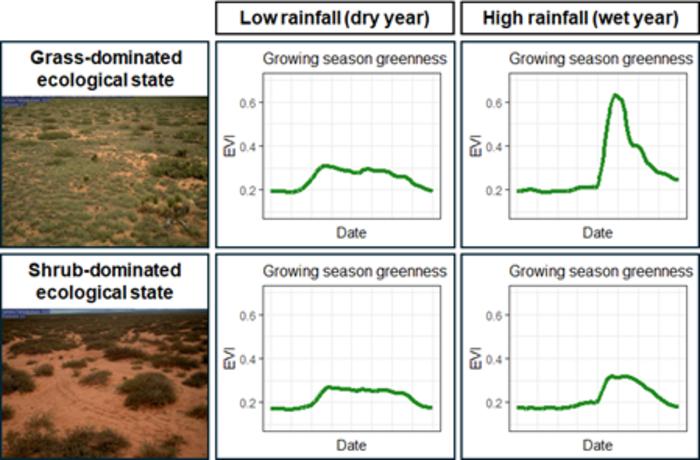
Their findings showed that grass-dominated states were the most affected by rainfall, with rapid spikes in greenness and productivity during wet growing seasons. Shrub-dominated states were less affected by growing season rainfall.
The distinct phenological responses of grass-dominated states can serve as indicators of grass productivity and ecological state change in drylands.
“These differences in greenness responses may help us map and monitor dryland states and productivity using remotely sensed imagery,” Myers said.
By refining remote sensing techniques, the researchers hope to identify and monitor more effectively dryland areas with significant grass cover. This insight could guide management strategies for maintaining grass cover and preventing shrub encroachment in these increasingly vulnerable ecosystems.
“We would like to explore more ways to characterize the growing season, with a particular focus on measurements that are sensitive to the rapid increases in greenness that are indicative of grassy productivity,” Browning said.
Journal
Journal of Remote Sensing
Method of Research
Imaging analysis
Subject of Research
Not applicable
Article Title
Novel Use of Image Time Series to Distinguish Dryland Vegetation Responses to Wet and Dry Years
Article Publication Date
9-Aug-2024
COI Statement
The authors declare that there is no conflict of interest regarding the publication of this article.
Cite Scienmag News
Denise Maddox. (August 21, 2024). Eyes in the sky and on the ground: enhanced dryland monitoring with remote sensing. Scienmag. https://scienmag.com/eyes-in-the-sky-and-on-the-ground-enhanced-dryland-monitoring-with-remote-sensing/
Denise Maddox. "Eyes in the sky and on the ground: enhanced dryland monitoring with remote sensing." Scienmag, 21 August 2024, https://scienmag.com/eyes-in-the-sky-and-on-the-ground-enhanced-dryland-monitoring-with-remote-sensing/. Accessed 5 September 2026.
Denise Maddox. "Eyes in the sky and on the ground: enhanced dryland monitoring with remote sensing." Scienmag. August 21, 2024. https://scienmag.com/eyes-in-the-sky-and-on-the-ground-enhanced-dryland-monitoring-with-remote-sensing/

