Wednesday, October 28, 2026
Science
No Result
View All Result
  • Login
  • HOME
  • SCIENCE NEWS
  • CONTACT US
  • HOME
  • SCIENCE NEWS
  • CONTACT US
No Result
View All Result
Scienmag
No Result
View All Result
Home Science News Social Science

Eye-Tracking Study Shows Nominalizations Make Children Reread to Answer Correctly

October 28, 2026
in Social Science
Courtney Benton
By Courtney Benton Scienmag Editorial Profile - Science and Technology Policy
Reading Time: 3 mins read
0
Eye-Tracking Study Shows Nominalizations Make Children Reread to Answer Correctly

Eye-Tracking Study Shows Nominalizations Make Children Reread to Answer Correctly

65
SHARES
587
VIEWS
Share on FacebookShare on Twitter
ADVERTISEMENT

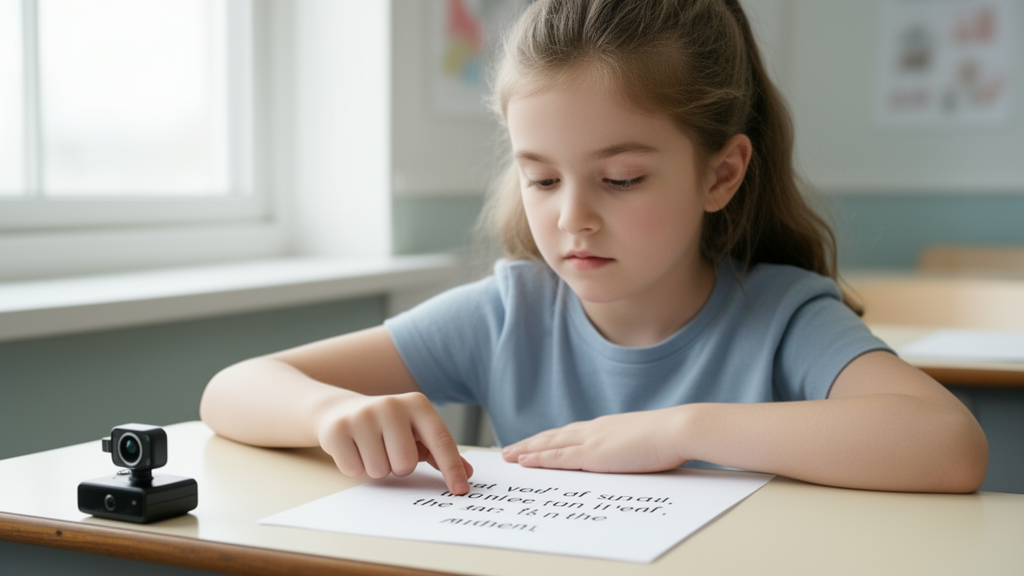
Event nominalizations—structures that compress complex events into nominal form, increasing informational density while reducing the transparency of thematic-role assignment—are a central feature of academic language. They pack more information into fewer words, but they also hide who did what to whom. A new eye-tracking study from the University of Verona examines how children learning to read handle this trade-off, and the results show that even when young readers answer comprehension questions correctly, the way their eyes move through the text reveals extra processing effort beneath the surface.

The study, published in Frontiers in Language Sciences, recruited 79 fifth- and sixth-grade children from three groups: 28 typically developing monolingual Italian children, 21 monolingual Italian children with developmental dyslexia, and 30 typically developing bilingual children with a migrant background for whom Italian was the societal language. Each child silently read short passages in which the same target event was expressed three ways: as a nominalization, as a passive construction, or as an active construction. After each passage, the children answered a comprehension question while their eye movements were continuously recorded.

The researchers analyzed three kinds of data: comprehension accuracy, standard eye-movement measures such as fixation times, and scanpaths—the ordered sequences of fixations that trace how a reader’s gaze travels across the text.

The headline finding concerns accuracy versus process. Nominalizations did not significantly reduce how often children answered the comprehension questions correctly. Yet they clearly changed how the children arrived at those answers. During the initial reading of the passages, scanpath dissimilarity was higher for nominalizations than for either verbal construction, meaning children’s gaze patterns became more varied and less uniform when the event was packed into a noun.

The effect persisted into the question-answering phase. In trials where children answered correctly, scanpath dissimilarity was again higher for nominalizations than for passives. More strikingly, nominalizations increased the probability of partial rescanning and decreased the probability of minimal rescanning relative to active texts. In plain terms, children answering questions about nominalized events were more likely to go back and reread parts of the passage before committing to a correct answer, rather than relying on a single, efficient pass through the text.

Correct answers, in other words, do not mean effortless reading.

The three reader groups did not behave identically. Children with developmental dyslexia showed a generalized increase in processing effort, visible in both the online reading of the passages and the question-answering phase. Bilingual children displayed an intermediate profile, with increased reliance on rereading during question-answering.

The design compared three expressions of the same events within the same children, which strengthens the claim that the construction type itself—not the underlying content—drove the processing differences. Still, the measures capture online behavior and immediate comprehension questions; the authors’ conclusions concern processing patterns during reading and answering, not long-term learning outcomes.

The broader significance lies in what the results imply about academic language. The study suggests that comprehension assessments based on accuracy alone may underestimate the effort that complex morphosyntax demands of developing readers, and that eye-movement measures can expose the hidden work behind seemingly correct answers.

Subject of Research: How developing readers, including bilingual children and children with dyslexia, process event nominalizations during reading comprehension.

Article Title: Processing event nominalizations in developing readers: eye-tracking evidence from bilingual and dyslexic readers

Article References: Vender, M., Venagli, I., Nardon, A., Piccinin, S., Dal Maso, S., & Melloni, C. (2026). Processing event nominalizations in developing readers: eye-tracking evidence from bilingual and dyslexic readers. Frontiers in Language Sciences, 5, Article 1912839. https://doi.org/10.3389/flang.2026.1912839

Image Credits: AI Generated

DOI: 10.3389/flang.2026.1912839

Keywords: eye-tracking, reading comprehension, nominalizations, developmental dyslexia, bilingual children, developing readers, scanpaths, morphosyntactic complexity, question answering, Italian children, academic language, Processing

Cite Scienmag News

Courtney Benton. (October 28, 2026). Eye-Tracking Study Shows Nominalizations Make Children Reread to Answer Correctly. Scienmag. https://scienmag.com/eye-tracking-study-shows-nominalizations-make-children-reread-to-answer-correctly/


Courtney Benton. "Eye-Tracking Study Shows Nominalizations Make Children Reread to Answer Correctly." Scienmag, 28 October 2026, https://scienmag.com/eye-tracking-study-shows-nominalizations-make-children-reread-to-answer-correctly/. Accessed 28 October 2026.

Courtney Benton. "Eye-Tracking Study Shows Nominalizations Make Children Reread to Answer Correctly." Scienmag. October 28, 2026. https://scienmag.com/eye-tracking-study-shows-nominalizations-make-children-reread-to-answer-correctly/

Tags: academic languagebilingual childrenbilingual children reading comprehensionchildren’s reading processing strategiescomprehension accuracy versus processing effortdeveloping readersdevelopmental dyslexiadevelopmental dyslexia and complex sentence processingeffects of nominalizations on reading comprehensioneye movement analysis in language studieseye trackingeye-tracking language comprehensioneye-tracking methodology in language scienceimpact of nominalization on thematic-role transparencyItalian childrenmorphosyntactic complexitynominalizationsnominalizations in academic readingprocessingprocessing complex event structures in childrenquestion answeringreading comprehensionreading strategies for nominalized versus active sentencesscanpaths
Share26Tweet16
Previous Post

Aging Reshapes How Lung Stem Cells and Their Niche Talk to Each Other

Next Post

When prompts learned to move: how AI video generation rewrote the grammar of human-AI co-creation

Related Posts

Taller cities are greener cities’ worst enemy, global study of 10,000 urban centres finds
Technology and Engineering

Taller cities are greener cities’ worst enemy, global study of 10,000 urban centres finds

October 28, 2026
Research report: How new moms cope with stressful news may matter more than the news itself, study finds
Social Science

Research report: How new moms cope with stressful news may matter more than the news itself, study finds

October 28, 2026
Montreux Convention still anchors NATO’s Black Sea security posture, study finds
Social Science

Montreux Convention still anchors NATO’s Black Sea security posture, study finds

October 28, 2026
Digital behavioral coaching could extend GLP-1 weight loss beyond the prescription, viewpoint argues
Social Science

Digital behavioral coaching could extend GLP-1 weight loss beyond the prescription, viewpoint argues

October 28, 2026
New Scale Measures How Public Support Really Works for Entrepreneurs Beyond Financial Metrics, Study of 1,941 SMEs Finds
Social Science

New Scale Measures How Public Support Really Works for Entrepreneurs Beyond Financial Metrics, Study of 1,941 SMEs Finds

October 28, 2026
Research report: Beyond the wiretap: criminal activity networks in court cases built on captured encrypted data
Social Science

Research report: Beyond the wiretap: criminal activity networks in court cases built on captured encrypted data

October 28, 2026
Next Post
When prompts learned to move: how AI video generation rewrote the grammar of human-AI co-creation

When prompts learned to move: how AI video generation rewrote the grammar of human-AI co-creation

  • Mothers who receive childcare support from maternal grandparents show more optimized

    Mothers who receive childcare support from maternal grandparents show more parental warmth, finds NTU Singapore study

    27656 shares
    Share 11059 Tweet 6912
  • University of Seville Breaks 120-Year-Old Mystery, Revises a Key Einstein Concept

    1061 shares
    Share 424 Tweet 265
  • Bee body mass, pathogens and local climate influence heat tolerance

    682 shares
    Share 273 Tweet 171
  • Researchers record first-ever images and data of a shark experiencing a boat strike

    546 shares
    Share 218 Tweet 137
  • Groundbreaking Clinical Trial Reveals Lubiprostone Enhances Kidney Function

    531 shares
    Share 212 Tweet 133
Science

Embark on a thrilling journey of discovery with Scienmag.com—your ultimate source for cutting-edge breakthroughs. Immerse yourself in a world where curiosity knows no limits and tomorrow’s possibilities become today’s reality!

RECENT NEWS

  • Water-storing tissue drives pseudobulb size in Dendrobium orchids
  • CD36 Gene Variant Linked to Higher Death Risk in Childhood Cerebral Malaria
  • Fungal Hormone Hypothesis Gains Ground as Heptelidic Acid Loss Silences Metabolite Genes in Trichoderma virens
  • Iraq’s 2050 solar and battery plan hinges on hourly adequacy, not annual totals

Categories

  • Agriculture
  • Anthropology
  • Archaeology
  • Athmospheric
  • Biology
  • Biotechnology
  • Blog
  • Bussines
  • Cancer
  • Chemistry
  • Climate
  • Earth Science
  • Editorial Policy
  • Marine
  • Mathematics
  • Medicine
  • Pediatry
  • Policy
  • Psychology & Psychiatry
  • Science Education
  • Science News
  • Social Science
  • Space
  • Technology and Engineering

Subscribe to Blog via Email

Enter your email address to subscribe to this blog and receive notifications of new posts by email.

Join 5,151 other subscribers

© 2025 Scienmag - Science Magazine

Welcome Back!

Login to your account below

Forgotten Password?

Retrieve your password

Please enter your username or email address to reset your password.

Log In
No Result
View All Result
  • HOME
  • SCIENCE NEWS
  • CONTACT US

© 2025 Scienmag - Science Magazine

Discover more from Science

Subscribe now to keep reading and get access to the full archive.

Continue reading