

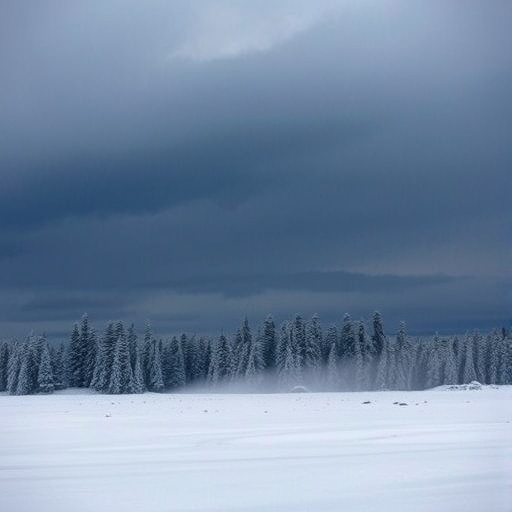
In a groundbreaking study poised to reshape our understanding of climate dynamics, researchers have unveiled how extreme rainfall events are profoundly altering the thermal regimes of permafrost across the Northern Hemisphere. This revelation, published in Nature Communications, signals a paradigm shift in how scientists interpret permafrost responses to climate variability, with significant implications for global carbon cycles and ecosystem stability.
Permafrost, the perpetually frozen ground underlying vast expanses of the Arctic and sub-Arctic regions, has historically been considered a relatively stable carbon reservoir, sequestering vast amounts of organic material. However, this stability is now threatened by an increasing frequency of extreme rainfall episodes, a phenomenon that has intensified alongside global warming. The research team, led by Li, Q., alongside Peng, X., and Frauenfeld, O.W., employed a sophisticated combination of satellite data, ground-based sensor networks, and modeling simulations to dissect the complex interactions between hydrological and thermal dynamics within permafrost terrains.
Central to the study’s findings is the recognition that heavy rainfall, especially when occurring during traditionally colder seasons or in rapid succession, disrupts the insulating snow cover while simultaneously increasing soil moisture content. This moisture enhancement elevates thermal conductivity within the soil matrix, facilitating heat transfer that warms permafrost layers more efficiently than previously understood. Such anomalous warming accelerates thawing processes, destabilizing the thermal equilibrium that governs permafrost persistence.
Further complicating this dynamic is the differential impact of rainfall depending on its timing and intensity. For instance, rainfall during the thawing season exacerbates heat penetration, whereas cold-season rain events can reduce snow insulation, exposing permafrost to colder air temperatures but paradoxically facilitating deeper warmth infiltration when subsequently warmed by sunlight. These nuanced effects underscore the need to revisit existing permafrost models that predominantly emphasize air temperature as the main driver of permafrost dynamics.
The spatial scope of the research is remarkably comprehensive, encompassing diverse permafrost zones across North America, Siberia, and parts of Scandinavia. Using high-resolution thermal data from numerous monitoring sites, the researchers documented shifts in permafrost active layer thicknesses, often exceeding historical variability ranges. This thickening of the active layer—that seasonal surface soil horizon that thaws each summer—suggests enhanced microbial decomposition of organic matter, a process that releases significant amounts of greenhouse gases such as carbon dioxide and methane into the atmosphere.
Importantly, the study delineates how extreme rainfall does not act in isolation but interacts synergistically with other climate stressors, particularly rising air temperatures and altered snow cover patterns. Such interaction amplifies feedback loops that accelerate permafrost degradation, posing critical challenges to climate mitigation efforts. The potential release of stored greenhouse gases represents a potent positive feedback mechanism, with the capacity to exacerbate global warming beyond current projections.
The researchers also highlighted regional variability in permafrost response, linked to local geomorphology, vegetation cover, and soil composition. For example, peat-rich soils exhibited pronounced sensitivity to moisture fluctuations induced by heavy rain, whereas rocky or well-drained soils demonstrated relatively muted thermal shifts. This underscores the necessity of integrating local-scale heterogeneity into predictive permafrost thermal models to enhance forecast accuracy and inform adaptive strategies.
Addressing these intricate dynamics required advances in remote sensing technologies and in situ observations. The team harnessed differential interferometric synthetic aperture radar (DInSAR) alongside novel thermal infrared imaging to track subsurface temperature changes with unprecedented precision. When combined with ground truth data from borehole thermal sensors, these methodologies enabled a robust, multi-dimensional analysis of permafrost thermal response under extreme hydrological perturbations.
One unexpected outcome of the research was the identification of lag effects between extreme rainfall events and permafrost warming. Thermal responses were often delayed by weeks or even months, suggesting that soil moisture and heat distribution dynamics are governed by complex, temporally extended processes rather than immediate surface-atmosphere exchanges alone. This finding points to the need for extended temporal monitoring and refined temporal resolution in permafrost models.
The implications extend beyond environmental and climatic concerns, as permafrost degradation threatens critical infrastructure in northern communities, including roads, pipelines, and buildings. The increased thawing and ground instability linked with altered precipitation patterns necessitate reevaluating engineering standards and disaster preparedness protocols in affected regions, highlighting the study’s relevance to policymakers and indigenous populations.
Moreover, the altered hydrological regimes bear consequences for Arctic and sub-Arctic ecosystems. Changes in soil moisture and temperature affect vegetative growth cycles, nutrient cycling, and habitat availability for endemic species. The cascading ecological effects stand to redefine biodiversity patterns and ecosystem services, with broader repercussions for subsistence and commercial activities in northern latitudes.
The research team advocates for integrating extreme precipitation metrics into permafrost vulnerability assessments, a step that current climate models largely omit. This integration promises enhanced predictive capabilities and more effective mitigation planning. They also call for expanded transdisciplinary collaborations, merging climatology, hydrology, ecology, and socio-economic analyses to capture the multifaceted nature of permafrost change.
In conclusion, this pioneering work illuminates the intricate and previously underappreciated role of extreme rainfall in modulating the thermal behavior of permafrost across vast northern regions. As climate change scenarios predict increased rainfall variability and intensity, understanding these processes becomes crucial for anticipating permafrost trajectories, managing risks, and formulating effective climate responses. The study not only redefines scientific paradigms but also serves as a clarion call for immediate action at the intersect of climate science, environmental stewardship, and societal resilience.
Subject of Research:
Article Title:
Article References:
Li, Q., Peng, X., Frauenfeld, O.W. et al. Extreme rainfall reshapes permafrost thermal regimes across the Northern Hemisphere. Nat Commun (2026). https://doi.org/10.1038/s41467-026-70017-x
Image Credits: AI Generated
DOI: https://doi.org/10.1038/s41467-026-70017-x
Keywords: permafrost, extreme rainfall, thermal regimes, climate change, Northern Hemisphere, soil moisture, active layer thickness, remote sensing, DInSAR, greenhouse gas emissions


