


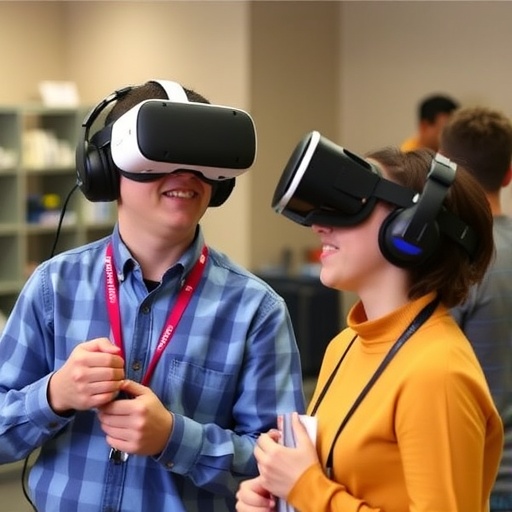
Recent advancements in technology have opened new avenues for the education and vocational training of individuals with autism and intellectual disabilities. Among these developments, Extended Reality (XR)—encompassing virtual reality (VR), augmented reality (AR), and mixed reality (MR)—represents a groundbreaking method to enhance the learning and skill acquisition processes. In a pivotal meta-analysis conducted by researchers Tao and Fu, the effectiveness of XR technology interventions on vocational skills for this demographic has been systematically explored.
The findings of this extensive research indicate that XR interventions have the potential to significantly benefit individuals with autism and intellectual disabilities by providing a safe, controlled environment in which these learners can practice essential vocational skills. Traditional methodologies often overlook the unique learning styles and challenges faced by these individuals. Consequently, employing XR technologies, which offer immersive and interactive experiences, can foster better engagement and enhance learning outcomes.
One of the noteworthy aspects highlighted by the authors is the adaptability of XR technologies in catering to the varied sensory preferences and learning paces of individuals on the autism spectrum. Unlike traditional classroom environments, which may be overwhelming due to sensory overload, XR can create tailored experiences that mitigate distractions and focus attention where it is most needed. This personalized approach is invaluable for learners who may struggle in a conventional educational setting.
Furthermore, the researchers point out that XR not only aids in the acquisition of specific vocational skills but also contributes to broader developmental benefits. For example, immersive simulations can bolster social interaction capabilities, allowing individuals to practice communication and teamwork in a risk-free environment. These simulations can be designed to model real-world work scenarios, providing authentic experiences that enhance social understanding while also addressing practical skill needs.
Another critical finding from the meta-analysis is the enhanced retention of learned skills through XR interventions. The interactive nature of XR fosters an engaging learning atmosphere that encourages repetition and practice—critical components of mastering vocational tasks. The research indicates that such repeated exposure leads to better memory retention, allowing individuals to transfer these skills more effectively to real-world situations.
Moreover, the meta-analysis examines the role of XR in fostering independence among individuals with autism and intellectual disabilities. By simulating tasks they may encounter in various workplaces, XR can empower users to navigate their environment with more confidence and skill. This increase in autonomy not only enhances the individuals’ resume but also elevates their quality of life as they engage more fully with the world around them.
Accessibility is a significant concern when implementing any new technology. The findings underscore the importance of ensuring that XR tools and applications are user-friendly and designed with the needs of individuals with disabilities in mind. The research advocates for the continued involvement of stakeholders—education professionals, therapists, and the individuals themselves—during the development of these tools to create effective and inclusive resources.
Importantly, the study sheds light on the need for further research regarding the long-term impacts of XR interventions. While the preliminary results are promising, continued investigation is necessary to comprehensively understand how these technologies can be optimized for various learning contexts and individual needs. This ongoing exploration is critical to refining XR applications and ensuring they provide maximum benefit.
Furthermore, the authors identify how collaborative efforts between technology developers and educational institutions can lead to the creation of innovative XR solutions tailored for vocational training. A synergy between cutting-edge technology and hands-on curriculum can greatly enhance the learning landscape for individuals with disabilities.
As we consider the larger implications of this research, it is clear that XR technology holds tremendous promise in reshaping the conventional approaches to training and education for individuals with autism and intellectual disabilities. As the field advances, it is imperative that we remain focused on creating equitable access to these pioneering technologies, ensuring they are available to anyone who could benefit from them.
The meta-analysis by Tao and Fu serves as a compelling call to action. It encourages educators, practitioners, and researchers to rethink traditional teaching methodologies and embrace innovative solutions that technology can offer. As we stand on the cusp of a technological revolution in education, the potential for XR to transform vocational training for individuals with autism and intellectual disabilities cannot be overlooked. A commitment to exploration and innovation will pave the way for a brighter future.
In conclusion, the study spearheaded by Tao and Fu reiterates that while challenges remain, the integration of Extended Reality technology can profoundly impact the vocational skills development of individuals with autism and intellectual disabilities. As we move forward, harnessing the power of such technologies will be key in reshaping how we approach education, training, and ultimately, inclusion within the workforce.
The transformation brought about by XR is but one chapter in the ongoing journey toward a more inclusive society where every individual, regardless of their neurological background, has the opportunity to thrive and contribute meaningfully to the workforce.
Tao, T., Fu, W. The Effectiveness of Extended Reality Technology Interventions on Vocational Skills for Individuals with Autism and Intellectual Disabilities: A Meta-analysis.
J Autism Dev Disord (2025). https://doi.org/10.1007/s10803-025-07040-2
Cite Scienmag News
Ophelia Keating. (October 12, 2025). Extended Reality Boosts Vocational Skills for Autistic Individuals. Scienmag. https://scienmag.com/extended-reality-boosts-vocational-skills-for-autistic-individuals/
Ophelia Keating. "Extended Reality Boosts Vocational Skills for Autistic Individuals." Scienmag, 12 October 2025, https://scienmag.com/extended-reality-boosts-vocational-skills-for-autistic-individuals/. Accessed 7 September 2026.
Ophelia Keating. "Extended Reality Boosts Vocational Skills for Autistic Individuals." Scienmag. October 12, 2025. https://scienmag.com/extended-reality-boosts-vocational-skills-for-autistic-individuals/


