

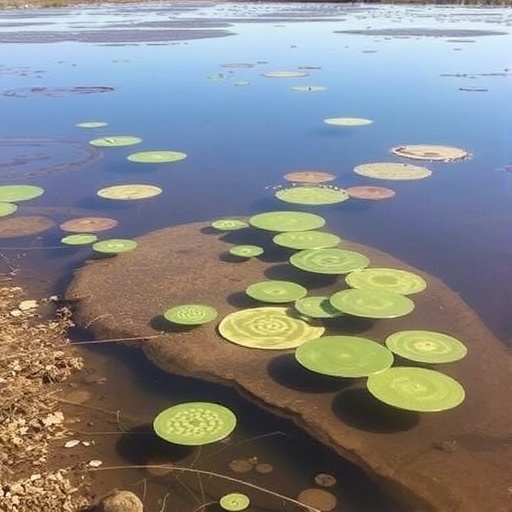
A recent study spearheaded by Dr. Anne Bernhard, professor of biology at Connecticut College, unveils compelling evidence that prolonged drought conditions can severely destabilize key microbial populations responsible for nitrogen cycling in coastal salt marshes. Published in the influential journal Estuaries and Coasts, this extensive observational study probes the intricate interactions between environmental stressors and microbial community dynamics across thirteen years of data collection at Barn Island Wildlife Management Area in southeastern Connecticut. The findings illuminate critical biochemical shifts in salt marsh ecosystems, often considered natural buffers for coastal health, especially under the increasing specter of climate variability.
The investigation spans data from 2006 to 2019, encompassing a pronounced regional drought between 2013 and 2018, a period marked by significantly negative Palmer Drought Severity Index values, reflecting severe to extreme drought conditions. By employing rigorous molecular quantification of microbial genes, particularly those encoding ammonia monooxygenase (amoA) enzymes, the researchers detail the fluctuating abundance and stability of ammonia-oxidizing archaea (AOA) and ammonia-oxidizing bacteria (AOB)—two microbial groups that drive nitrification processes fundamental to nitrogen availability and ecosystem productivity.
Nitrification, the sequential oxidation of ammonium (NH4+) to nitrate (NO3-), is a pivotal step in the nitrogen cycle, influencing nutrient dynamics and mitigating nitrogen accumulation in aquatic ecosystems. Disruption to this process can cascade through food webs and biochemical pathways, affecting plant growth, microbial interactions, and overall marsh resilience. The study’s key revelation that both AOA and AOB populations exhibited reduced temporal stability and dramatic abundance declines amid drought imposes a pressing concern regarding the resilience of nitrogen cycling under adverse climatic pressures.
Intriguingly, the archaeal amoA gene abundance was observed to be nearly 35 times higher during wet conditions compared to dry periods, suggesting that moisture availability exerts a profound regulatory influence on AOA populations. Over the 13-year study, AOA abundances varied by an astonishing magnitude of 30,000-fold, while AOB demonstrated a drastic 9,500-fold variation. This dynamic fluctuation underscores the sensitivity of microbial nitrifiers to hydrological stress, highlighting their vulnerability to extended drought episodes that can perturb microbial community equilibrium.
Further scrutiny revealed that the reduced stability observed in these ammonia-oxidizing microbes was more pronounced than in other microbial groups within the marsh ecosystem, indicating a specific susceptibility profile. Such destabilization threatens the integrity of nitrogen transformation processes, potentially leading to nitrogen imbalances, increased greenhouse gas emissions such as nitrous oxide, and altered marsh biogeochemistry. Given salt marshes’ role in carbon storage, storm surge buffering, and providing essential fish and shellfish habitat, disturbances to microbial mediation of nitrogen cycles may provoke wide-ranging environmental impacts.
Beyond abundance metrics, the study emphasizes the broader ecological implications of prolonged drought-induced microbial fluctuations. Diminished nitrification efficiency affects nitrogen availability for primary producers, which can cascade to affect marsh vegetation productivity, resilience, and carbon sequestration capacity. As these salt marshes are integral in coastal protection and fisheries support, the microbial response to drought represents a critical nexus for ecosystem services vulnerable to climate change stressors.
Importantly, the research demonstrated recovery trends following the cessation of drought conditions in 2018 and 2019. Both AOA and AOB populations rebounded to levels resembling those documented before prolonged dry spells, suggesting that while drought imposes significant perturbations, microbial community resilience and capacity for recovery remain evident. Nonetheless, the stark variability and reduced stability during drought highlight concerns about increased frequency or severity of future droughts under global warming scenarios.
This study marks one of the first longitudinal field-based efforts to elucidate microbial community dynamics in response to climatic oscillations within coastal salt marshes. By focusing on molecular markers of ammonia oxidation, it provides granular insights into microbial functionality underpinning biogeochemical cycles, filling an essential knowledge gap at the intersection of microbiology, environmental science, and climatology.
Given that coastal marshes act as carbon sinks, storm surge buffers, and nurseries for aquatic life, understanding how foundational microbial communities respond to environmental extremes is pivotal to predicting ecosystem trajectories amid ongoing climate change. Dr. Bernhard’s work thus offers a potent call to incorporate microbial perspectives in marsh conservation strategies and climate impact assessments.
Future research directions emerging from this work include mechanistic investigations into microbial community recovery pathways, metabolic adaptations under hydrological stress, and potential feedbacks between microbial nitrification rates and greenhouse gas emissions. Such multidisciplinary efforts are vital to develop holistic models that integrate microbial ecology with physical and chemical stressors confronting coastal systems.
In conclusion, the decreased stability of ammonia-oxidizing archaea and bacteria during drought conditions revealed by this study signals a critical vulnerability in coastal nitrogen cycling processes. As salt marshes confront mounting climate-driven challenges, microbial communities represent both a linchpin and an early indicator of ecosystem health shifts. This groundbreaking research underscores the need for sustained long-term monitoring and integrative science to safeguard the essential functions that these dynamic microbial players provide within the coastal environment.
Subject of Research: Cells
Article Title: Decreased Stability in Ammonia-Oxidizing Archaea and Bacteria During Dry Conditions in a Salt Marsh
News Publication Date: 20-Jan-2026
Web References: http://dx.doi.org/10.1007/s12237-025-01666-2
Image Credits: Anne Bernhard
Keywords: Microbiology, Climate change, Ecology, Environmental sciences


