


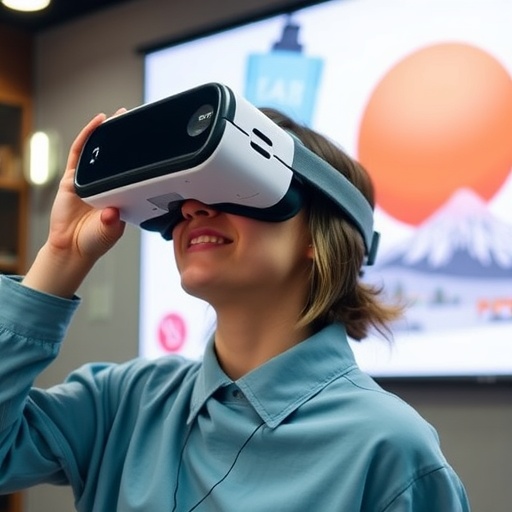
In an innovative exploration of language acquisition, researchers Olexa and Taquet have embarked on a groundbreaking study that examines the nuances of virtual reality (VR) as a transformative tool for language learning among Japanese EFL (English as a Foreign Language) students. While traditional study abroad experiences have long been hailed as the gold standard for immersive language learning, this new research presents a novel perspective by leveraging virtual environments to mimic the cultural and linguistic immersion typically associated with international travel. The study, scheduled for publication in 2026, promises to reshape the way educational institutions approach language pedagogy in an increasingly digital world.
At the heart of this research lies the recognition that exposure to a target language—such as English—is crucial for effective learning. In traditional settings, students often face barriers to immersion, including financial constraints, geographic limitations, or insufficient time. Olexa and Taquet argue that VR technology can effectively lower these barriers, offering students an alternative route to familiarizing themselves with a new language and culture without the need for physical relocation. By simulating real-life interactions and contexts, VR presents an intriguing solution that could democratize the language learning experience.
The methodological framework of the study involved a cohort of Japanese EFL learners engaging with VR applications designed specifically to enhance language acquisition. These applications incorporated realistic scenarios—such as navigating through bustling city streets, ordering food in a cafe, or attending social events—each crafted to stimulate authentic language use. This immersive approach is critical, as it allows learners to practice vocabulary, grammar, and pronunciation in situational contexts, thereby reinforcing their learning experience through active engagement.
Preliminary results indicate unprecedented levels of linguistic engagement among participants using VR technology. Learners reported heightened motivation and a sense of presence in the language-learning process, which are essential factors for long-term retention of new language skills. The study also highlights the significance of an environment that encourages risk-taking in language use, an aspect often missing in traditional classroom settings where learners may feel inhibited or self-conscious.
Furthermore, the research underscores the role of language contact patterns—how learners interact with English during their VR experiences. Participants engaging in role-playing scenarios had the opportunity to communicate with AI-driven avatars, creating spontaneous dialogues that reflect real-life conversations. This interaction not only facilitated learning but also allowed students to experiment with language in a safe environment, ultimately enhancing their fluency and comprehension.
Another key finding from Olexa and Taquet’s study is the influence of cultural context on language learning. By integrating virtual cultural experiences—such as attending virtual festivals or participating in English-speaking community events—students could link language learning with cultural understanding. This aspect is vital, as language is inextricably tied to culture; thus, understanding cultural nuances aids learners in grasping contextual meanings and usage of words or phrases.
The implications of such research reach far beyond Japanese EFL learners alone. As educational institutions worldwide look for innovative ways to enhance language education, findings from this study could guide the integration of VR technology in language curricula. Envisioning classrooms equipped with VR sets opens the door to endless possibilities, allowing learners from various backgrounds to experience language immersion tailored to their needs and aspirations.
Moreover, the study raises important questions about the future of remote learning modalities. As the COVID-19 pandemic has illustrated, the landscape of education is rapidly evolving, necessitating an adaptability that VR can provide. Virtual reality could potentially serve as a bridge during periods where face-to-face interactions are not feasible, ensuring that language acquisition continues despite external limitations.
One of the more remarkable aspects of Olexa and Taquet’s research is the potential to combine VR with other technologies, such as artificial intelligence. AI can learn from individual learners’ progress, personalizing experiences that adapt to their unique linguistic journey. This individualized approach can address varying levels of proficiency among learners, providing tailored support that maximizes the effectiveness of the learning process.
Additionally, engaging with VR has shown potential for fostering collaboration among learners who might not otherwise interact in a traditional classroom. By creating shared virtual spaces where peers can practice together, there is an opportunity for social learning—critical for language development. Group interactions in VR can promote collaborative problem-solving in a language-rich environment, enhancing both language and interpersonal skills.
As educational researchers and practitioners alike anticipate the results of this study, the excitement surrounding VR in language education continues to build. The potential for VR to redefine immersion experiences, coupled with its ability to provide equal opportunities for all learners, points towards a future where language learning is characterized by flexibility, engagement, and cultural richness.
In conclusion, the research by Olexa and Taquet marks a pivotal moment in the intersection of technology and education, heralding new possibilities for EFL learners. As they unveil the full scope of their findings in the coming months, the academic community will undoubtedly be eager to embrace the advancements that promise to evolve traditional paradigms of language learning. The dawn of virtual reality as a legitimate substitute for educational travel may be at hand, promising to change the dynamics of language acquisition for generations to come.
Cite Scienmag News
Courtney Benton. (January 28, 2026). Exploring VR’s Impact on Japanese EFL Language Learning. Scienmag. https://scienmag.com/exploring-vrs-impact-on-japanese-efl-language-learning/
Courtney Benton. "Exploring VR’s Impact on Japanese EFL Language Learning." Scienmag, 28 January 2026, https://scienmag.com/exploring-vrs-impact-on-japanese-efl-language-learning/. Accessed 5 September 2026.
Courtney Benton. "Exploring VR’s Impact on Japanese EFL Language Learning." Scienmag. January 28, 2026. https://scienmag.com/exploring-vrs-impact-on-japanese-efl-language-learning/


