

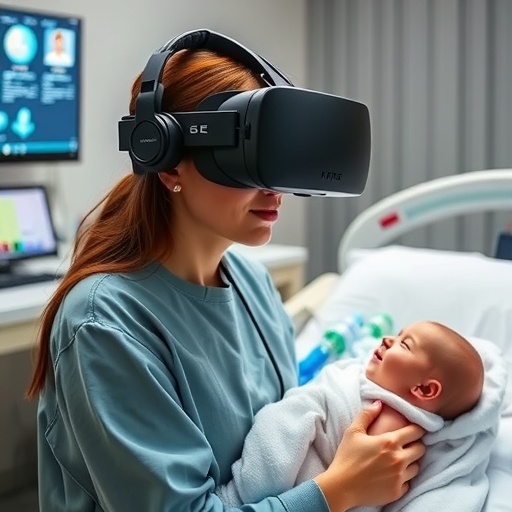
In an era where technology shapes education and enhances learning experiences, a groundbreaking research initiative has emerged from Germany, focusing on virtual reality (VR) in midwifery and medical education. This study, led by a team of researchers including Vogel, Adams, and Datta, aimed to explore the perceptions of students and teaching professionals regarding the potential use of virtual reality to teach complicated yet crucial skills such as birth mechanics. As traditional teaching methods often face limitations in providing experiential learning, the introduction of VR presents an innovative alternative that deserves thorough examination.
The necessity for such a study stems from a very real challenge faced by educational institutions: the significant gap between theoretical knowledge and practical application in high-stakes environments such as childbirth. With the rising complexity of birth processes and the associated risks, both students and educators are recognizing the imperative for training methods that allow for immersive and safe practice. Virtual reality, with its ability to create lifelike simulations, appears to be an appealing solution to this age-old dilemma.
The study’s methodology involved surveying a representative sample of students enrolled in midwifery and medicine programs, alongside experienced educators in these fields. The goal was to gauge their perceptions on the feasibility and potential effectiveness of incorporating VR into their curricula. Through carefully crafted questionnaires, researchers collected quantitative data that would provide insights into not just the acceptance of VR as a learning tool, but also the specific scenarios where it could most effectively enhance the learning experience.
Responses indicate a notable enthusiasm among students regarding the use of virtual reality to simulate the birthing process. Many participants expressed that hands-on experience with realistic, virtual scenarios would build their confidence and competence before entering the delivery room. The idea of practicing delicate maneuvers and familiarizing themselves with the dynamics of childbirth in a risk-free environment proved to be highly appealing. The feedback illustrates a clear shift in the educational landscape, where learners are increasingly open to exploring new technologies that can enrich their understanding of complex subjects.
On the flip side, perceptions among teaching professionals were more mixed. While many recognized the potential benefits of VR, some raised concerns about the integration of such technologies into existing curricula. Questions about the cost of implementation, the sufficiency of technology-based training, and the challenge of aligning VR scenarios with established pedagogical methods were highlighted during discussions. These apprehensions reflect a broader hesitance often observed when educational institutions consider the adoption of new technologies.
Intriguingly, the study also delved into the areas of learning where augmented models of VR could be most effective. Educators and students alike identified skills such as communication and emotional support during childbirth as critical components that could be better taught through immersive experiences. They suggested that VR could facilitate role-playing exercises for various scenarios, helping future midwives and medical professionals develop both technical skills and empathetic interactions—a dual benefit that traditional methods may fail to address adequately.
Moreover, the researchers collected qualitative insights that deepened the discussion around the emotional impacts of incorporating VR into educational settings. Many students articulated that practicing in a stress-free environment would lessen anxiety, a common barrier for many when facing real-life births. The personalization and repetitive practice afforded by virtual scenarios could empower students, translating to improved performance when it matters most—during actual childbirth.
Across the board, participants acknowledged a strong need for further studies to evaluate the long-term retention of skills acquired through VR training. As much as participants are enthusiastic about immediate applications, the question of efficacy remains paramount. Producing compelling evidence about the impact of VR on skill development in obstetric medicine could be the key to wider acceptance and integration into curricula nationwide.
The findings from this nationwide assessment carry implications that extend beyond the borders of Germany; they set a precedent for medical education around the globe. Other nations grappling with similar challenges in teaching complex medical procedures could learn from the insights gathered in this study, potentially adopting similar methodologies to assess their educators’ and students’ perceptions. The global medical community may very well stand at the brink of a technological revolution in educational practices, prompted by the success of VR applications in Germany.
In conclusion, the research conducted by Vogel, Adams, and Datta is a significant step toward realizing a more effective and interactive approach to medical education. By fundamentally reshaping the way essential skills are taught, particularly in high-stress scenarios like childbirth, virtual reality has the potential to enhance competency, confidence, and overall educational outcomes in future medical professionals. As this exciting field develops, it will be essential to continue to explore the multifaceted benefits and possible drawbacks of virtual reality training, ensuring that the integration of technology nourishes rather than hinders the educational journey.
The results of this study do not only highlight the readiness of students and educators for VR but also draw attention to the urgency of addressing challenges related to implementation and efficacy. The dialogue surrounding VR in medical education is only just beginning, providing fertile ground for innovation and transformation. As education continuously evolves alongside technology, the insights gained from this work could drive significant advancements in teaching and learning, ultimately benefiting future generations of healthcare providers and the patients they serve.
In the coming years, we can expect continued discussions and research into how virtual reality intersects with various facets of healthcare education. The outcomes of this initial analysis could pave the way for further technological integration and the continuous evolution of educational methodologies tailored to meet the demands of modern medicine.
Subject of Research: The potential use of virtual reality in teaching birth mechanics.
Article Title: Nationwide needs assessment on the potential use of virtual reality in teaching birth mechanics: perceptions of students and teaching professionals in midwifery and medicine in Germany.
Article References:
Vogel, K., Adams, J., Datta, R.R. et al. Nationwide needs assessment on the potential use of virtual reality in teaching birth mechanics: perceptions of students and teaching professionals in midwifery and medicine in Germany. BMC Med Educ (2026). https://doi.org/10.1186/s12909-025-08532-6
Image Credits: AI Generated
DOI: 10.1186/s12909-025-08532-6
Keywords: virtual reality, midwifery education, medical training, childbirth simulation, educational technology.


