

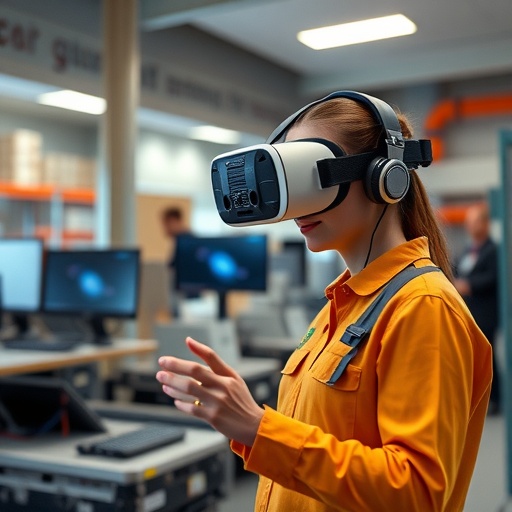
In a groundbreaking exploration of technological advancement in education, a new systematic review has been published that delves into user perceptions and acceptance of virtual reality (VR) for vocational training. The study, conducted by renowned researchers AlFajrani, DeWitt, and Shaharom, underscores how VR technology is revolutionizing the way individuals receive vocational training and highlights its potential to transform education in various fields.
At the heart of this research lies the increasing adoption of VR in educational settings, particularly in hands-on training scenarios. The study emphasizes that traditional methods of vocational training often fall short in providing the immersive experiences necessary for effective learning. By contrast, VR offers a unique and engaging platform for learners, enabling them to practice skills in a simulated environment that closely resembles real-world applications.
The findings of the review are particularly relevant in the context of rapid technological advancements. The world is witnessing a shift towards digitalization across various sectors, and educational institutions are not exempt from this trend. VR technology provides an innovative answer to the challenges faced by traditional vocational training methods, promising improved learner engagement and knowledge retention.
Researchers conducted a thorough analysis of existing literature, aggregating data from various studies that investigated users’ perceptions and acceptance of VR technology in vocational training. The systematic review aimed to identify common themes, barriers, and benefits as reported by users. This comprehensive approach allowed the authors to paint a holistic picture of the current state of VR as an educational tool.
One significant finding was the overwhelming positivity surrounding the user experience in VR environments. Many participants reported heightened motivation and increased enthusiasm towards learning when using VR technology. The immersive nature of VR can effectively transport users into a different world, allowing them to engage in experiential learning that traditional classrooms cannot provide.
Moreover, feedback from users highlighted the ability of VR to cater to diverse learning styles. For visual learners, VR can create vivid representations of complex concepts, making them easier to grasp. Kinesthetic learners benefit from the ability to practice skills through simulations, reinforcing their understanding through hands-on experiences. This adaptability makes VR an attractive option for educators looking to address a wide range of student needs.
However, the review also addresses challenges associated with the integration of VR into vocational training programs. Some users expressed concerns regarding the initial setup costs of VR systems, as well as the need for training facilitators to be adequately trained in using the technology effectively. Furthermore, the potential for technical issues during sessions poses a risk to the smooth delivery of training.
Despite these concerns, the researchers argue that the advantages of VR far outweigh the drawbacks. For example, VR can significantly reduce the risks associated with real-life training scenarios, particularly in fields that involve hazardous conditions. Simulation environments allow learners to navigate dangerous tasks without the threat of physical harm, providing a safe space for trial and error.
Another noteworthy aspect of the review is the impact of VR on accessibility. The technology opens up opportunities for individuals who may not have access to traditional vocational training due to geographical or economic constraints. VR can provide remote training solutions, bridging gaps in accessibility and ensuring that quality education reaches those who need it the most.
As the study indicates, the success of VR in vocational training is heavily reliant on positive user perception. The authors advocate for a concerted effort among educators, developers, and policymakers to promote awareness about the efficacy of VR as a training tool. By engaging stakeholders and showcasing successful case studies, the broader educational community can foster a more widespread acceptance of this innovative technology.
Moreover, the systematic review emphasizes the need for ongoing research to continuously improve VR experiences based on user feedback. In light of the rapid advancements in VR technology, staying attuned to user needs and evolving capabilities is crucial for maximizing the potential of VR in vocational training.
The implications of this research extend beyond vocational training; they herald a new era in education where immersive technologies redefine learning experiences across disciplines. As educators and institutions begin to harness the power of VR, the potential for enhanced learner outcomes and skill acquisition becomes evident.
Overall, AlFajrani, DeWitt, and Shaharom’s systematic review serves as a significant step forward in understanding user perceptions of VR in vocational training. The findings illuminate the path towards a future where virtual reality is not just an adjunct to learning, but a core component in shaping the skilled workforce of tomorrow. The excitement surrounding this research underscores the vital intersection between technology and education, as we move towards a future that embraces innovation.
As the study approaches publication in the journal Discov Educ, the educational community is buzzing with anticipation about the insights it promises to unveil. As VR technology evolves, so too does the landscape of vocational training, suggesting that the days of traditional methods may soon be numbered in favor of more dynamic, engaging, and effective solutions.
Subject of Research: User perceptions and acceptance of virtual reality in vocational training
Article Title: A systematic review of user perceptions and acceptance of virtual reality toward vocational training innovation
Article References:
AlFajrani, K., DeWitt, D. & Shaharom, M.S.N. A systematic review of user perceptions and acceptance of virtual reality toward vocational training innovation.
Discov Educ (2026). https://doi.org/10.1007/s44217-025-00969-7
Image Credits: AI Generated
DOI:
Keywords: Virtual reality, vocational training, user perceptions, educational technology, immersive learning


