


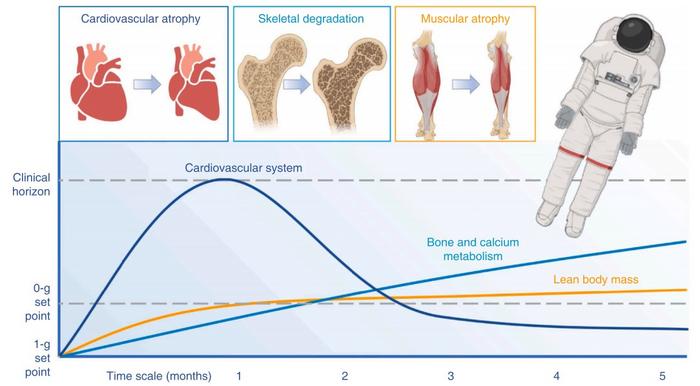
The exploration of space holds immense promise for advancing human knowledge and technology, yet it carries significant risks for those who venture beyond Earth’s atmosphere. Recent research presented in the journal Wearable Electronics sheds light on innovative flexible wearable technologies designed to monitor the health of astronauts during prolonged missions. This is particularly salient as human space exploration transitions toward more extended durations, demanding real-time insights into both the physiological and psychological states of crew members.
The unique challenges posed by the space environment, such as microgravity, increased radiation exposure, and extreme temperature fluctuations, can lead to a range of health issues. Astronauts face multifaceted risks including loss of bone density, muscle atrophy, and impaired cardiovascular function. Addressing these challenges, the review draws attention to the crucial role that wearable technology can play in safeguarding astronaut health. By integrating multimodal sensor arrays, these wearable systems can provide comprehensive, continuous monitoring to detect anomalies early in vital health parameters—such as cardiopulmonary functions, neuromuscular performance, and circadian rhythms.
Flexible wearable devices hold the potential to revolutionize health surveillance in space. Equipped with biosignal electrodes, environmental detectors, and inertial measurement units, these systems can track diverse health metrics ranging from heart rates to environmental exposures. Advanced algorithms process this data in real-time, allowing for the early identification of critical health trends among astronauts. Such innovative approaches can facilitate timely, personalized countermeasures that support astronauts’ health, potentially mitigating the adverse effects associated with long-term spaceflight.
However, while the advancements in materials science and miniaturization of electronics have paved the way for these developments, the review identifies persistent technical barriers that must be overcome. The reliability of wearable devices under the combined stressors of space—such as microgravity and radiation—is paramount for mission success. Ensuring that data is collected, transmitted, and stored securely poses additional challenges, especially within the confined spaces of a spacecraft, where privacy and data integrity are paramount.
The integration of heterogeneous biosignals—derived from various sensors—into cohesive, actionable insights also presents a formidable hurdle. Synchronizing this multi-parametric data to present a coherent picture of an astronaut’s health profile requires sophisticated algorithms capable of real-time data fusion. Researchers are dedicating significant efforts to develop solutions for these challenges, with a focus on interdisciplinary collaboration across fields such as materials science, bioengineering, and information technology.
As the technological landscape evolves, future research trajectories in flexible wearable devices for space applications aim to advance several key areas. These include the development of advanced materials capable of withstanding the space environment, innovative sensor technologies, and intelligent algorithms to process complex health data. Notably, the emphasis on user experience plays a critical role; wearables must be lightweight, comfortable, and easy for astronauts to use. Continuous development and maturation of these devices will be crucial to enhancing health monitoring capabilities throughout missions and successfully advancing human space exploration.
The potential benefits of these wearable technologies extend beyond immediate astronaut health monitoring. As they become refined, they could be adapted for use in various medical fields on Earth, including telemedicine, elderly care, and chronic disease management. The insights gained from monitoring astronauts in the extreme conditions of space might also yield innovations applicable in terrestrial healthcare systems, ultimately improving medical outcomes for patients worldwide.
The continued push for excellence in wearable technology for space health monitoring can reinforce international collaboration among scientists and researchers from around the globe. Countries involved in space exploration, as well as private enterprises, stand to benefit greatly from developing technologies that preserve astronaut health for longer missions to destinations such as Mars and beyond.
The urgency for effective health monitoring is underscored by a global push toward human settlement in space. As organizations like NASA and private space ventures invest in long-term missions, scalable solutions backed by wearable technology will be indispensable. This innovative approach to astronaut health management is not only about fostering human resilience in space but also about preparing for the next era of exploration.
As the field progresses, ongoing research, investment, and collaboration among academia, industry, and space agencies will be critical. By harnessing the power of advanced technologies, there is a vast potential to advance our understanding of human health in extreme environments, ultimately setting the stage for the future of space exploration.
New developments in this field present exciting possibilities for the broader implications of wearable technologies and human health. By learning from the experiences of astronauts, researchers can uncover valuable information that may lead to improved monitoring methods and treatments for various health issues faced by individuals on Earth.
With the continuous advancements in flexible wearables, the integration of scientific knowledge, and the dedication of researchers and institutions, the vision of a thoroughly monitored and well-maintained space crew can soon become a tangible reality. Efforts toward these goals may not only empower astronauts but could also illuminate pathways for future technological innovations in health monitoring that influence countless lives beyond our planet.
The combined advancements in materials, sensors, and innovative data processing will usher in a new frontier of health monitoring and performance optimization for astronauts, paving the way to ambitious missions that could one day take humanity to the stars and beyond.
Keywords
Wearable Technology, Space Medicine, Astronaut Health Monitoring, Microgravity Impact, Biomedical Sensors, Interdisciplinary Research.
Cite Scienmag News
Grant Pearson. (April 14, 2025). Exploring the Role of Flexible Wearables in Safeguarding Astronaut Health in Space. Scienmag. https://scienmag.com/exploring-the-role-of-flexible-wearables-in-safeguarding-astronaut-health-in-space/
Grant Pearson. "Exploring the Role of Flexible Wearables in Safeguarding Astronaut Health in Space." Scienmag, 14 April 2025, https://scienmag.com/exploring-the-role-of-flexible-wearables-in-safeguarding-astronaut-health-in-space/. Accessed 4 September 2026.
Grant Pearson. "Exploring the Role of Flexible Wearables in Safeguarding Astronaut Health in Space." Scienmag. April 14, 2025. https://scienmag.com/exploring-the-role-of-flexible-wearables-in-safeguarding-astronaut-health-in-space/


